
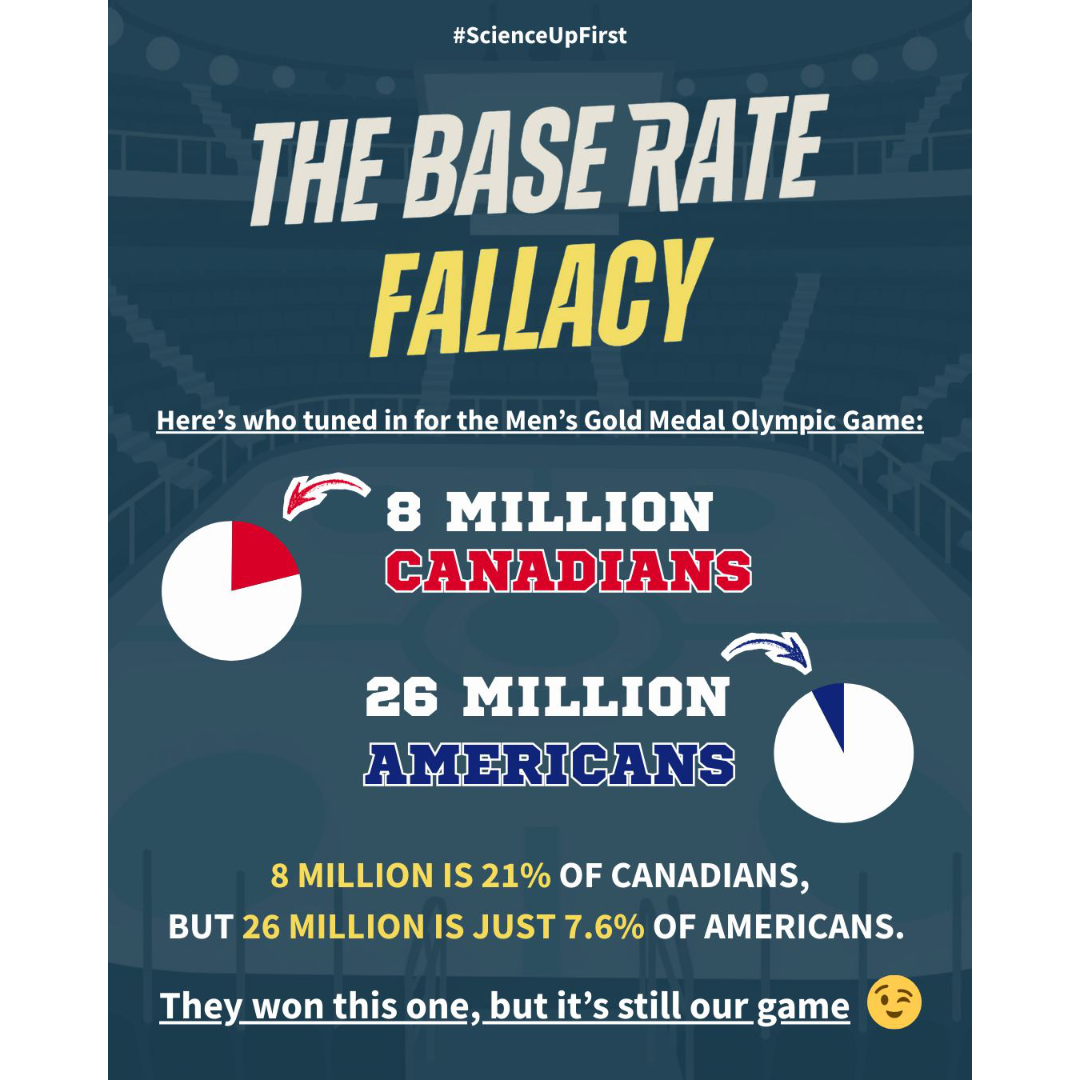
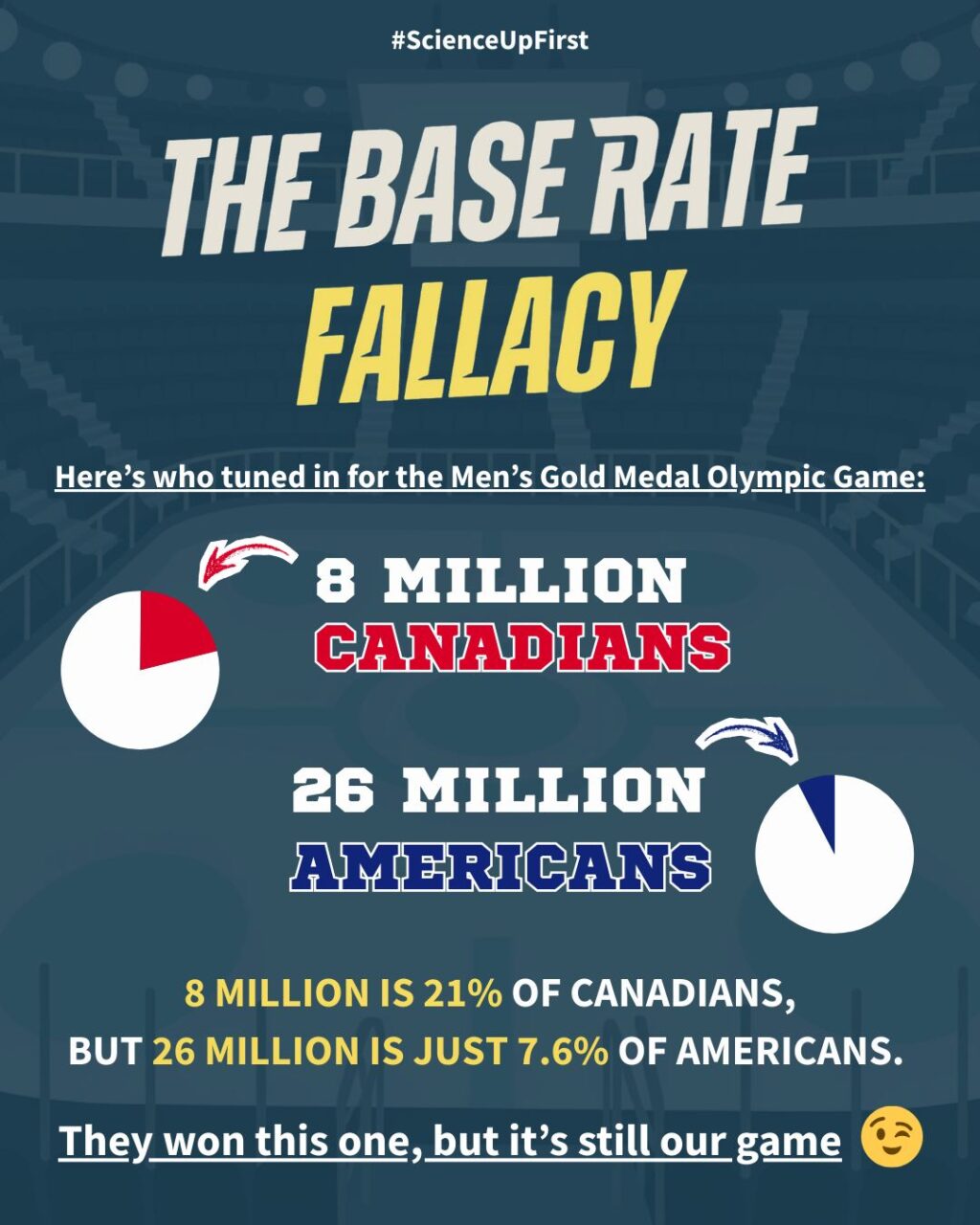
It’s true that more Americans were watching the Sunday game than Canadians: 8.7 million Canadians vs. 26 million Americans, to be exact (1,2).
Looking at the stats sheet alone, it may seem like Americans care more about hockey than Canadians. But that would be a base rate fallacy.
The Base Rate Fallacy is the tendency for people to incorrectly judge the likelihood of a situation by benching relevant data. The way data is presented can greatly influence how we perceive it (3,4).
Yes, only 8.7 million Canadians watched the game last Sunday, but there are also only 41.5 million people living in Canada. Compared to the 342.4 million people living in the United-States of America, that nuance matters. It matters because 8.7 million of 41.5 million is 20.9% of the population, while 26 million of 342.4 million is only 7.6% of the American population. Quite a lot of people, but still, not quite as much as Canada (proportion wise!) (5,6). We will take the percentage win. 💪
We hope the American men’s hockey team enjoys their gold, because based on their track record they won’t see another one until the 2070s…
Come on, what’s hockey without some chirping?!
And remember: Numbers without context? That is a power play for misinformation.
- 8.7 million Canadians watched end of men’s Olympic gold-medal hockey game | CBC Sports | February 24, 2026
- Hughes’ OT goal in Olympic final averages 26M live viewers on NBC and Peacock | NBC New York | Updated February 25, 2026
- Base Rate Fallacy | The Decision Lab
- Base Rate Fallacy | Logically Fallacious
- Canada’s population clock (real-time model) | Government of Canada | As of February 25, 2026
- Population Clock | United States Census Bureau | As of February 25, 2026
Share our original Bluesky Post!
View our original Instagram Post!