
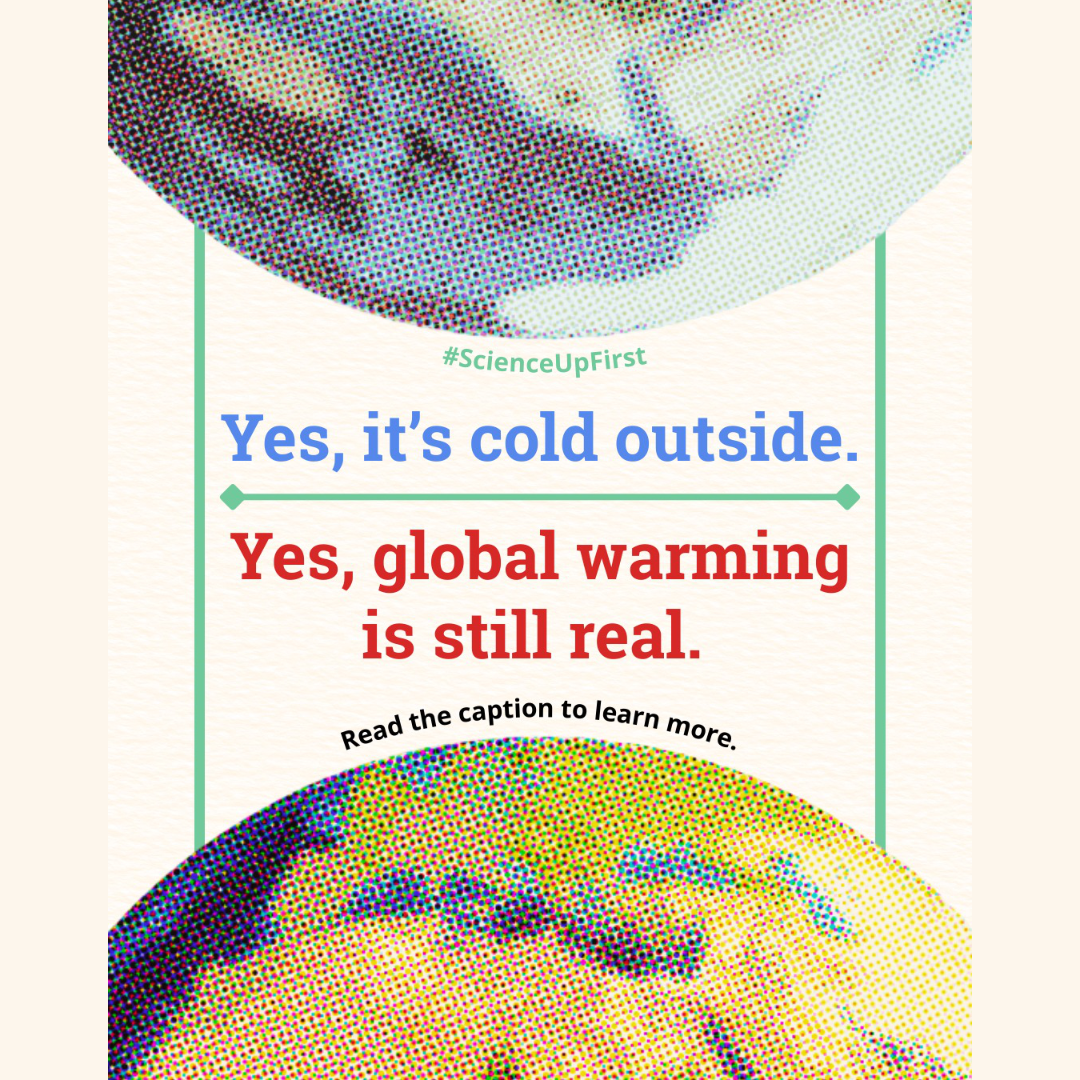
Some people use cold snaps and big winter storms as ‘evidence’ that the world isn’t warming. But global warming – or, more broadly, climate change – is about more than hot weather.
Global warming is a long-term trend across the world, and the occasional extreme cold weather does not change the overall pattern (1,2).
The consensus on climate change is clear: 99% of climate scientists agree the planet is warming and human emissions are to blame (3). With that said, scientists are now working to understand how global warming influences cold weather, possibly making it more frequent or severe. Some scientists propose that a warming Arctic changes the behaviour of the polar vortex – a large region of cold air circling the North Pole – making it ‘wobbly,’ which pushes cold Arctic air further south more often (1,4-7). Other scientists have a working theory that severe winter weather in the last several decades is a coincidence of natural climate variation, and that cold extremes are becoming less frequent and less severe overall (2,6,7). We don’t have a scientific consensus on this aspect of climate change yet, but many more studies are in the works.
What we know for sure: while record-cold temperatures still occur, record-high temperatures are happening significantly more often (2). Overall temperatures are increasing, and cold weather is becoming less frequent, with the last 3 years the hottest ever on record (1,2,8).
Even in a warming world, we will continue to experience cold weather. This does not make global warming any less real.
Have you heard any other climate myths that refuse to melt away? Let us know.
- Why Do We Run Hot and Cold on Climate Change? | Columbia Climate School | 12 January 2014
- Extreme cold and climate change: What’s the deal? | CBC News | 19 January 2024
- Greater than 99% consensus on human caused climate change in the peer-reviewed scientific literature | Environmental Research Letters | 19 October 2021
- Sweater Weather in North America | NASA | 21 February 2025
- Cold weather and climate change explained | Greenpeace | 22 March 2021
- Update: How’s U.S. winter weather changing in a warming world? | Yale Climate Connections | 18 February 2025
- Influence of high-latitude blocking and the northern stratospheric polar vortex on cold-air outbreaks under Arctic amplification of global warming | Environmental Research: Climate | 10 December 2024
- Canada forecasts 2026 to be among the hottest years on record | Environment and Climate Change Canada | 19 January 2026
Share our original Bluesky Post!
Some people use cold snaps and big winter storms as ‘evidence’ that the world isn’t warming. But global warming – or, more broadly, climate change – is about more than hot weather. 🌨️ 👇 scienceupfirst.com/climate/glob… #ScienceUpFirst
— ScienceUpFirst (@scienceupfirst.bsky.social) February 9, 2026 at 3:27 PM
[image or embed]
View our original Instagram Post!