
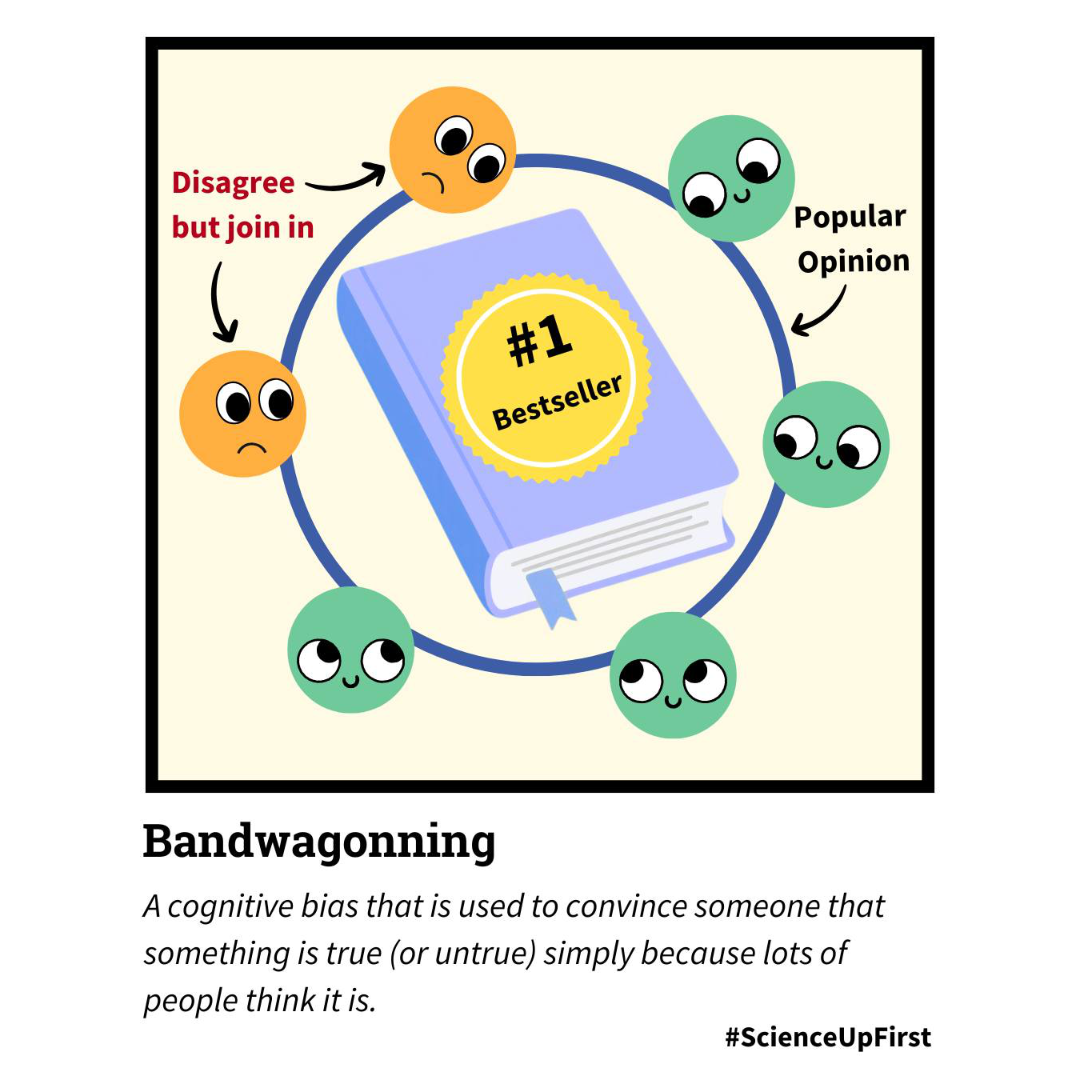
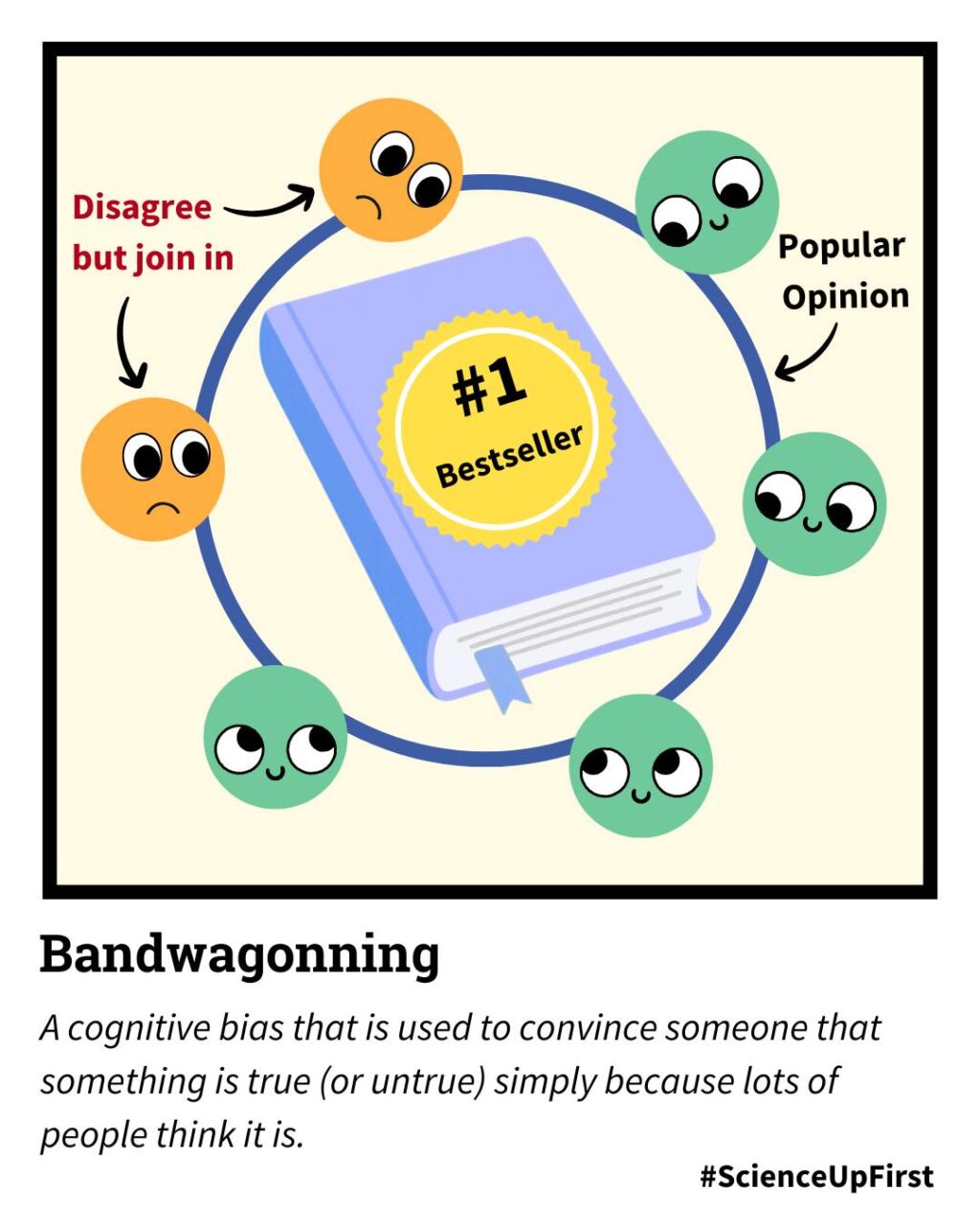
Have you ever bought a book just because it was on the best-seller list? You might have succumbed to the bandwagon fallacy.
Also called the appeal to common belief or the appeal to popularity, it is used to convince someone that something is true (or untrue) simply because lots of people think it is (1). There is nothing wrong with popular things (popular things are often popular for a reason!), but the fallacy lies in claiming that because it is popular, then it must be true (1,2,3,4,5). It is a mental shortcut: if many people believe it, it is easier for our brain to assume it must be right than to take the time to question and fact check it (4).
Think of it this way: There was a time when the most popular belief was that the Earth was flat. Today, the popular belief is that it’s round (it’s actually an irregularly shaped ellipsoid, but you get the idea!) (6). Both were popular theories, but only one is actually backed by facts.
Similarly, lots of people believe they need supplements to be healthy. However, science has said time and again that most people don’t need supplements if they eat a healthy diet and that they can even be harmful and dangerous (7,8,9,10,11,12,13,14,15).
Others jump on the bandwagon to fit in, or out of fear of missing out (4,5). If we see protein enriched products everywhere, then surely it must mean most people must not eat enough right? In reality, most people in Canada already get enough protein through their usual meals. For most Canadian adults, protein intake is not a major concern (16,17), even if protein-enriched products are everywhere (check out our latest post on protein consumption!).
Next time someone tells you “Everyone knows that…” or “people say…” ask yourself (and maybe ask them too!): “Am I believing this because lots of people believe it is true/untrue or because there are facts backing it up?” (3).
- Your logical fallacy is bandwagon | Your Logical Fallacy
- Bandwagon Fallacy | Excelsior University OWL
- Guide to the Most Common Logical Fallacies | Thinking is Power
- Bandwagon Fallacy: Definition and Examples | Grammarly | September, 2022
- Bandwagon Effect | The Decision Lab
- Is the Earth round? | National Ocean Service – National Oceanic and Atmospheric Administration
- Do you need a daily supplement? | Harvard Health | February 2021
- Is There Really Any Benefit to Multivitamins? | Johns Hopkins Medicine
- Vitamin C for preventing and treating the common cold | Cochrane Library | January 2013
- The Vitamin Myth: Why We Think We Need Supplements | The Atlantic | July 2013
- Antioxidant Supplements to Prevent Mortality | JAMA | September 2013
- Long-term multivitamin supplementation and cognitive function in men: a randomized trial | Annals of Internal Medicine | December 2014
- Vitamin and mineral supplements in the primary prevention of cardiovascular disease and cancer: An updated systematic evidence review for the U.S. Preventive Services Task Force | Annals of Internal Medicine | December 2013
- Vitamins, Are They Safe? | Advanced Pharmaceutical Bulletin | December 2016
- Meta-analysis: high-dosage vitamin E supplementation may increase all-cause mortality | Annals of Internal Medicine | January 2005
- Protein consumption in Canadian habitual diets: usual intake, inadequacy, and the contribution of animal- and plant-based foods to nutrient intakes | Canadian Science Publishing | November 2020
- Protein | Government of Canada
Share our original Bluesky Post!
View our original Instagram Post!