
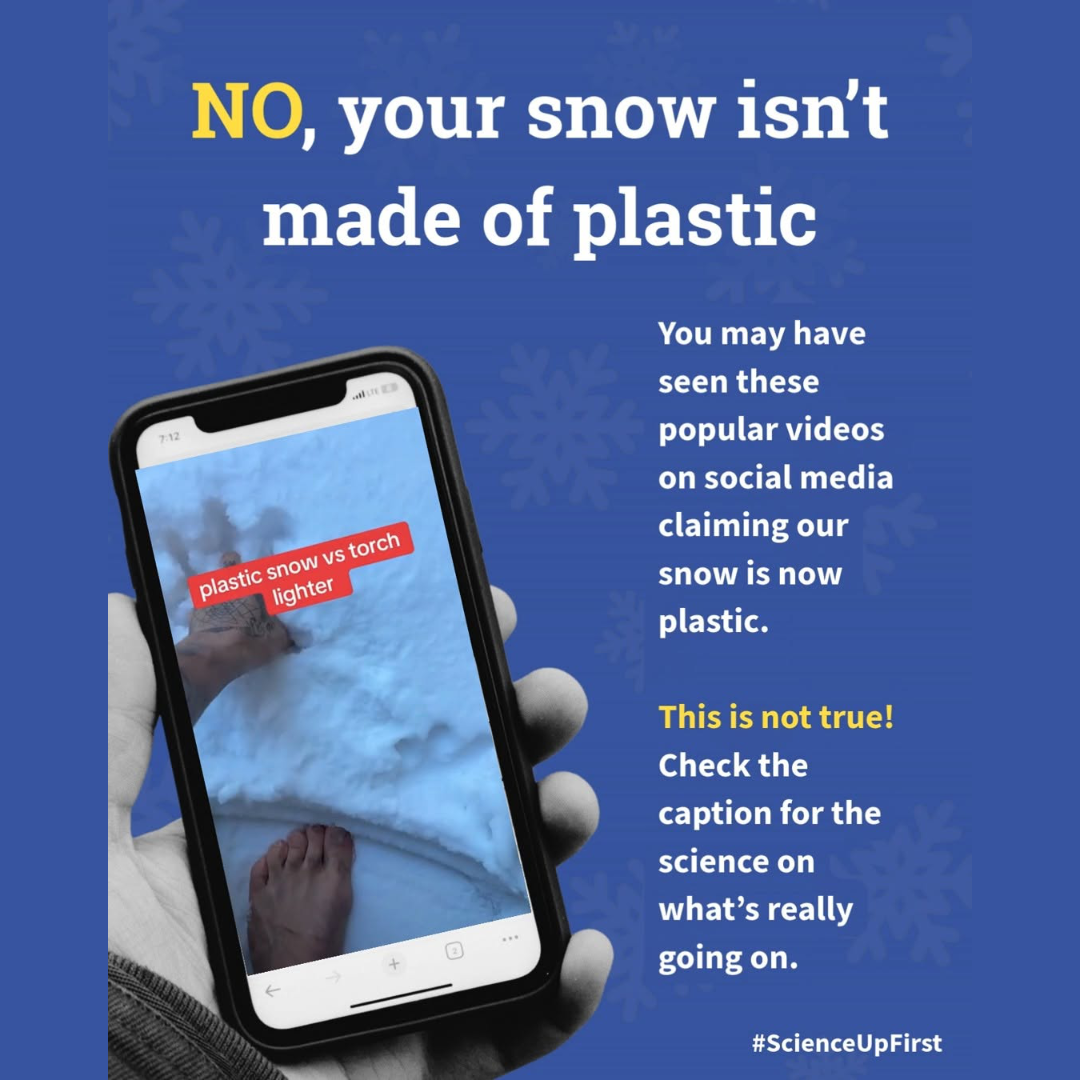
You might have seen videos of people attempting to melt snow from their backyard with a lighter, only to find that the snow doesn’t appear to be melting, but instead looks like it’s burning, turning black and giving off a weird plastic smell. Some even say the snow “looks” unnatural.
We would like to reassure you. Your snow (and theirs) is not fake and is not made of plastics. That doesn’t mean what these people have experienced isn’t true. But, there is a scientific explanation for it (1,2).
The reason people are not seeing the snow dripping away as the flame melts is because the small amount that does melt is immediately sponged up by the remaining snow – essentially, the snowballs are refreezing more densely and shrinking. Instead of melting, the snow could also be undergoing a process called sublimation, where a substance goes directly from solid to gas without ever becoming liquid (1,2,3).
As for the burnt mark on the snow and the bad smell, these come from the combustion of butane from the lighter. As it burns, butane gives off a petroleum-like odor and creates soot, which sticks to the cold snow. The same thing would happen if you put a lighter to a cold glass (1,2,4,5,6).
Now, some videos claim the snow looks unnatural. But in reality, not all snowflakes look like the perfect six-armed shapes we often picture. Snowflakes form around tiny dust or pollen particles, and their final shape depends on temperature and humidity as they fall through the clouds. Warmer temperatures with high humidity produce needle-like crystals, while colder and drier air produces simple hexagonal plates. The classic six-armed snowflakes usually form around −15 to −20 °C with medium to high humidity (7,8).
It’s ok to be surprised when something doesn’t behave the way we expect. That doesn’t mean it’s fake. Questioning our assumptions can push us to look deeper.
- Debunking viral “burning snow” videos. Here’s what really happens | CBC News | January 2026
- Fact Check: Explaining ‘fake Texas snow’ posts and ‘scorched snow’ videos | Reuters | March 2021
- Sublimation | Definition, Examples, & Facts | Britannica
- Effects of oxygen on soot formation in methane, propane, and n-Butane diffusion flames | Combustion and Flame | May 1995
- It’s not fake — snow that doesn’t melt when burned has scientific explanation | Saskatoon StarPhoenix | December 2025
- Butane | C4H10 | CID 7843 | PubChem
- How do snowflakes form? Get the science behind snow | National Oceanic and Atmospheric Administration | December 2022
- Snowflake Science | Ontario Science Centre
Share our original Bluesky Post!
View our original Instagram Post!