
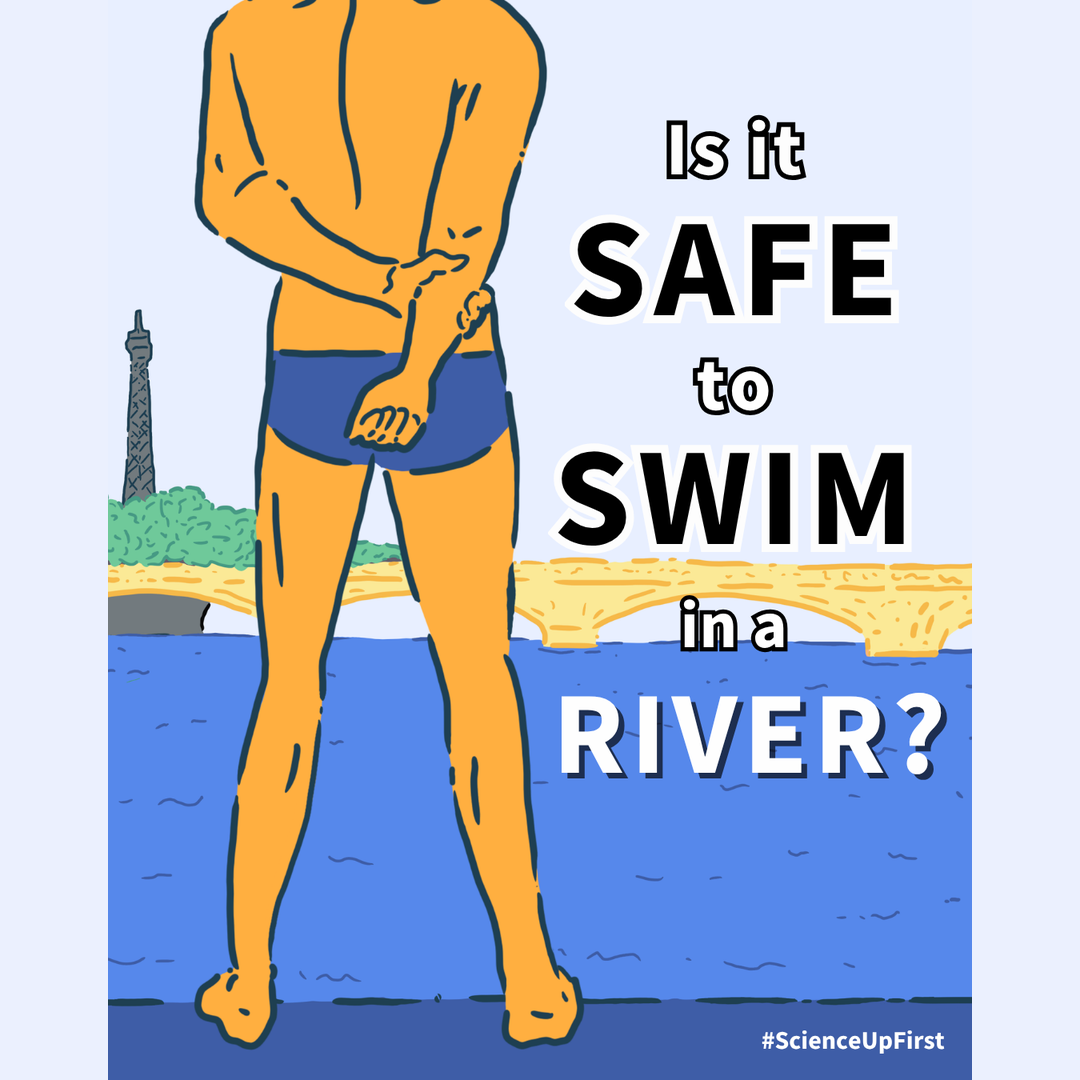
Thinking of taking a refreshing dip in your local river (or lake or pond)? Read on to understand the key indicators determining whether swimming in natural bodies of water is safe.
Because it is difficult and time consuming to test for all pathogens, experts tend to focus on “fecal indicators” in water like bacteria such as enterococci bacteria and E. coli. When these bacteria are found in the water, they indicate a potential contamination with human and/or animal fecal matter (1,3,4). Pathogens found in fecal matter can cause gastrointestinal illnesses as well as eye, ear, and skin infections when in high concentration (1,2).
Humans and farm animals are the primary sources of fecal contamination. Heavy rainfall can overwhelm sewage treatment systems, causing overflows into nearby waterways. Rain can also cause runoff of manure used on agricultural land, further contaminating rivers and lakes (1,4,5).
Safe concentrations of fecal indicators in the water are determined based on the activity the water is intended for. For example, primary contact activities such as swimming, wading, waterskiing or windsurfing, put people at higher risk of ingesting contaminated water than secondary contact activities such as canoeing and fishing (3,6).
When fecal indicators exceed safe levels, authorities might close the area or restrict the type of activities allowed (6,7,8,9).
One sure thing is if your local beach or river says it is closed, it is for a good reason and you should definitely not swim in it – Yes, even if it’s really hot outside (2).
- Splashing around: Checking up on water quality at the beach | Government of Canada | June 2023
- FR : La qualité de l’eau et les usages récréatifs | Ministère de l’Environnement, de la Lutte contre les changements climatiques, de la Faune et des Parcs
- Prairie Edition: “Is the Water Okay to Swim In?” | Swim Drink Fish Canada
- FR : La qualité de l’eau : des usages récréatifs sous surveillance | Ministère de l’Environnement, de la Lutte contre les changements climatiques, de la Faune et des Parcs
- FR : Les causes de la contamination : les eaux usées et la pollution agricole | Ministère de l’Environnement, de la Lutte contre les changements climatiques, de la Faune et des Parcs
- Guidelines for Canadian Recreational Water Quality – Indicators of Fecal Contamination | Government of Canada | February 2023
- Recreational water and health: Managing risk – Canada.ca | Government of Canada | June 2024
- Public Beaches – Frequently Asked Questions | Vancouver Coastal Health
- Beach Water Quality Results | Ottawa Public Health
- Paris to allow swimming in river Seine after 100-year ban | The Economic Times | July 2023
- Can Paris make the Seine clean enough to swim in for the Olympics? | Globalnews.ca | April 2024
- River Seine still not safe for swimming on most days due to E. Coli bacteria levels, with Olympics set to start on July 26 | CTV News | July 2024
- French sports minister takes a dip in the Seine weeks before the 2024 Paris Olympics begin | CBS News | July 2024
Share our original Bluesky Post!
If a river is out of bounds for swimming it’s probably for a good reason and you shouldn’t jump in, even if it’s really hot outside. There is a risk of coming in contact with pathogens! Let’s clear things up 👇 scienceupfirst.com/public-healt… #ScienceUpFirst
— ScienceUpFirst (@scienceupfirst.bsky.social) June 23, 2026 at 1:25 PM
[image or embed]
View our original Instagram Post!