
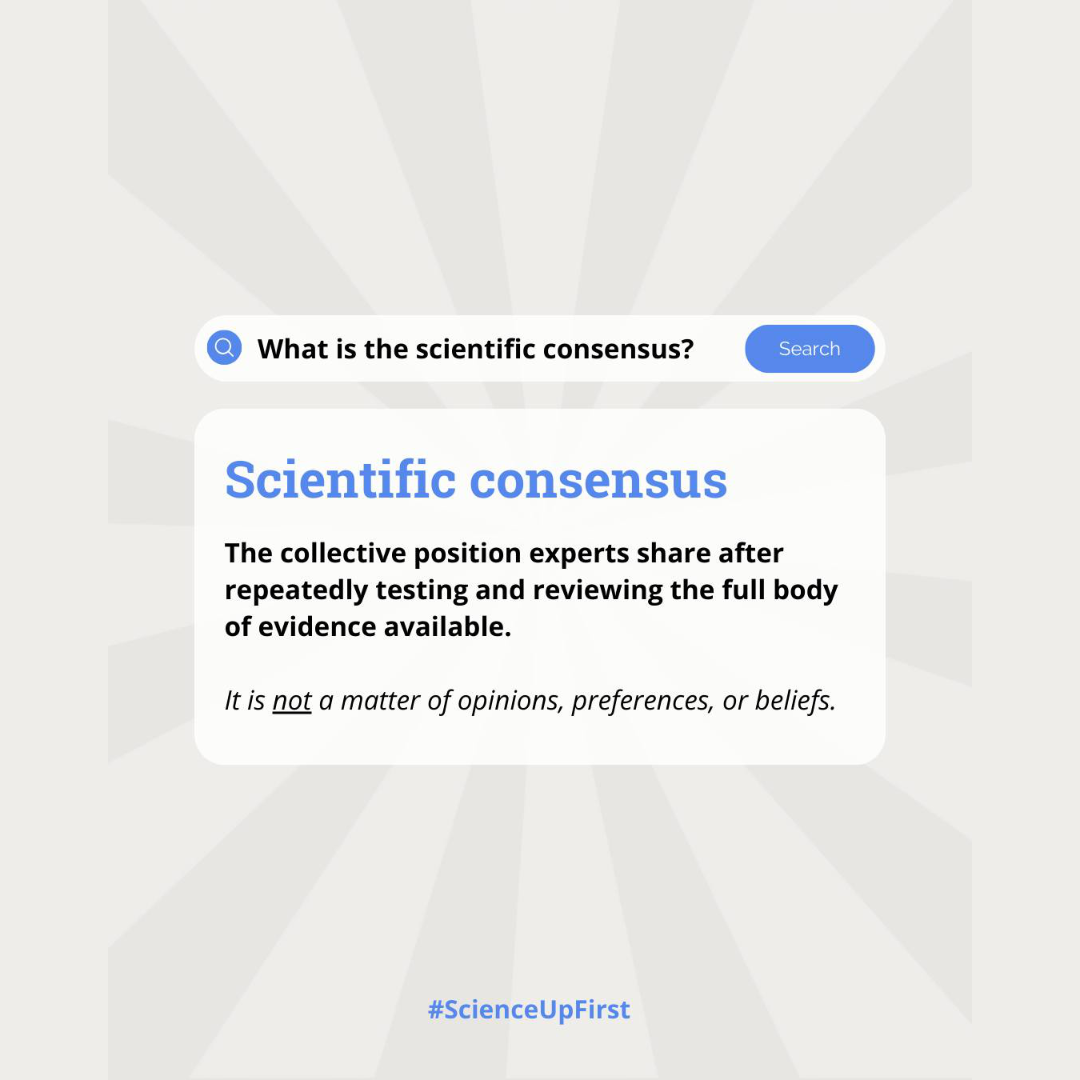
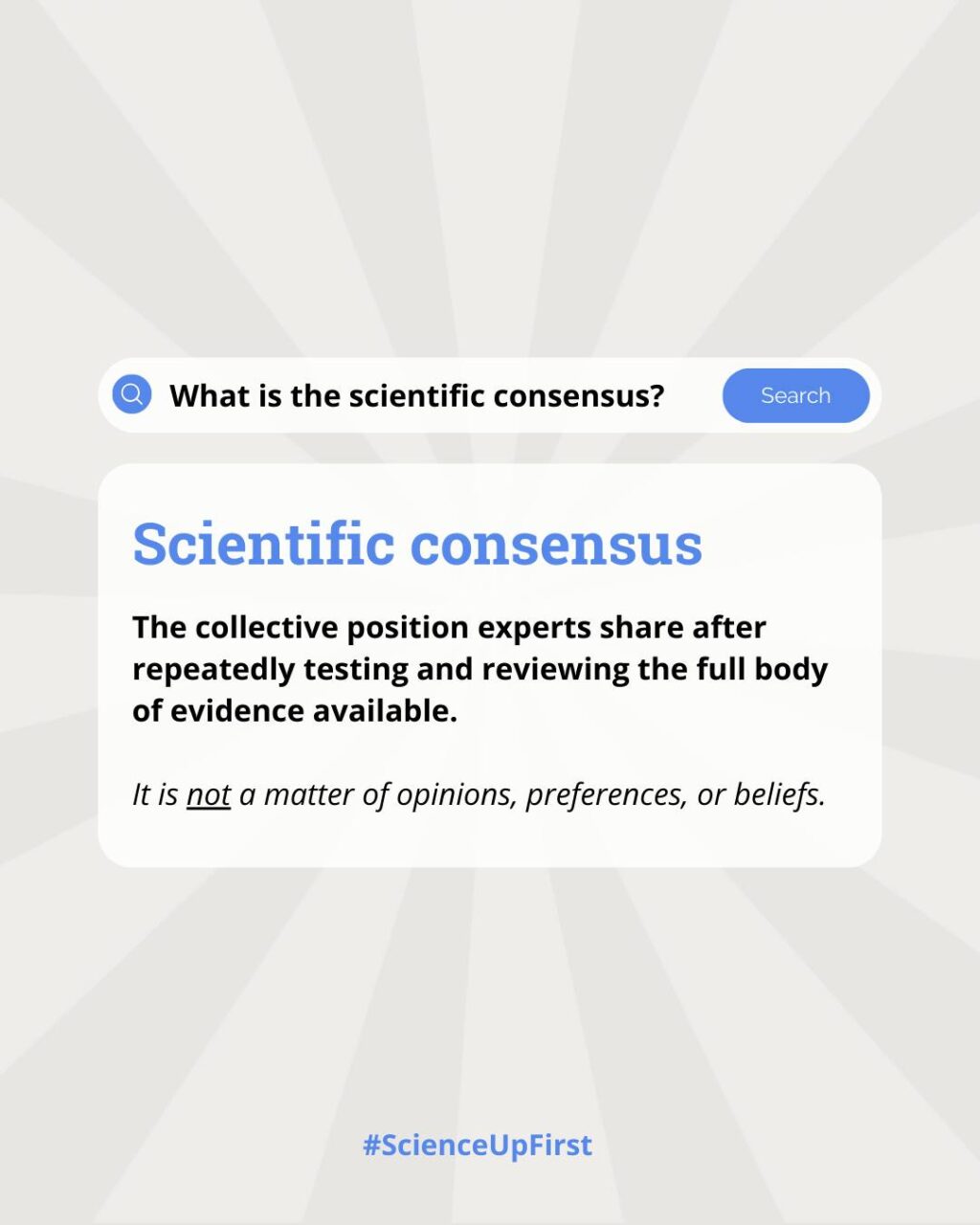
Reaching a consensus about where you and your friends should eat on Friday night is not the same as reaching a scientific consensus. It is not about opinions, preferences, or beliefs, but describes the body of evidence (5,6,7).
How is scientific consensus reached? 👇
Research begins with a question and a testable hypothesis, followed by experimentation. If the findings pass peer scrutiny, they are published 8). Other scientists will then replicate their work – they might reach the same conclusion, add to it, or have different findings entirely (9,10,11).
The key is that any claim, especially new ones, will be received with skepticism and faced with scrutiny. Scientific knowledge is built via continuous challenging, reexamination, re-testing, and criticism of other scientists’ work. It is only when scientists keep reaching the same conclusions, despite being challenged by alternative possibilities, that a scientific consensus can be reached (7,9,12).
Reaching a scientific consensus takes time and a lot of evidence. That is why there isn’t a consensus on every topic (19). The scientific consensus should always remain open to challenge. But overturning a well-established consensus requires strong evidence, as it would imply that the data, experiments, and conclusions of many were misinterpreted by the majority of experts in the field (6).
Unfortunately, various tactics are often used by misinformers to create an illusion of debate around the scientific consensus:
- Disguised experts – only experts in the field have the requisite understanding to debate the consensus (6).
- Cherry picking – presenting only a few pieces of opposing evidence is not enough to invalidate the consensus (13).
- Galileo gambit – just because an idea is ridiculed or out of the ordinary doesn’t mean it’s valid (14,15).
- Doubt mongering – casting doubt without evidence doesn’t change the consensus (16).
- False balance – presenting opposing views as equally valid when one lacks scientific support doesn’t change the consensus (17,18).
- Greater than 99% consensus on human caused climate change in the peer-reviewed scientific literature | Environmental Research Letters – IOPscience | October 2021
- Scientists Reach 100% Consensus on Anthropogenic Global Warming | Bulletin of Science, Technology & Society on Sage Journals | November 2019
- Consensus on consensus: a synthesis of consensus estimates on human-caused global warming | Environmental Research Letters – IOPscience | April 2016
- Expert credibility in climate change | Proceedings of the National Academy of Sciences of the United States of America on PubMed Central | June 2010
- Scientific consensus: Earth’s climate is warming | NASA
- What Does ‘Scientific Consensus’ Mean? | Forbes | June 2016
- The 97% consensus on global warming | Skeptical Science
- How does a scientific paper get published? | ScienceUpFirst | September 2023
- Naomi Oreskes: Why Should We Believe In Science? | NPR – TED radio hour | February 2017
- The real process of science | Understanding Science
- A blueprint for scientific investigations | Understanding Science
- Scientific Consensus and Certainty | Climate Science Investigations (CSI) – NASA
- Cherry-Picking in the Era of COVID-19 | Office for Science and Society – McGill University | July 2020
- Misinformer Tactic: The Galileo Gambit | ScienceUpFirst | October 2021
- Galileo Fallacy | Logically Fallacious
- Misinformer Tactic: Doubt Mongering | ScienceUpFirst | August 2022
- False Balance Bias | ScienceUpFirst | September 2023
- Is bothsidesism killing us? (And why scientific consensus matters) | Healthy Debate | August 2023
- How do health experts reach scientific consensus? | Healthcare for real
- Covering scientific consensus: What to avoid and how to get it right | The Journalist’s Resource – Informing the news | November 2021
- [Scientific consensus-building to promote the link between science and public policy] | Revue Médicale Suisse on PubMed Central | January 2024
Share our original Bluesky Post!
Reaching a consensus about where you and your friends should eat on Friday night is not the same as reaching a scientific consensus. Scientific consensus takes a lot of time and effort, and not every subject currently has one. Learn more here👇 scienceupfirst.com/science-101/… #ScienceUpFirst
— ScienceUpFirst (@scienceupfirst.bsky.social) January 21, 2026 at 11:49 AM
[image or embed]
View our original Instagram Post!
![[Image description: A woman is speaking to a group. Her voice travels as a soundwave across people of different ages, genders, and ethnicities. Her speech bubble is surrounded by bright colours and dots.]](https://scienceupfirst.com/wp-content/uploads/sites/4/2024/02/Solberg_EN-1000x1000.jpg)