
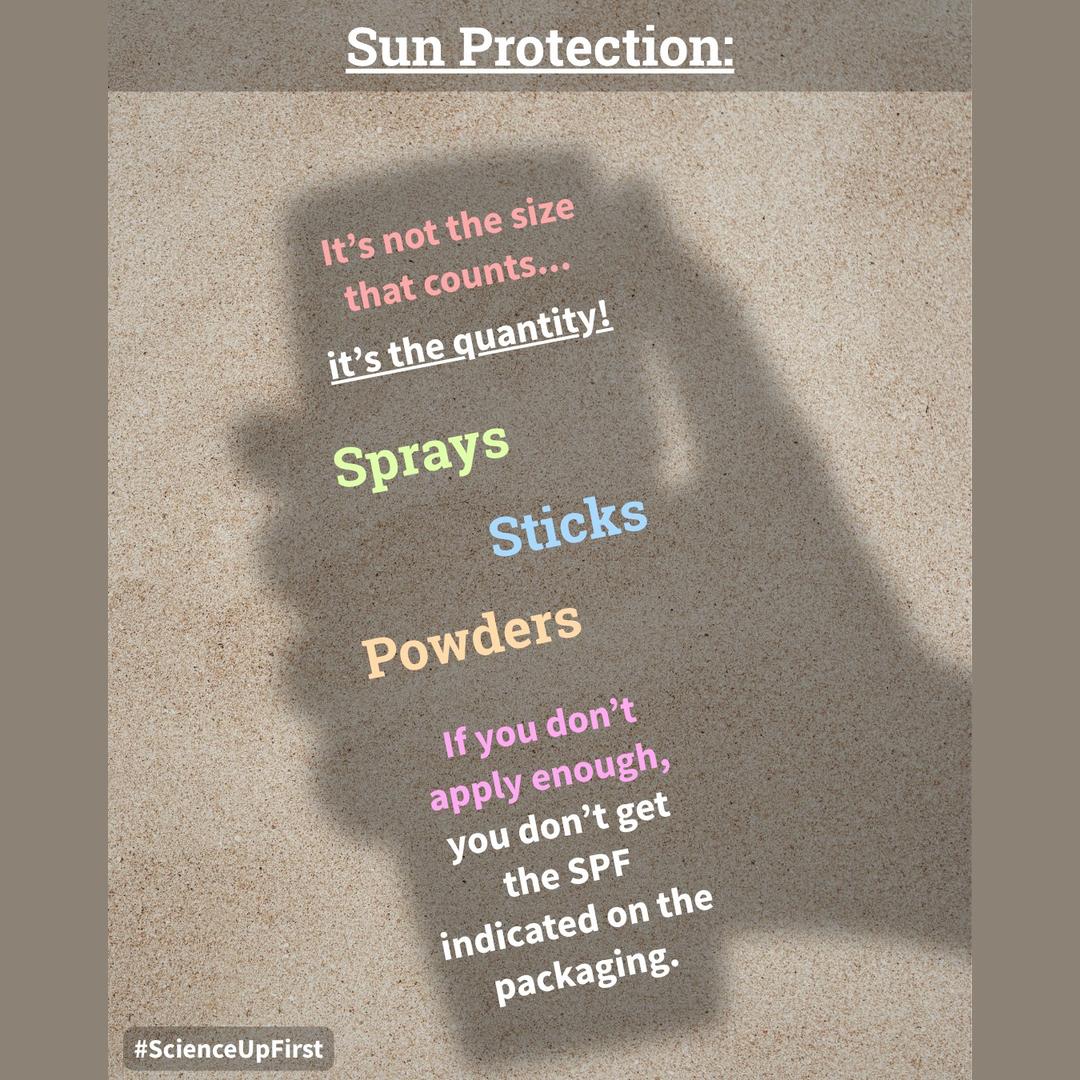
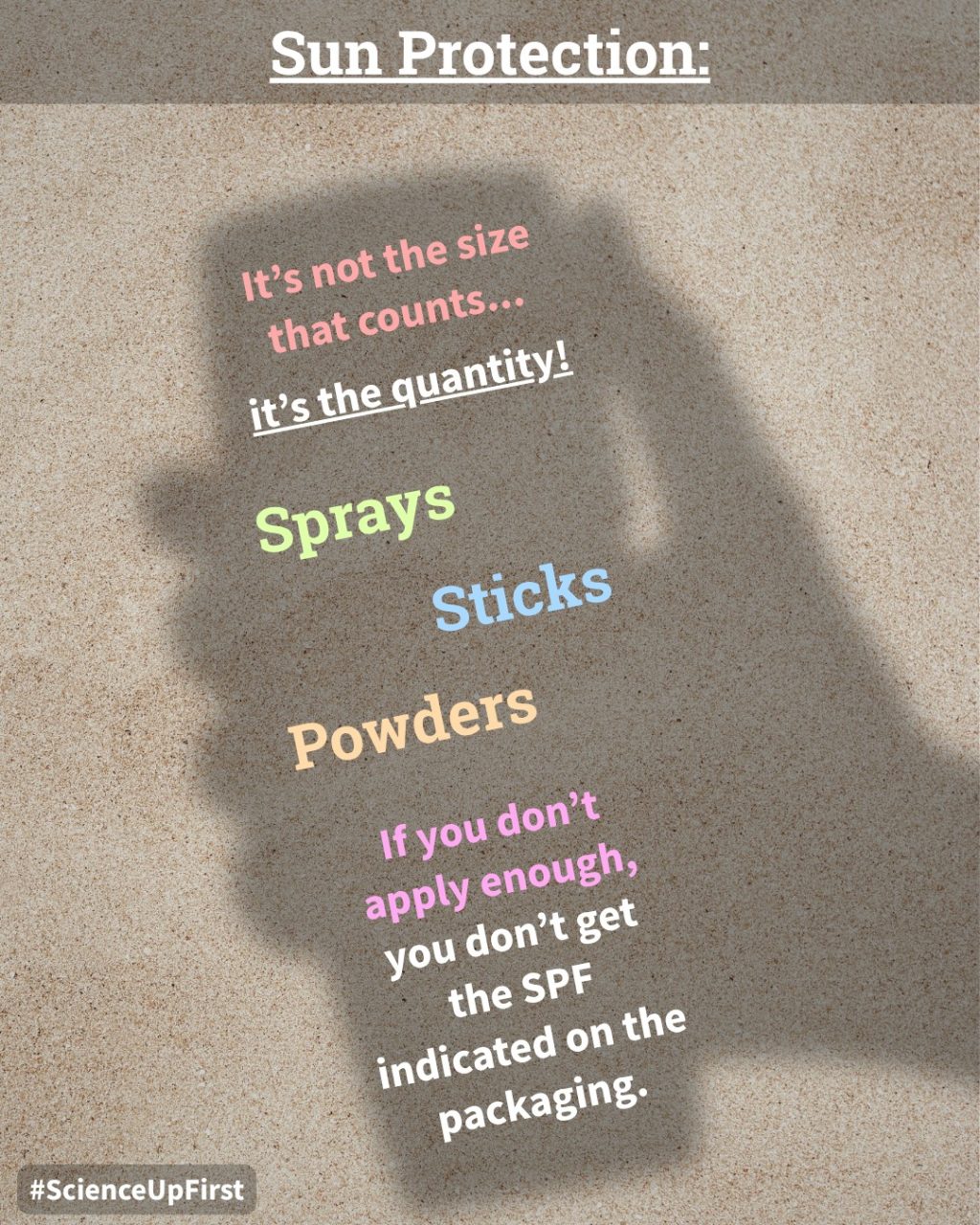
Have you ever looked for alternatives to liquid sunscreen? The problem with sunscreen sticks, powder, and pump and aerosol sprays isn’t that they can’t work. It’s that applying enough can be surprisingly difficult. To achieve the SPF on the label, 2 mg of sunscreen must be applied per cm² of skin – for example that’s roughly ¼ teaspoon of lotion sunscreen for your whole face – which is WAY tougher to achieve with these alternative sunscreens (1).
Cosmetic chemist Michelle Wong (@labmuffinbeautyscience) tested several popular sunscreen sticks and found they required 34 passes on average to get the labelled SPF (2). That’s far more product than most people would realistically use. Just imagine what your face would feel like after all those layers… yikes! Same goes with powder sunscreens: it would take dozens of applications on the face to get a decent SPF… Again, not a good look!
Sprays and aerosol sunscreens present a different challenge. Some of the sunscreen can drift away before it reaches your skin, especially if there is some wind (1,3,4,5). Aerosol sunscreens also contain a high concentration of compressed gases called propellants that help spray the sunscreen out of the can. These can make up a large portion of the product, meaning a typical aerosol usually only contains enough sunscreen for about 3 full-body adult applications under ideal conditions (1,6,5,7). Since sunscreen should be reapplied every 2 hours, one aerosol can may not even contain enough sunscreen for one adult spending more than ~6 hours in the sun!
Aerosol sunscreen can also be harmful if inhaled, making them best used in well-ventilated outdoor areas… where wind can make proper application even harder (5).
If you use one of these alternatives, remember that getting the SPF on the label usually requires much more product than most people expect. Applying less sunscreen doesn’t mean you get no protection, but it does mean you’re likely getting much less protection than the number on the bottle suggests (1).
- Do sunscreen sprays actually work? The science | Lab Muffin Beauty Science | August 2024
- How Much of a Sunscreen Stick Should You Apply? | Lab Muffin Beauty Science | June 2026
- Trends in US sunscreen formulations: Impact of increasing spray usage | Journal of the American Academy of Dermatology | January 2018
- The delivery of sunscreen aerosol sprays | Journal of the American Academy of Dermatology | May 2014
- Proposed adoption of the Australian/New Zealand Sunscreen Standard AS/NZS 2604:2021 | Australian Government – Department of Health and Aged Care | January 2024
- Testing and Evaluating Aerosol Sunscreens | Improving Health Outcomes for People | November 2020
- Scientific Report – Testing Aerosol Sunscreen Products: Exploring the Impact of Wind on the Application of Sunscreen | Griffith University | November 2021
Share our original Bluesky Post!
View our original Instagram Post!