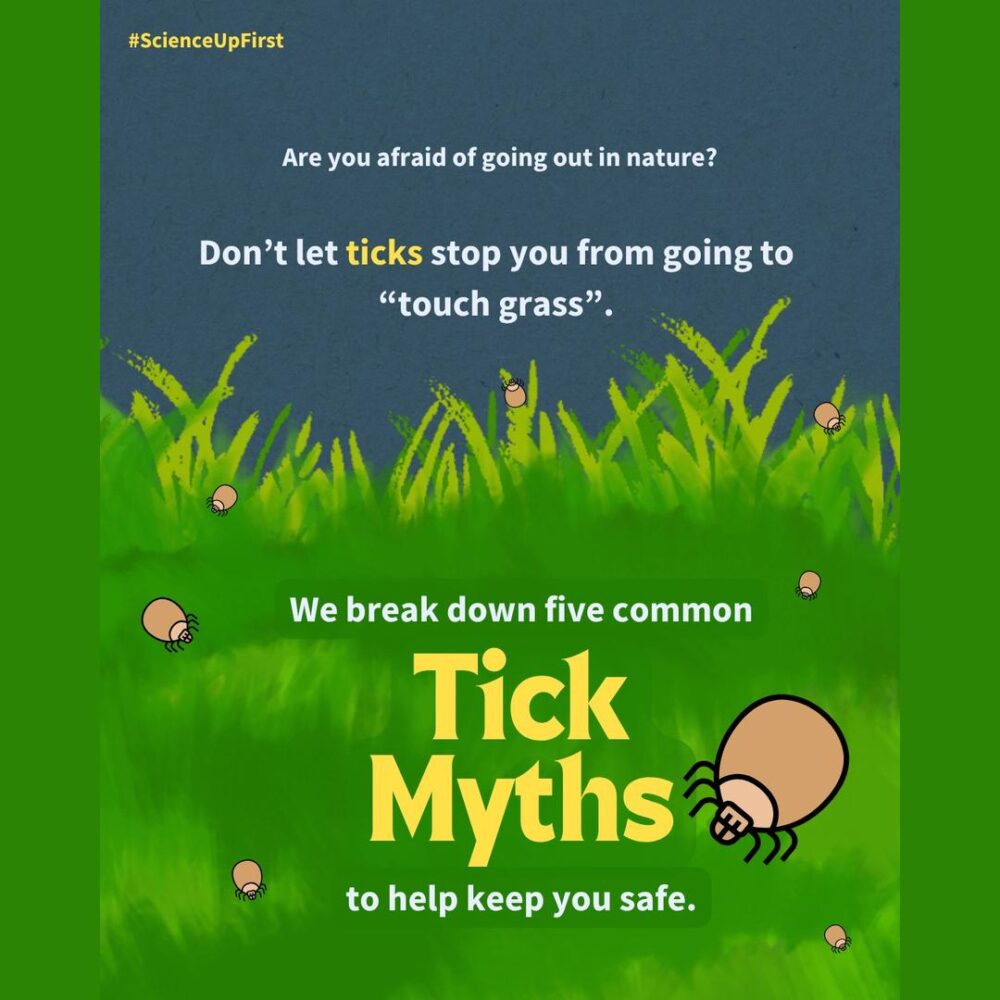


Ticks are a real problem at the moment, so we wanted to give you some tips to keep yourself safer in nature:
What you wear matters. Long sleeves, tuck in your shirts and pants, high socks, light colours, closed toe shoes, hair secured in a ponytail or hat. If you don’t have all these things remembered, you don’t have to be perfect to be cautious.
Apply EPA-approved tick repellent (such as picaridin or DEET) to skin and insecticide (such as permethrin) to clothing and shoes, as directed.
Avoid areas where ticks live such as wood piles, leaf litter, long grass, beach grass, stone walls, and perimeters where the lawn meets the woods.
Remove clothing upon entering the home; toss into the dryer at high temperature for 10-15 minutes to kill live ticks (putting them in the washer won’t work).
Examine yourself and your pets for ticks daily, feeling for bumps in areas like the back of knees, the groin, the armpits, in and behind the ears, in the belly button, and on the scalp.
Don’t let these little bush crabs stop you from enjoying nature (please note: ticks are not in fact crabs of the bush, they are arachnids).
Tick protection 101
There are a lot of great tips when it comes to tick safety. Here are the big points to remember:
Prevent: Wear long-sleeved, light-coloured clothes tucked into each other, use bug spray, stay on cleared paths and try to avoid Lyme disease at-risk areas.
Check: Shower as soon as you get back home and perform a tick check on yourself, your family members, your pets and your gear.
Got bitten? Don’t panic, and take action:
How to safely remove a tick:
Keep the tick in a closed container: It could be useful for identification purposes or if you develop symptoms and need to see a healthcare professional.
- e-Tick is a tick identification and population monitoring platform in Canada. Also available as an App.
- Identification guide for ticks found in Québec | Institut national de santé publique du Québec
- Tick ID | CanLyme – Canadian Lyme Disease Foundation
Know what diseases ticks can transmit and what symptoms to look for:
- Diseases Transmitted by Ticks | Ticks | CDC
- Alpha-gal Allergy | CDC
- Lyme disease: Symptoms and treatment | Canada.ca
- STARI or Lyme? | Southern Tick-Associated Rash Illness (STARI) | CDC
Contact your health care provider as soon as you are experiencing any of them.
Do you want to learn even more about ticks?
- Northward range expansion of Ixodes scapularis evident over a short timescale in Ontario, Canada | PLOS ONE | Published December 27, 2017
- Ticks were only a problem in the United States 30 years ago.
- Thanks to climate change, ticks are expanding their range up and into Canada at a predicted rate of 35 to 55 km per year.
- Tick-tock: Ticks are spreading across Canada. Here are their new homes | Globalnews.ca | Posted May 5, 2019 | Updated May 6, 2019
- Thanks to climate change, ticks are expanding their range up and into Canada at a predicted rate of 35 to 55 km per year.
- Geographic Expansion | Tick Talk
- Ticks have been found on people across all Canadian provinces and territories.
- Seasonality of Ticks | Tick Talk
- Preventing tick bites | CDC
- Spring: Ticks are active in temperatures above 4°C.
- Summer: Some adult ticks are less active in the warmer months of summer, but immature stages can be active from the end of spring throughout summer.
- Fall: When adult ticks are the most active.
- Winter: Ticks can stay active if the air temperature is above 4°C, even if there is snow on the ground!
- Lyme Disease | CDC
- Out of the 40 tick species found in Canada, Lyme disease is only transmitted by the blacklegged tick (a.k.a. deer tick).
- In North America, Lyme disease is caused principally by the bacterium Borrelia burgdorferi.
- Detailed description of the Ixodes scapularis, or black-legged tick or deer tick | Institut national de santé publique du Québec (INSPQ)
- Out of the 40 tick species found in Canada, Lyme disease can be transmitted by the blacklegged tick (a.k.a. deer tick).
- Lyme Disease : OSH Answers | Canadian Centre for Occupational Health and Safety (CCOHS) | Government of Canada
- Out of the 40 tick species found in Canada, Lyme disease can be transmitted by the Western blacklegged tick.
- Lyme disease: Prevention and risks | Government of Canada
- To infect you with the bacteria that causes Lyme disease, the tick needs to be infected with the bacteria itself and stay attached to you for 24 to 48 hours.
- The best way to avoid tick-borne diseases is to avoid being bitten by one.
- Lyme borreliosis: a review of data on transmission time after tick attachment | International Journal of General Medicine on PubMed Central | Published December 19, 2014
- To infect you with the bacteria that causes Lyme disease, the tick needs to be infected with the bacteria itself and stay attached to you for 24 to 48 hours.
- Risk Areas | CanLyme – Canadian Lyme Disease Foundation
- While the blacklegged ticks are more present in Eastern Canada, where their favourite host, the white-tailed deer is abundant, all Canadians are at risk.
- Your risk of exposure is higher if you are frequently in one of the tick’s preferred habitats such as grassy fields, woods, gardens, beaches and nature parks.
- Signs and Symptoms of Untreated Lyme Disease | CDC
- While being one of the most common early signs of Lyme disease, 20 to 30% of infected people won’t develop the target-like rash called erythema migrans.
- Other typical infection symptoms and signs include fever, chills, headache, fatigue, muscle aches and swollen lymph nodes.
- Lyme disease: Symptoms and treatment | Government of Canada
- Other typical infection symptoms and signs include fever, chills, headache, fatigue, muscle aches and swollen lymph nodes.
- But if you ever get bitten by one, know that Lyme disease can be treatable with antibiotics, and the sooner you start treatment, the better your chances of recovery will be.
- Diseases Transmitted by Ticks | CDC
- Ticks can pass on many more other serious diseases, other than Lyme disease.
- Lyme Prevention | CanLyme – Canadian Lyme Disease Foundation
- The best way to avoid tick-borne diseases is to avoid being bitten by one.
Share our original Bluesky Post!
Tick safety is on a lot of people’s minds at the moment. See our site for more resources on ticks and other summer safety tips. 👇 scienceupfirst.com/ #ScienceUpFirst
— ScienceUpFirst (@scienceupfirst.bsky.social) May 21, 2026 at 3:33 PM
[image or embed]
View our original Instagram Post!