
Modeling research from the COVID-19 pandemic estimated that misinformation in the United States resulted in approximately $2 billion additional costs in hospitalizations and approximately 45,000 avertable deaths.
Category: Misinformation 101
-
Conspiratorial Claims and Institutional Distrust in Canada’s Online Ecosystem
In Canada, conspiracy theories that generate mistrust in democratic institutions are created and amplified by a relatively small but very active and influential group of online influencers. Many Canadians (between 30-60%) have been exposed to trending conspiracy theories but only a small minority endorse these beliefs.
-
Disconnected health systems and misinformation are putting patient care at risk, say Canadian physicians
Survey research finds 99% of Canadian physicians say that a disconnected health care system impacts their ability to provide patient care. 97% of Canadian physicians say they have had to provide patient care in response to false or misleading information that patients have found online. More than one-third of physicians surveyed (34%) say they have to deal with these misinformation issues “often.”
-
No one is immune to conspiracy theories, not even you!
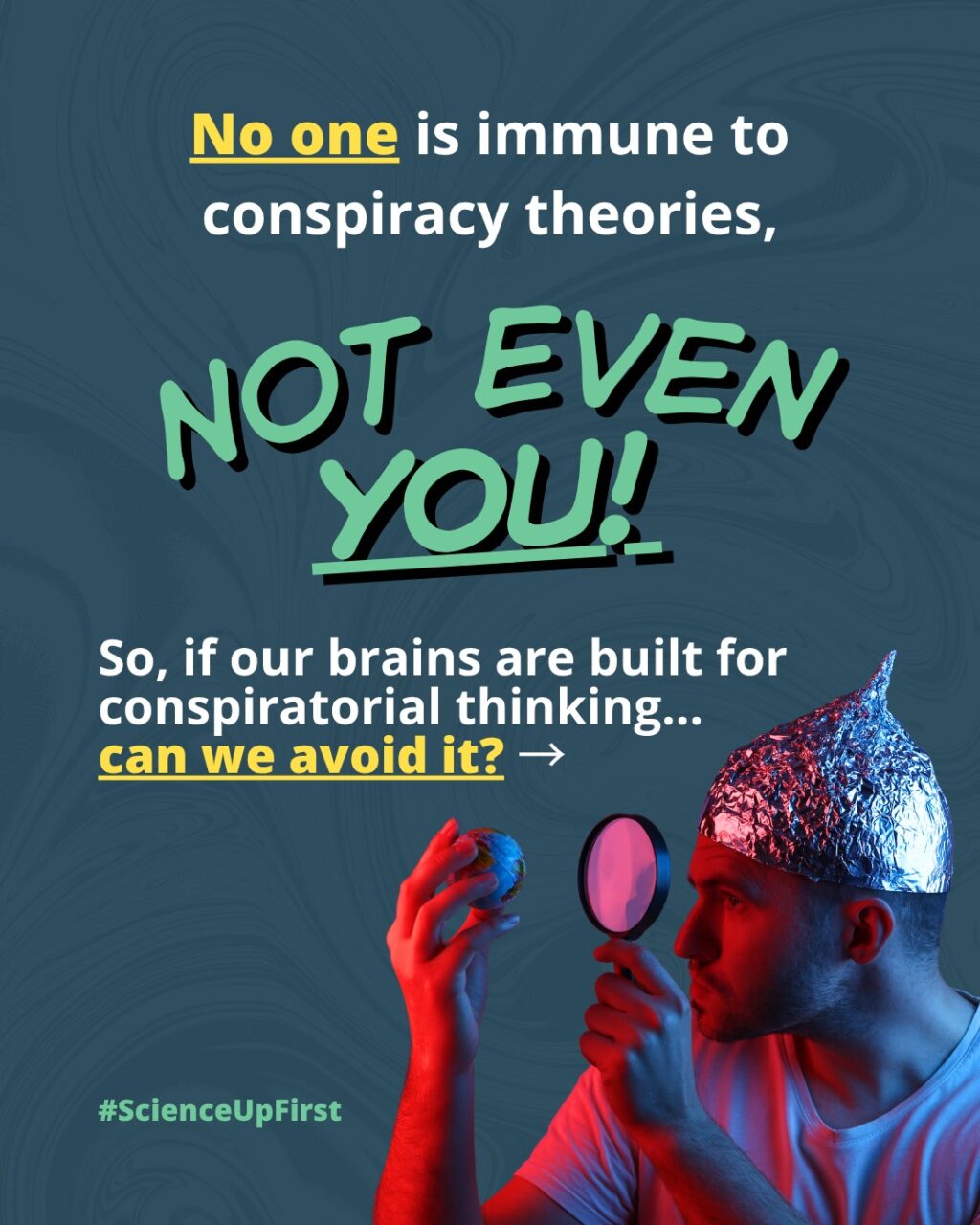
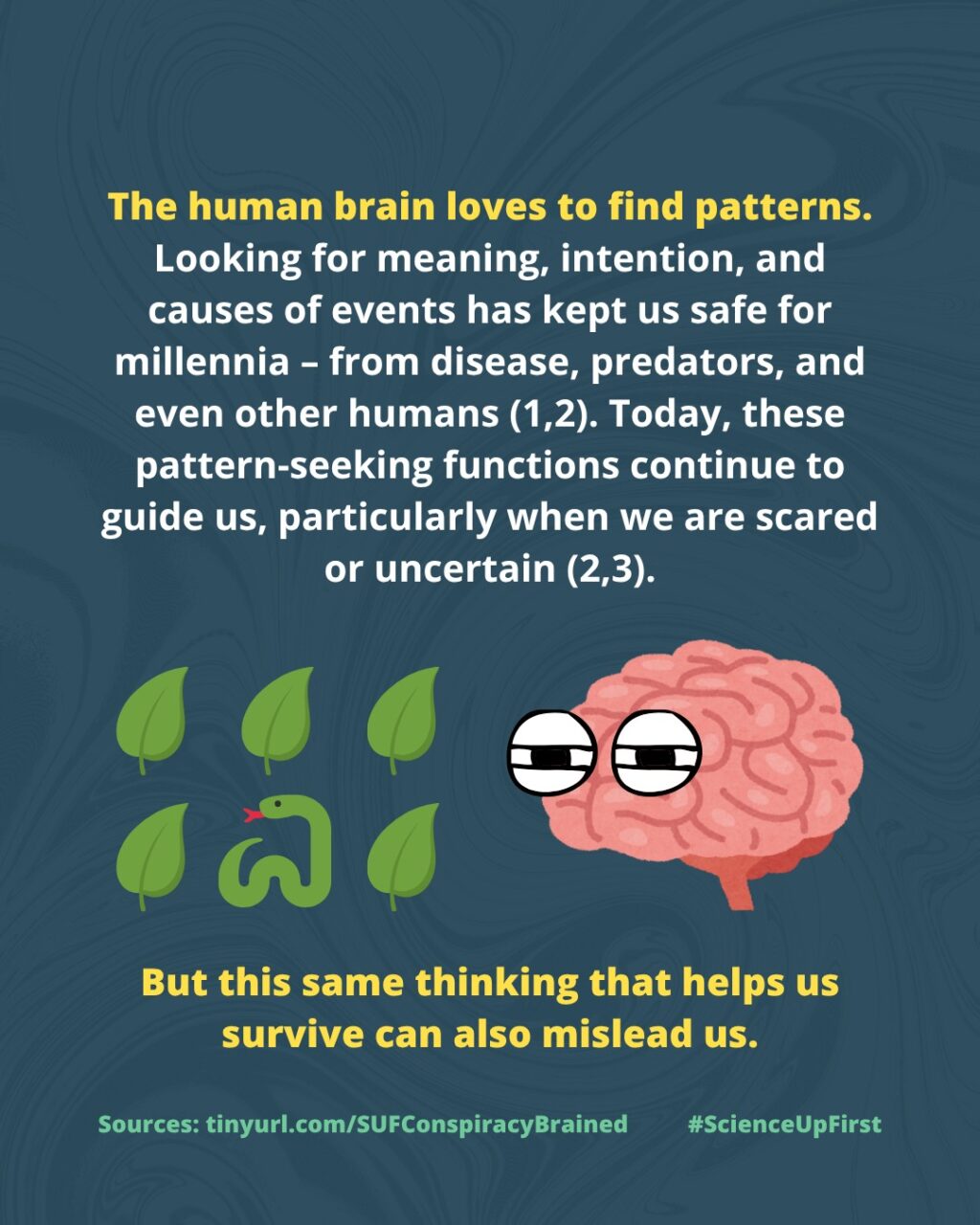
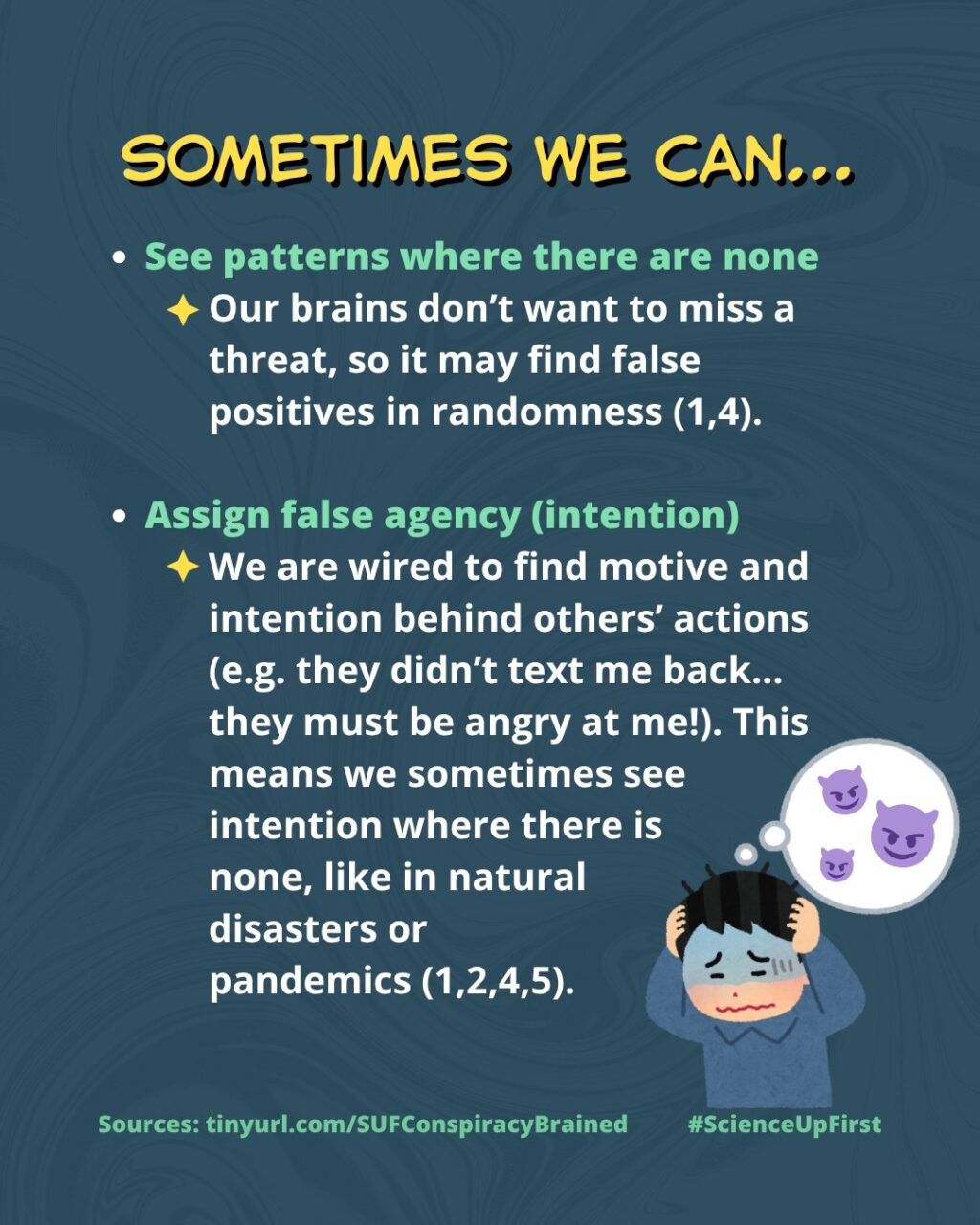
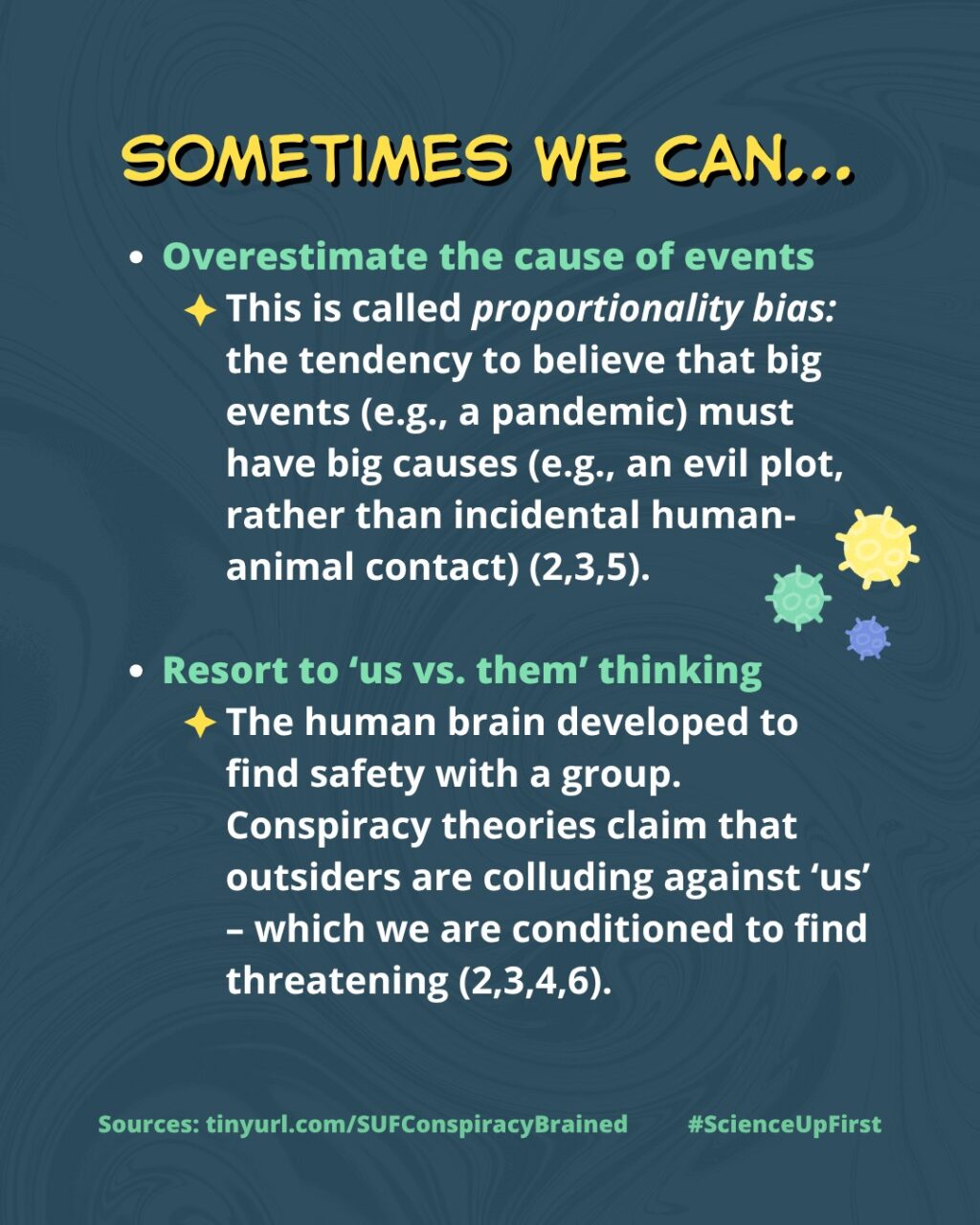
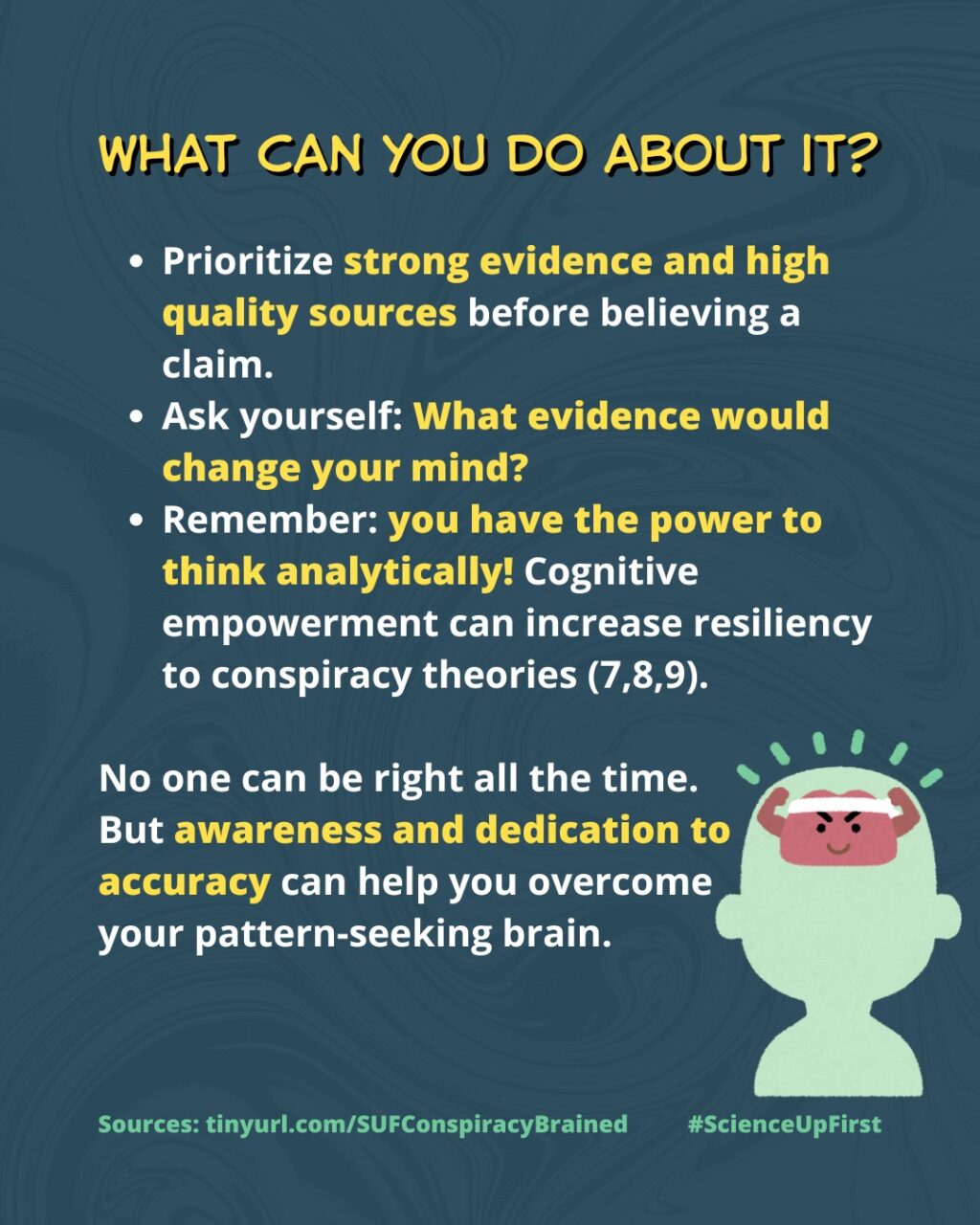
Brains love conspiracy theories. Yes, even yours!!
While some people may be more prone to conspiratorial thinking, everyone is susceptible. Conspiratorial thinking has existed for eons, across time and cultures (1,2,4). Falling for a conspiracy theory doesn’t make you foolish. In fact, it’s a side effect of survival mechanisms that the human brain has developed to keep us alive (1,2).
Check out the rest of the post to learn more about why our brains are hardwired for conspiracy, and how you can help reason win out.
Be honest – what’s a conspiracy theory that you’ve fallen for? How did you get out of it? Let us know!
Sources- Conspiracy Theories: Evolved Functions and Psychological Mechanisms | Perspectives on Psychological Science | 19 September 2018
- Medical conspiracy theories: cognitive science and implications for ethics | Medicine, Health Care and Philosophy | 16 April 2020
- The Psychology of Conspiracy Theories | Current Directions in Psychological Science | 7 December 2017
- Belief in conspiracy theories: Basic principles of an emerging research domain | European Journal of Social Psychology | 24 August 2018
- Is it pathological to believe conspiracy theories? | Transcultural Psychiatry | 1 August 2023
- Conspiratorial Claims and Institutional Distrust in Canada’s Online Ecosystem | Media Ecosystem Observatory | 23 February 2026
- The efficacy of interventions in reducing belief in conspiracy theories: A systematic review | PLoS One | 5 April 2023
- Chapter One – Countering misinformation through psychological inoculation | Advances in Experimental Social Psychology | 2024
- The Conspiracy Theory Handbook | Skeptical Science | March 2020
Share our original Bluesky Post!
Brains love conspiracy theories. While some people may be more prone to conspiratorial thinking, everyone is susceptible. Check out the rest of the post to learn more about why our brains are hardwired for conspiracy, and how you can help reason win out.👇 scienceupfirst.com/misinformati…
— ScienceUpFirst (@scienceupfirst.bsky.social) June 9, 2026 at 2:38 PM
[image or embed]View our original Instagram Post!
-
Moving the Goalposts
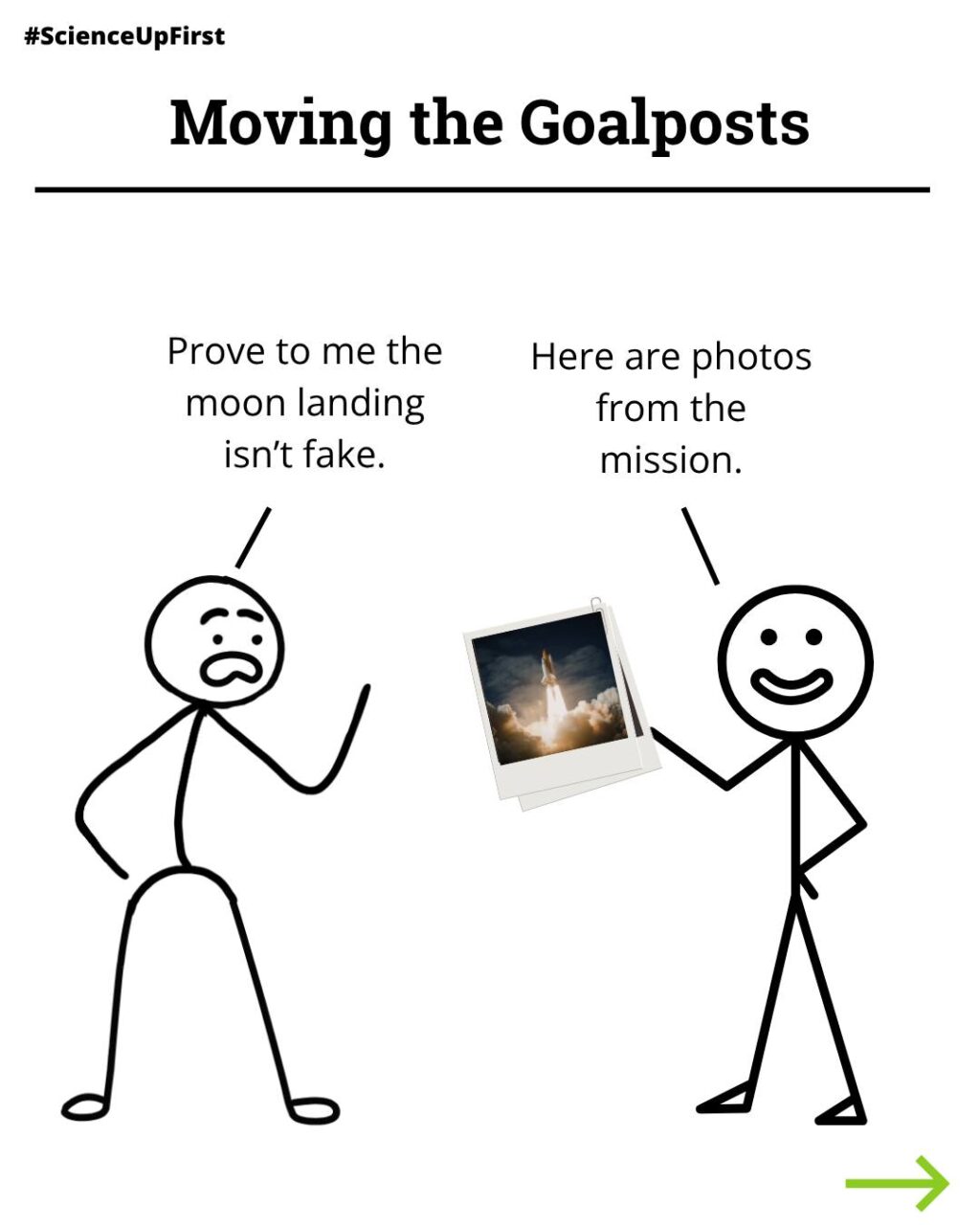
Ever seen a conversation like this?
Person A: “Prove to me the moon landing isn’t fake.”
Person B: “Here are photos from the mission.”
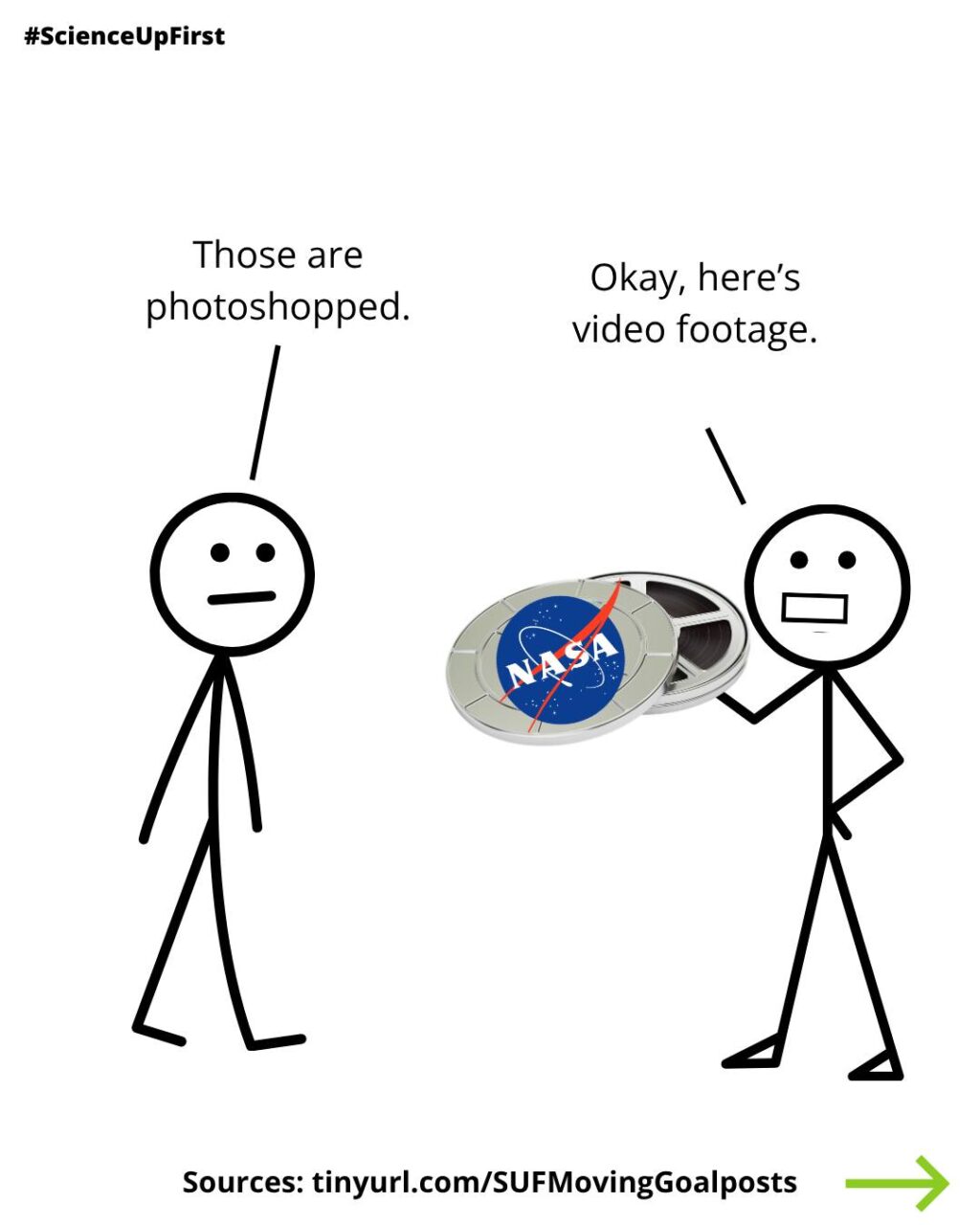
Person A: “Those are photoshopped.”
Person B: “Okay, here’s video footage.”
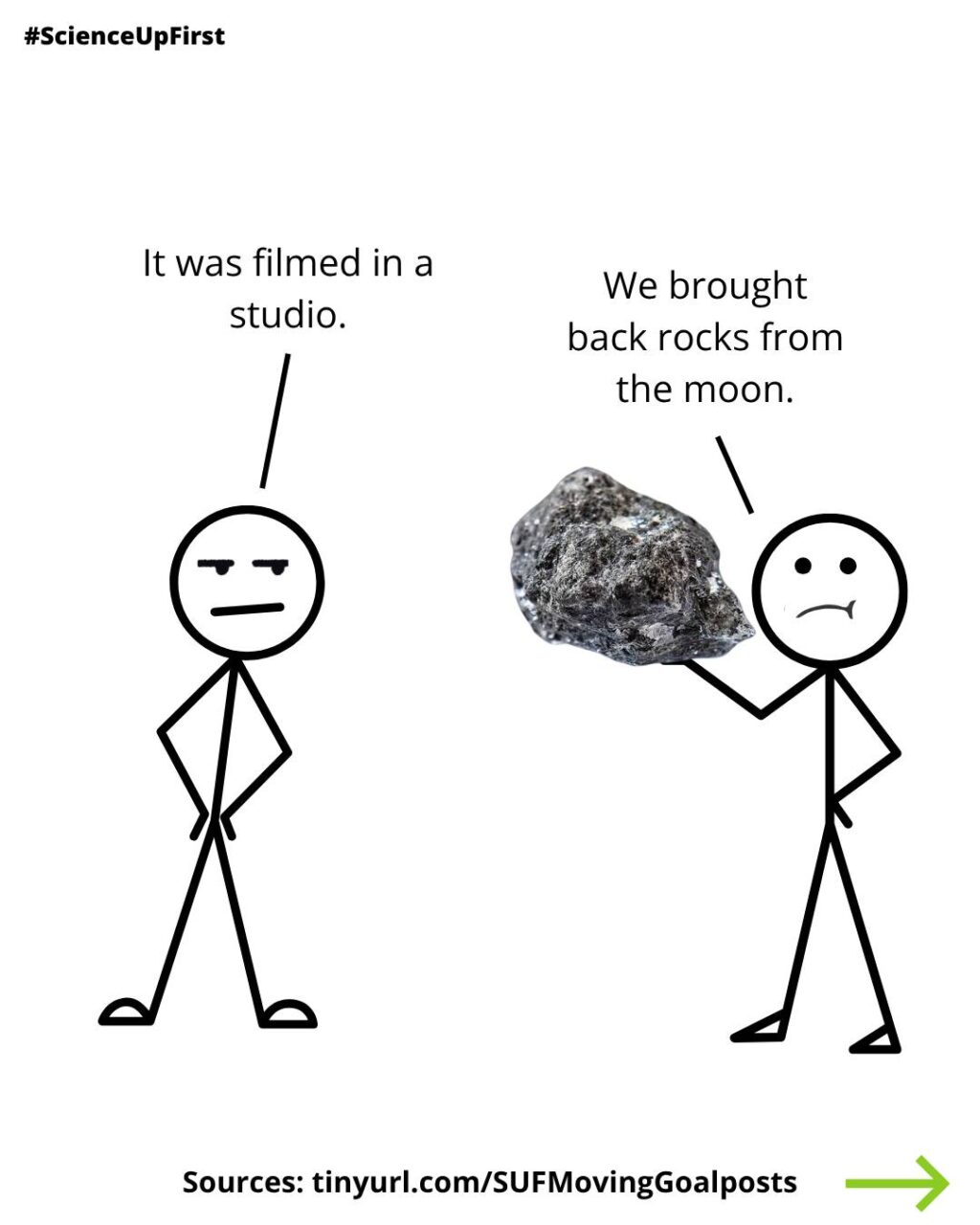
Person A: “It was filmed in a studio.”
Person B: “We brought back rocks from the moon.”
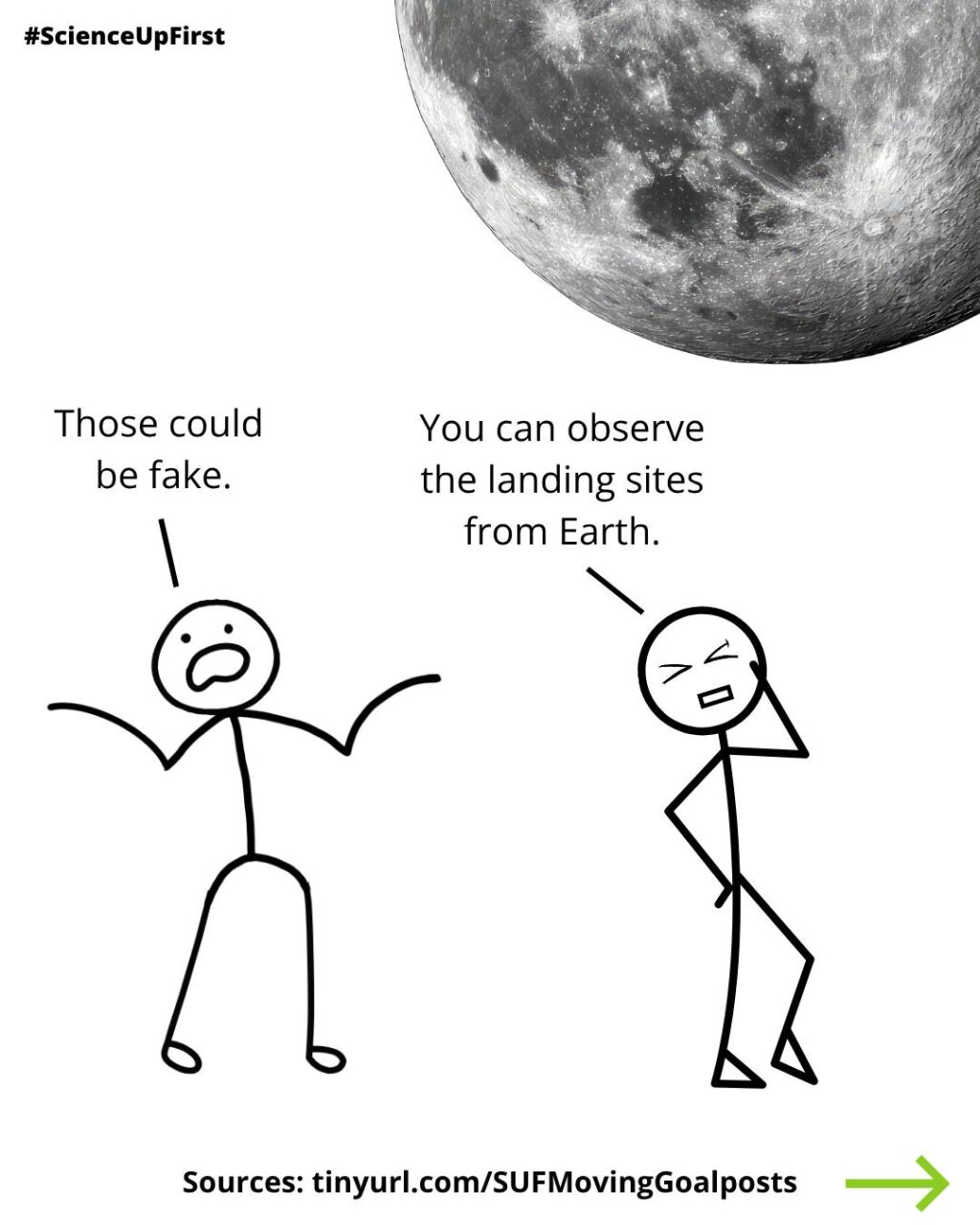
Person A: “Those could be fake.”
Person B: “You can observe the landing sites from Earth.”
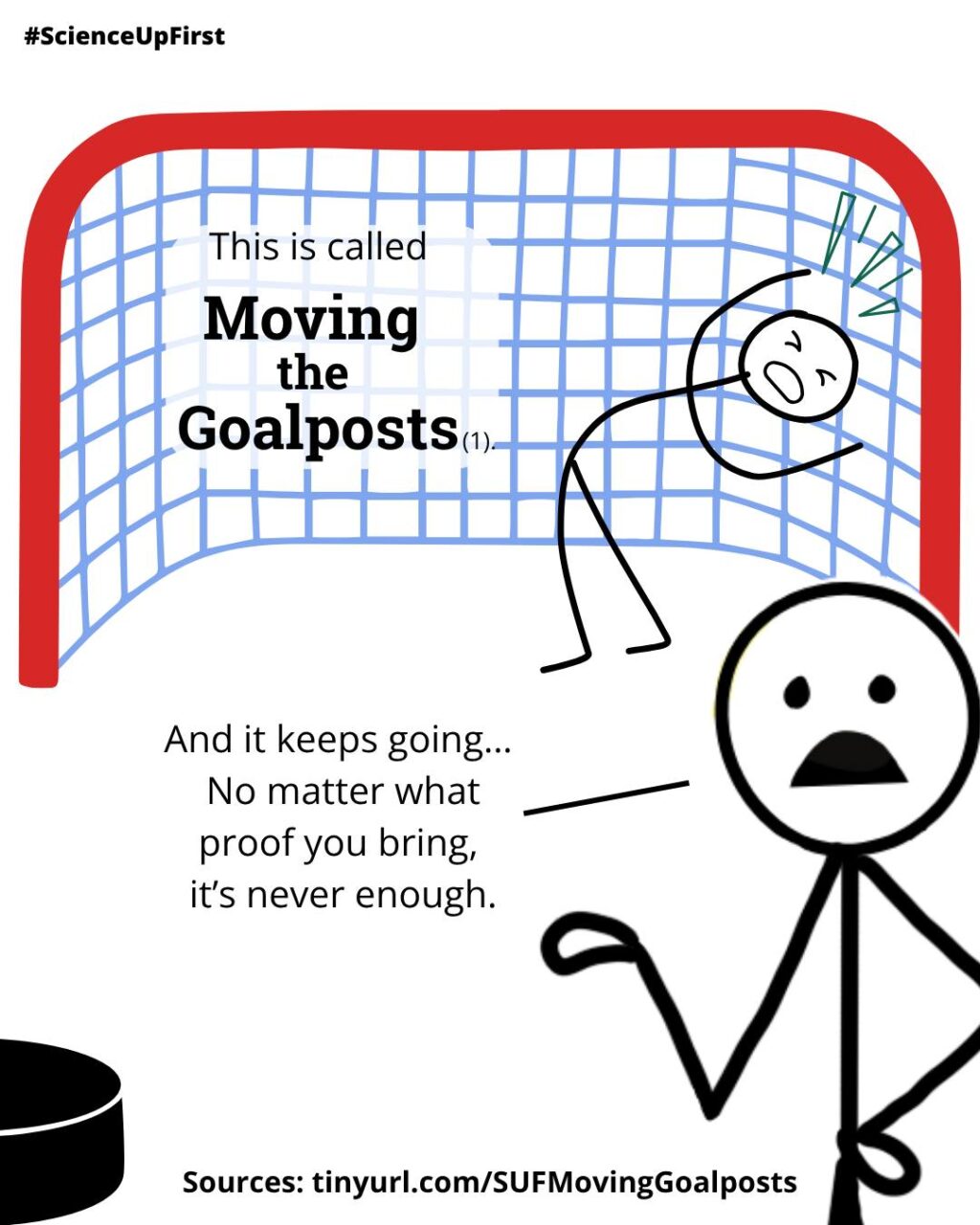
Person A: “I still don’t believe it.”And it keeps going… No matter what proof you bring, it’s never enough.
This is called moving the goalposts (1).
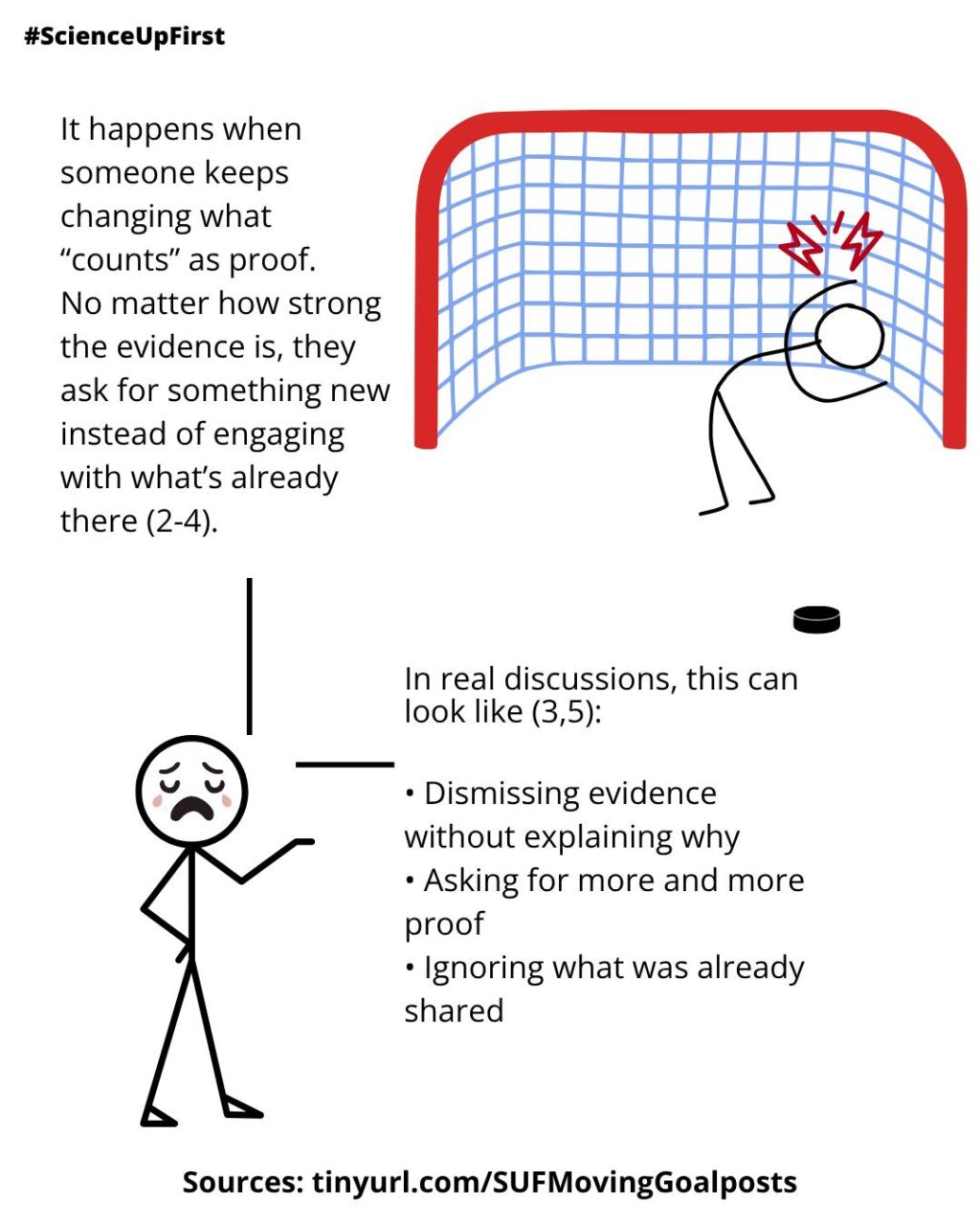
It happens when someone keeps changing what “counts” as proof. No matter how strong the evidence is, they ask for something new instead of engaging with what’s already there (2,3,4).
In real discussions, this can look like (3,5):
- Dismissing evidence without explaining why
- Asking for more and more proof
- Ignoring what was already shared
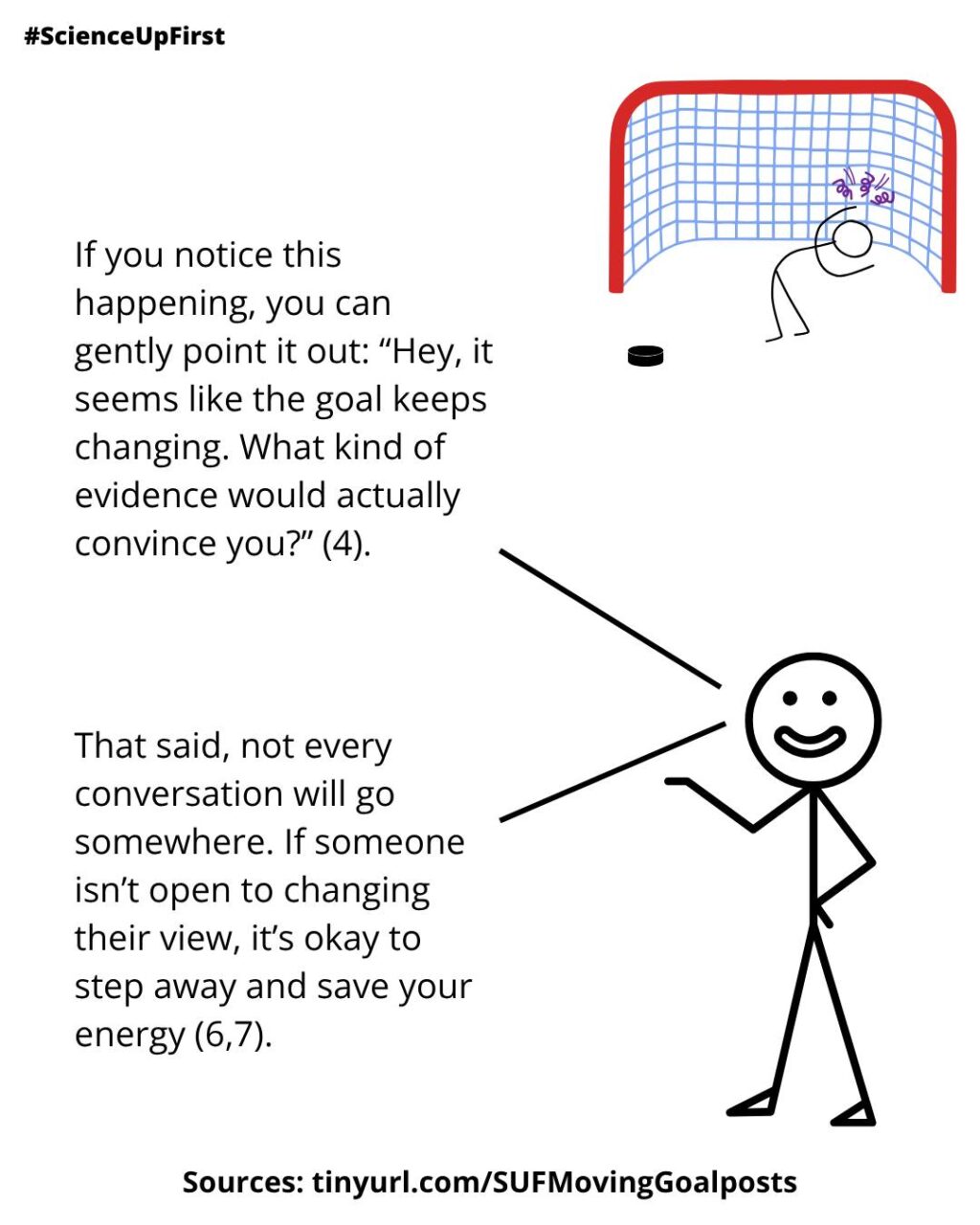
If you notice this happening, you can gently point it out: “Hey, it seems like the goal keeps changing. What kind of evidence would actually convince you?” (4).
That said, not every conversation will go somewhere. If someone isn’t open to changing their view, it’s okay to step away and save your energy (6,7).
Sources- Move the Goalposts | Cambridge Dictionary
- Moving the Goalposts | Logically Fallacious
- Understanding conspiracy theory tactics: moving the goalposts | The Skeptic | December 2021
- Moving the Goalposts | Bad Arguments – Wiley Online Library | May 2018
- The Fallacy of ‘Moving the Goalposts’, Explained | Snopes.com | February 2023
- Tips on countering conspiracy theories and misinformation | SciBeh | 2020
- How to talk to conspiracy theorists—and still be kind | MIT Technology Review | July 2020
Share our original Bluesky Post!
Ever notice how some debates never move forward? No matter the evidence, the standard keeps changing. That’s called moving the goalposts, and it’s a common misinformation tactic. Read more about it here 👇 scienceupfirst.com/misinformati… #ScienceUpFirst
— ScienceUpFirst (@scienceupfirst.bsky.social) June 3, 2026 at 10:20 AM
[image or embed]View our original Instagram Post!
-
Generative artificial intelligence-driven chatbots and medical misinformation: an accuracy, referencing, and readability audit.
A health misinformation audit of five popular AI chatbots found that approximately 50% of all responses were either “somewhat” or “highly problematic.” The audit evaluated how AI chatbots responded to health misinformation across five health topics: vaccines, cancer, stem cells, nutrition, and athletic performance. The audit also found that the chatbots returned accurate, error-free scientific references in only 40% of cases.
-
3 myths from the Manosphere
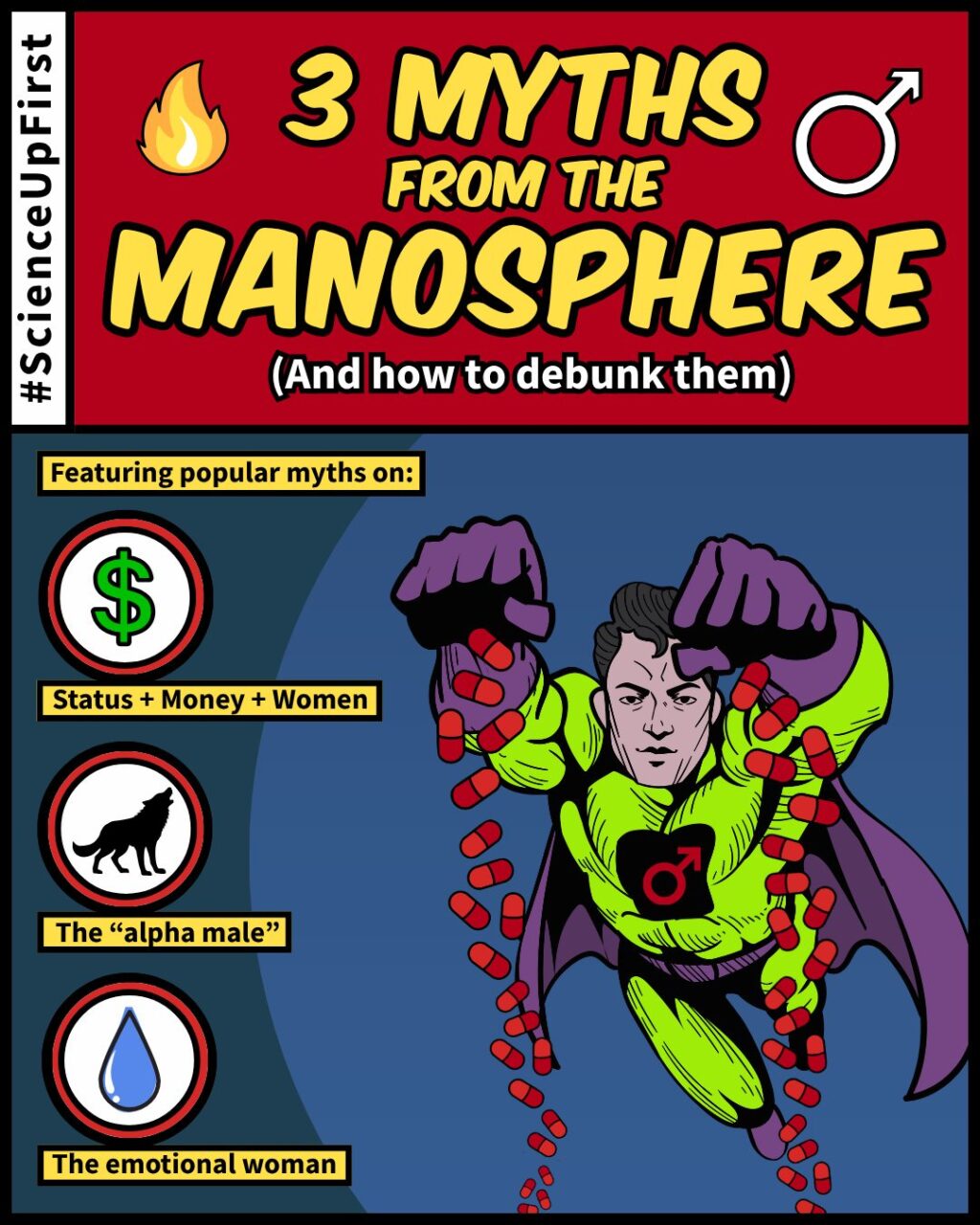
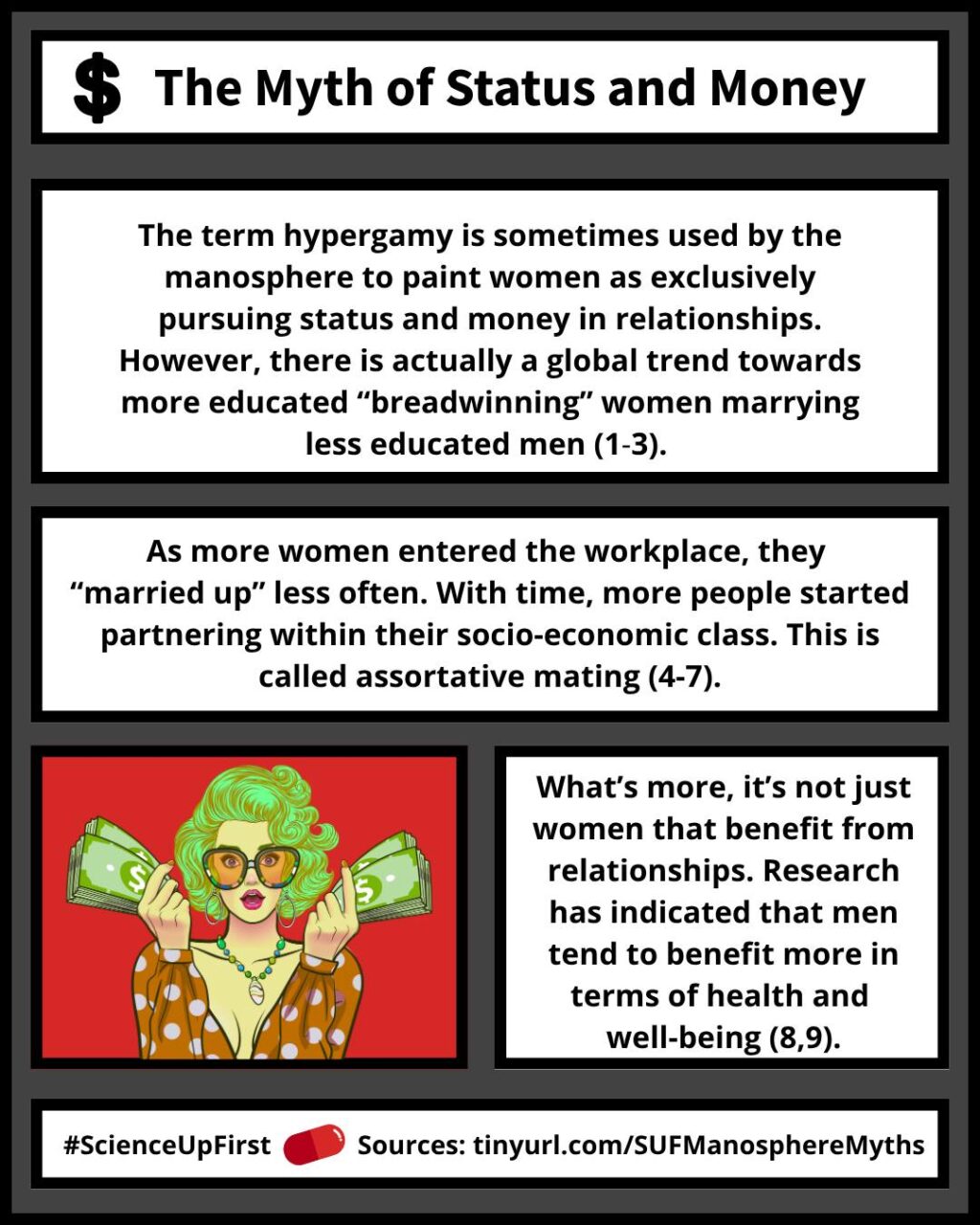
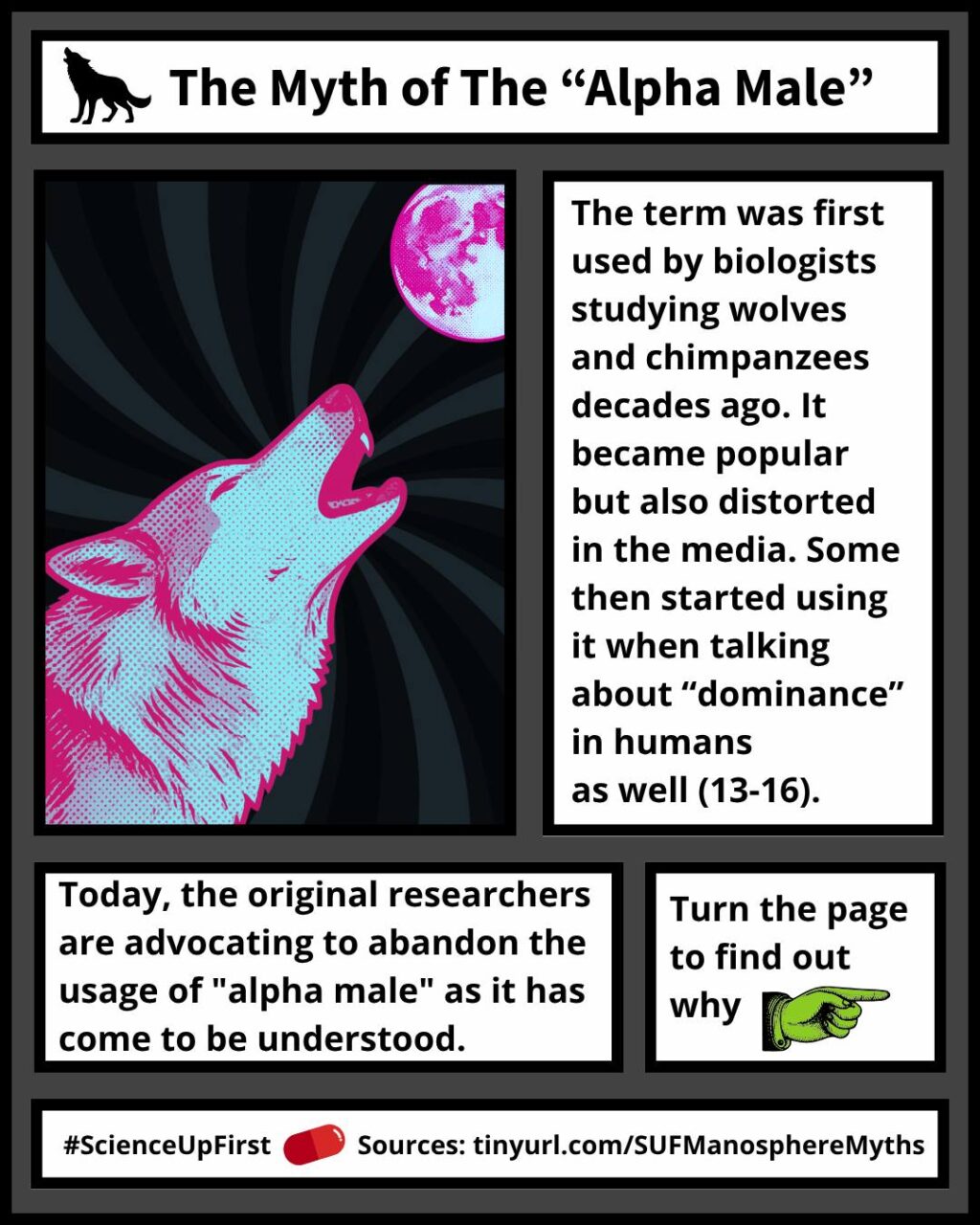
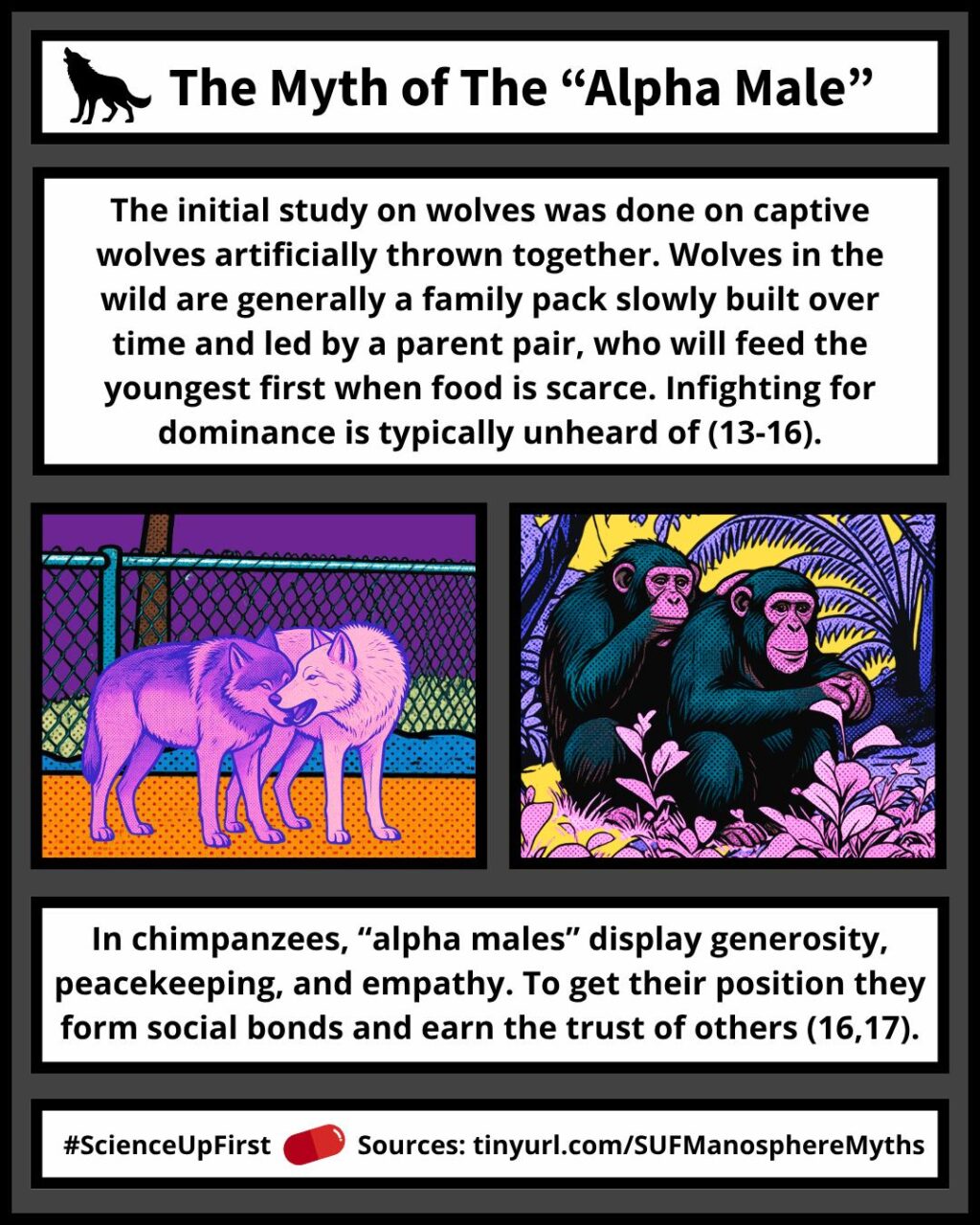
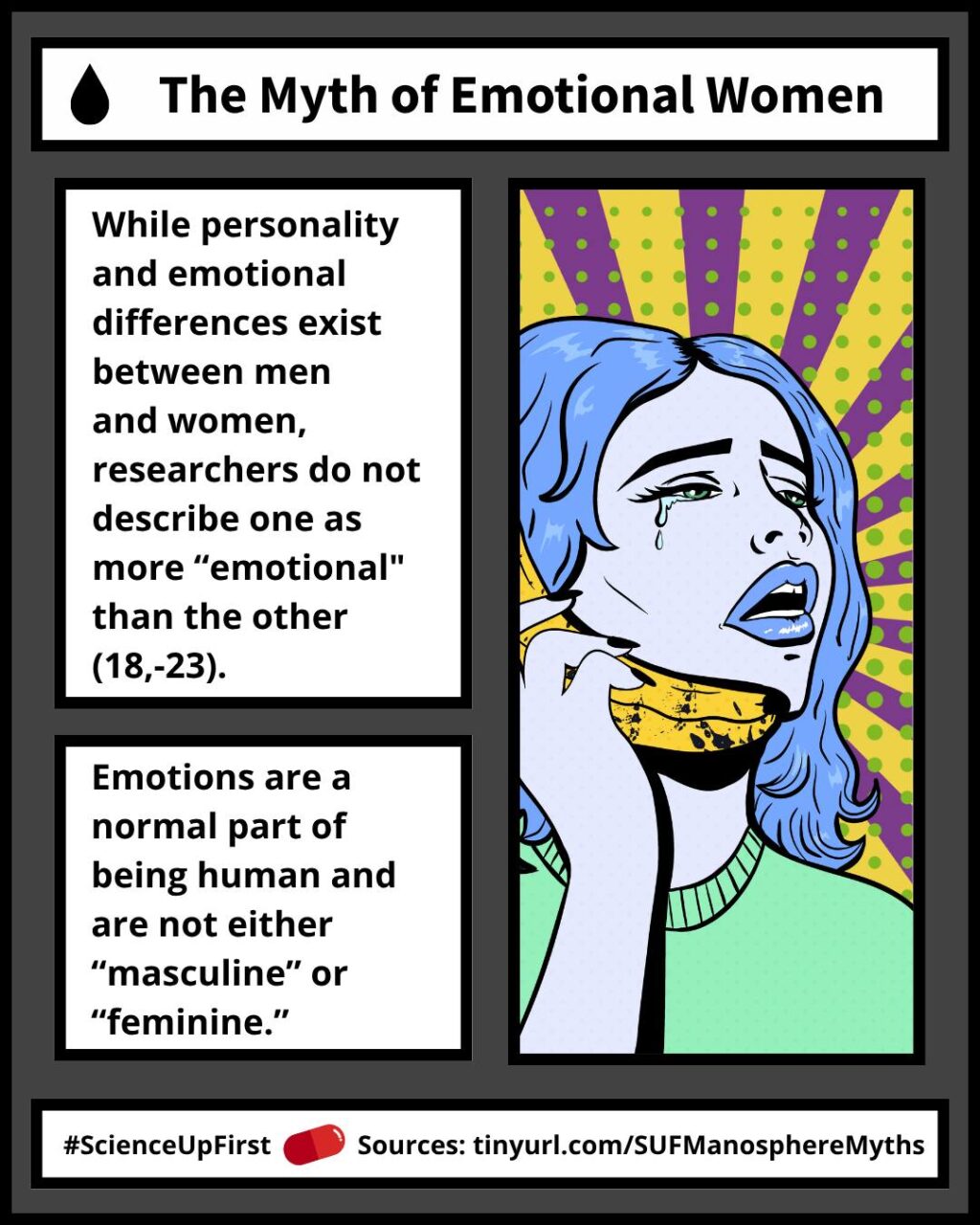
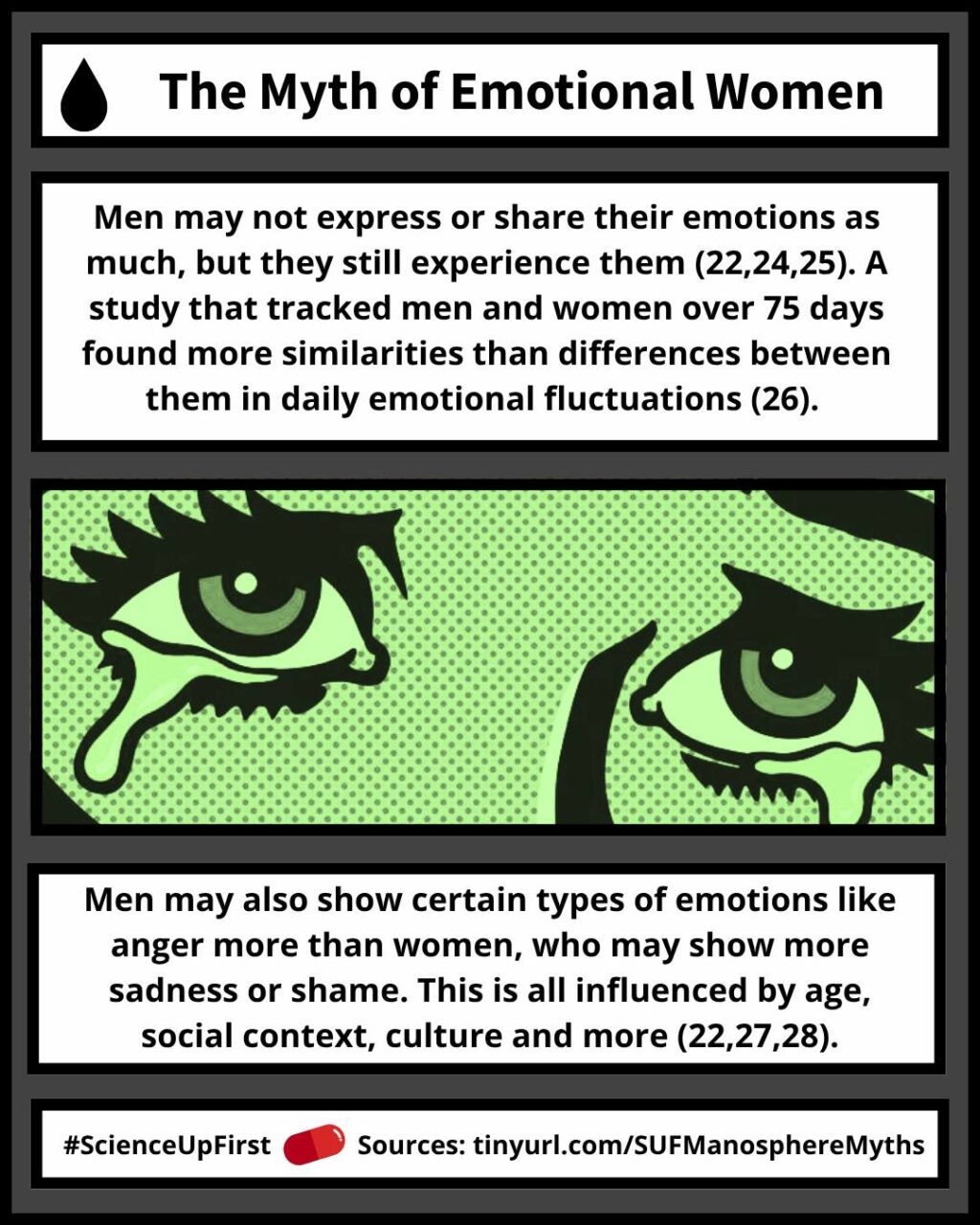
Heard of the “manosphere”? It’s often used to refer to a collection of online communities and influencers who claim to promote men’s health and well being. It unfortunately rarely stops there.
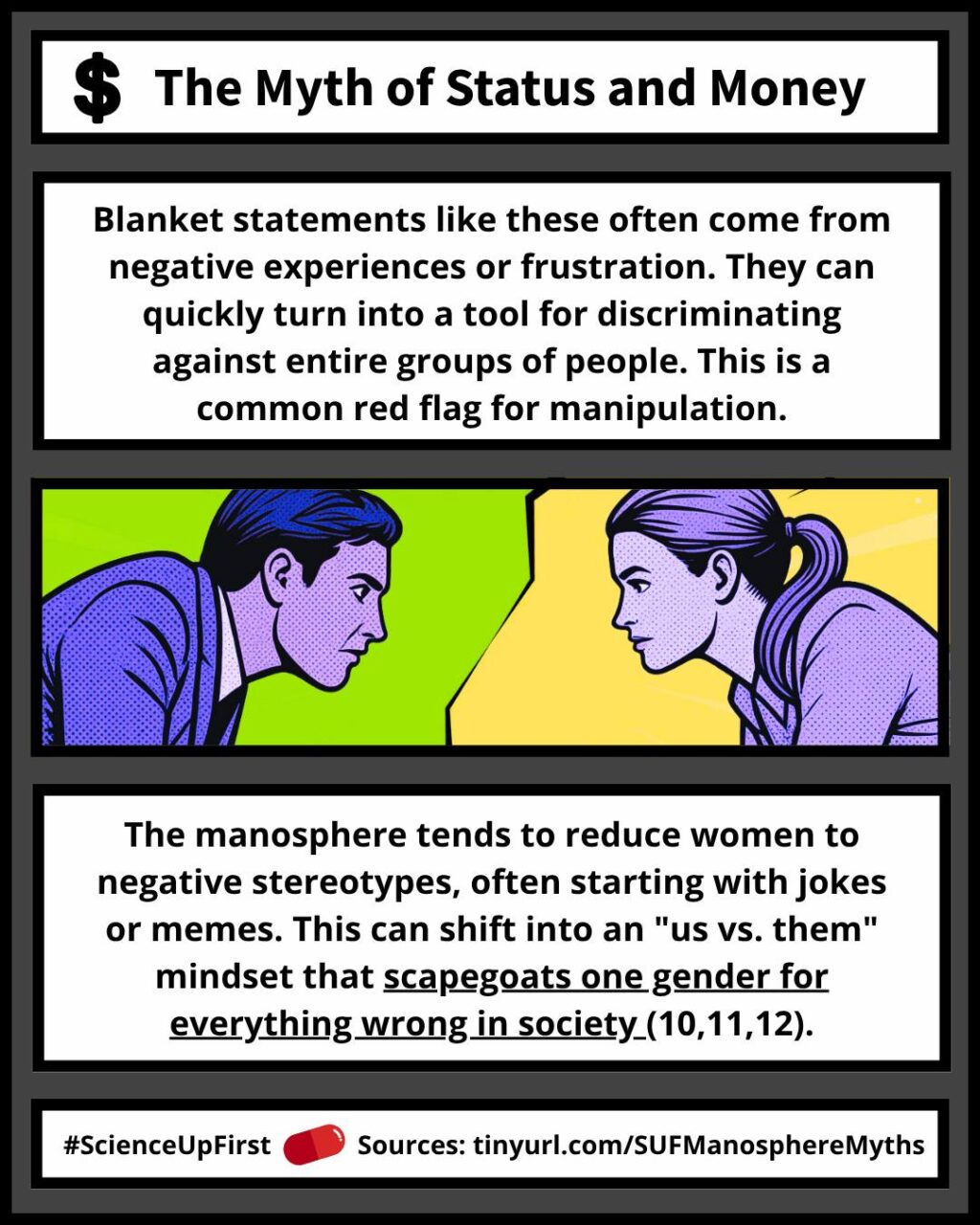
Manosphere influencers will often rely on narrow and exaggerated definitions of masculinity. They will use anecdotes and negative experiences to degrade women. To them, the world must be seen through rigid “men”/”women” differences.
What’s more, they spread harmful myths and create content meant to elicit a reaction out of you, whether you agree with them or not.
Don’t be swayed by these manipulation tactics and read how these myths fall apart under scrutiny.
As always, do not feed the trolls!
Sources- The End of Hypergamy: Global Trends and Implications | Population and Development Review | November 2016
- The Reversal of the Gender Gap in Education and Its Consequences for Family Life | Annual Review of Sociology | May 2018
- Eight Decades of Educational Assortative Mating: A Research Note | Demography | October 2024
- Modern women marrying men of the same or lower social class | IPPR | April 5, 2012
- Assortative mating and couple similarity: Patterns, mechanisms, and consequences | Social and Personality Psychology Compass | August 3, 2017
- Genetic and educational assortative mating among US adults | PNAS | June 3, 2014
- Trends in Education Assortative Marriage From 1940 to 2003 | California Center for Population Research | February 2005
- Romantic relationships are more important for men than for women | Behavioral and Brain Sciences | December 26, 2024
- Gender Differences in the Associations between Relationship Status, Social Support, and Wellbeing | Journal of Family Psychology | 2019
- UN Women sounds the alarm over online misogyny | United Nations | June 24, 2025
- How Online Spaces Are Fueling Misogyny – And What We Can Do About It | Welsh Women’s Aid | May 9, 2025
- Online misogyny: the “manosphere” | CMHR | September 12, 2023
- Is the Alpha Wolf Idea a Myth? | Scientific American | February 28, 2023
- Wolf News and Information | Dave Mech | Retrieved May 7, 2026
- 50 Years in Print, L. David Mech’s The Wolf Remains Relevant | International Wolf Center | Summer 2020
- Le mâle alpha des masculinistes, un mythe? Vrai | Détecteur de rumeurs | December 14, 2023
- Frans de Waal: The surprising science of alpha males | TED Talk | November 2017
- The Emergence of Sex Differences in Personality Traits in Early Adolescence: A Cross-Sectional, Cross-Cultural Study | Journal of Personality and Social Psychology | January 2015
- The Distance Between Mars and Venus: Measuring Global Sex Differences in Personality | PLoS ONE | January 4, 2012
- Gender differences in implicit and explicit personality traits | Personality and Individual Differences | November 2013
- Gender and emotions | Personality and Individual Differences | February 2003
- Gender Differences in Emotion Expression in Children: A Meta- Analytic Review | Psychological Bulletin | July 2013
- Gender Differences in Emotional Response: Inconsistency between Experience and Expressivity | PLOS One | June 30, 2016
- Gender and Emotion Expression: A Developmental Contextual Perspective | Emotion Review | January 2015
- Sex Differences in Emotion: Expression, Experience, and Physiology | Journal of Personality and Social Psychology | 1988
- Little evidence for sex or ovarian hormone influences on affective variability | Scientific Reports | October 22, 2021
- Sex Differences in Emotion | The Counseling Psychologist | 2002
- Gender differences in self-conscious emotional experience: A meta-analysis | Psychological Bulletin | September 2012
Share our original Bluesky Post!
Manosphere influencers spread harmful myths and create content meant to elicit a reaction out of you. Don’t be swayed by these manipulation tactics and read how these myths fall apart under scrutiny. As always, do not feed the trolls! 👇 scienceupfirst.com/misinformati… #ScienceUpFirst
— ScienceUpFirst (@scienceupfirst.bsky.social) May 19, 2026 at 2:42 PM
[image or embed]View our original Instagram Post!
-
The Straw Man Fallacy
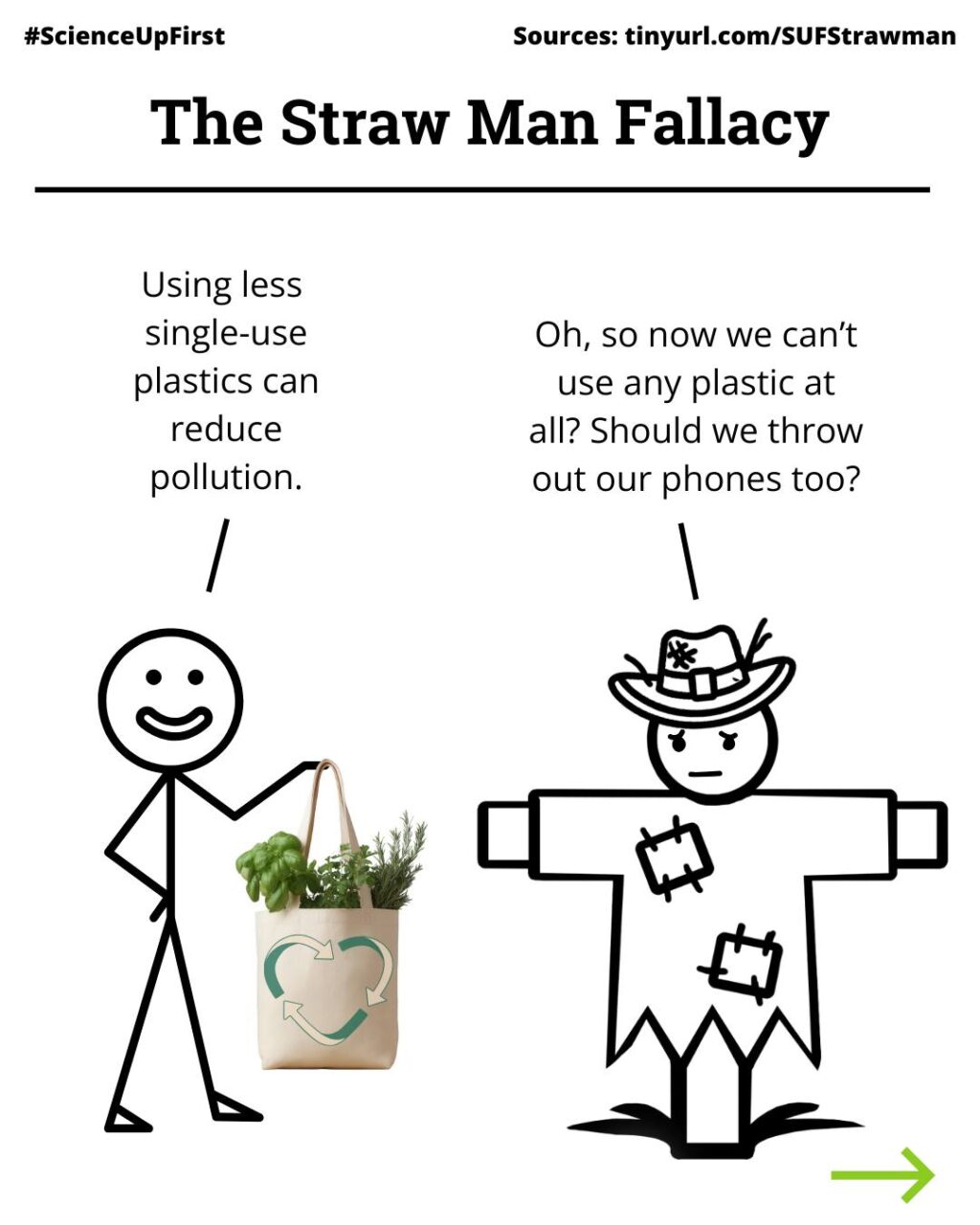
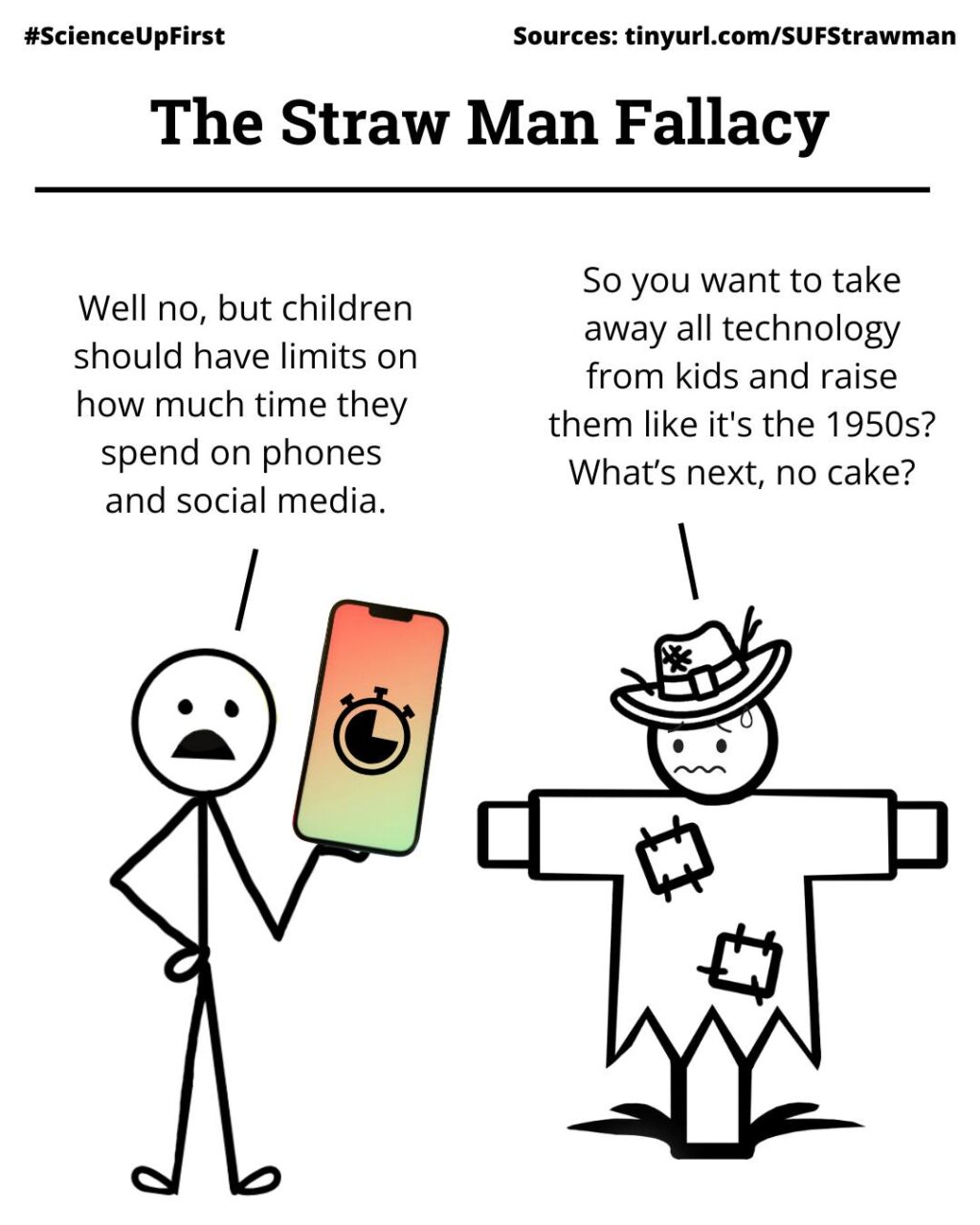
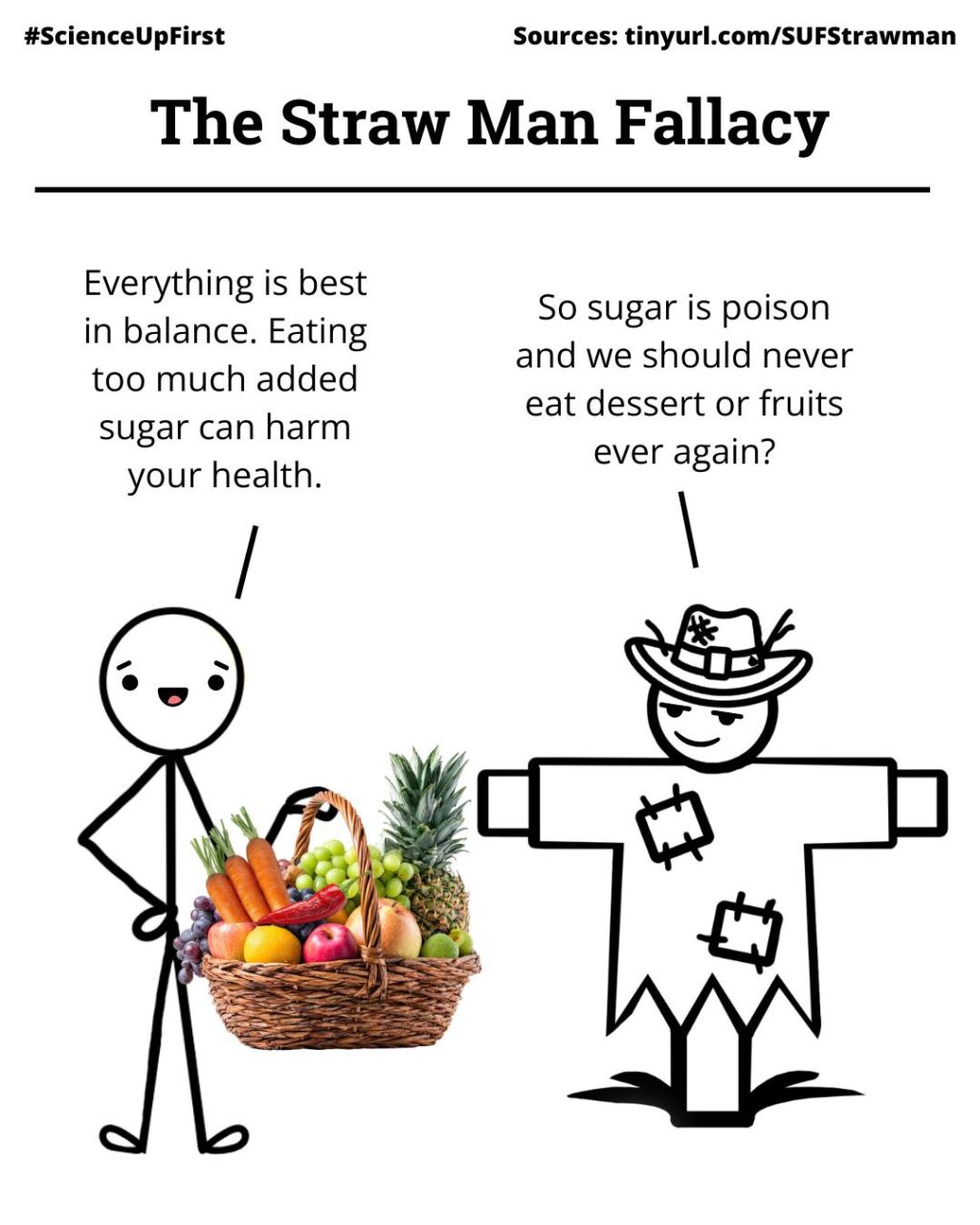
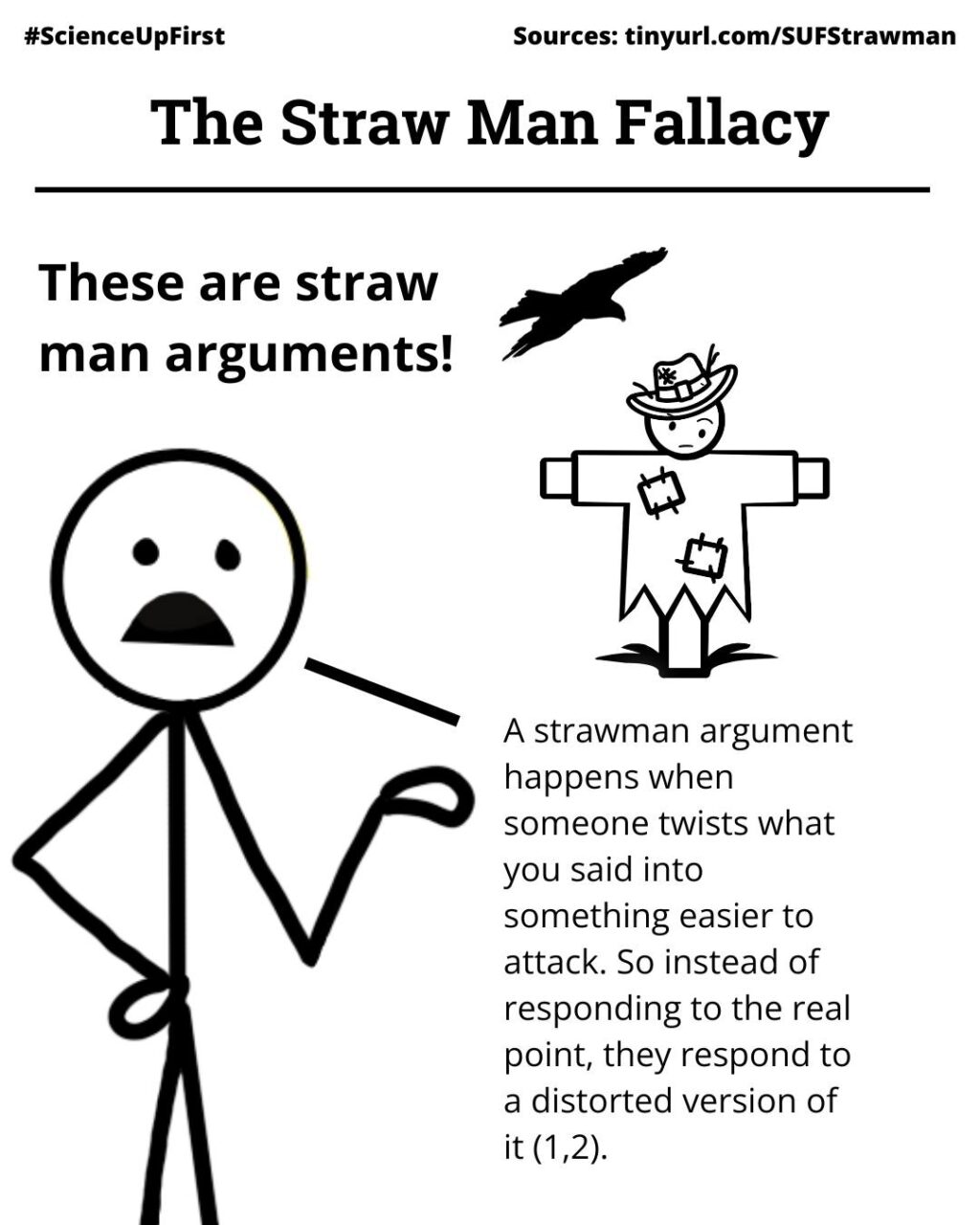
A strawman argument happens when someone twists what you said into something easier to attack. So instead of responding to the real point, they respond to a distorted version of it (1,2).
Example:
- Person A: “We should reduce plastic waste.”
- Person B: “So you think we should ban all plastic and make life impossible?”
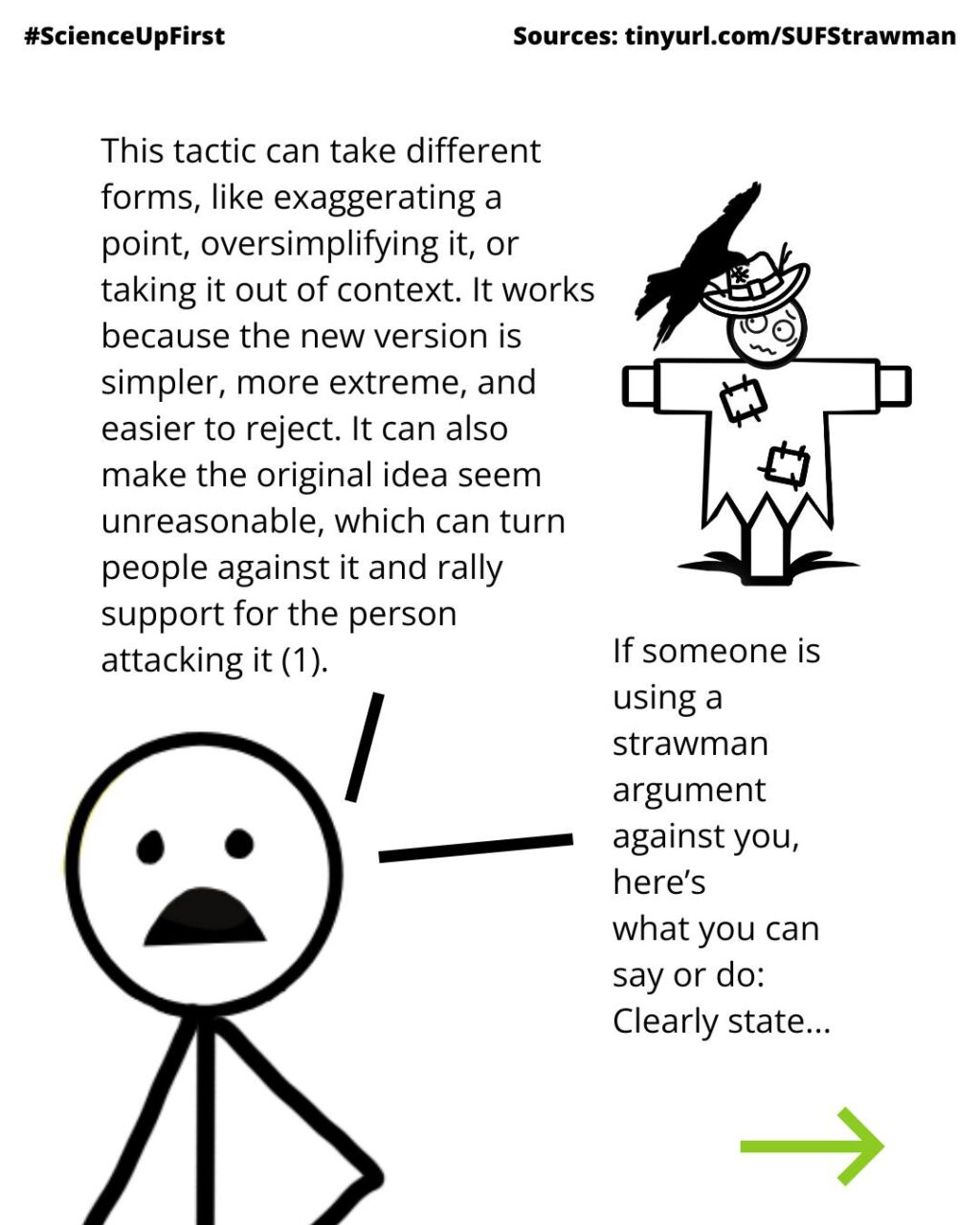
This tactic can take different forms, like exaggerating a point, oversimplifying it, or taking it out of context. It works because the new version is simpler, more extreme, and easier to reject. It can also make the original idea seem unreasonable, which can turn people against it and rally support for the person attacking it (1).
This is different from simply misunderstanding someone. We can all misinterpret things sometimes, especially in fast conversations. If you’re not sure you understood, it’s better to ask questions or ask the person to clarify their point before assuming (3).
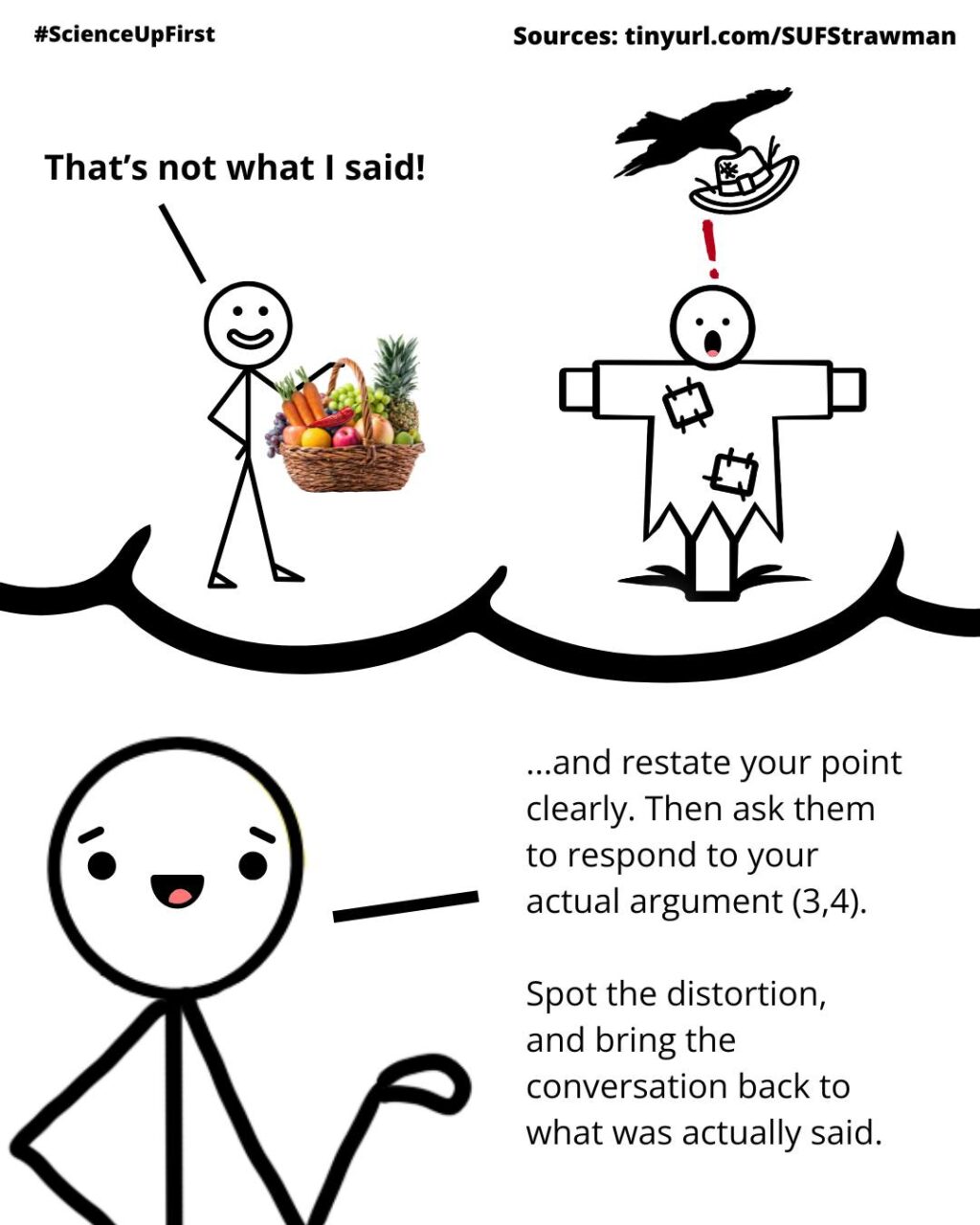
If someone is using a strawman argument against you, here’s what you can say or do:
Clearly state “That’s not what I said” and restate your point clearly. Then ask them to respond to your actual argument (3,4).Spot the distortion, and bring the conversation back to what was actually said.
Sources- Full article: The persuasiveness of the straw man rhetorical technique | Social Influence – Taylor & Francis Online | September 2008
- Strawman Fallacy | Logically Fallacious
- Straw Man Fallacy | Excelsior Online Writing Lab
- Strawman Arguments: What They Are and How to Counter Them | Effectiviology
Share our original Bluesky Post!
A strawman argument happens when someone twists what you said into something easier to attack. There are effective ways to respond! 👇 scienceupfirst.com/misinformati… #ScienceUpFirst
— ScienceUpFirst (@scienceupfirst.bsky.social) May 14, 2026 at 5:58 PM
[image or embed]View our original Instagram Post!
-
Misinformer Tactic: Moving the Goalposts
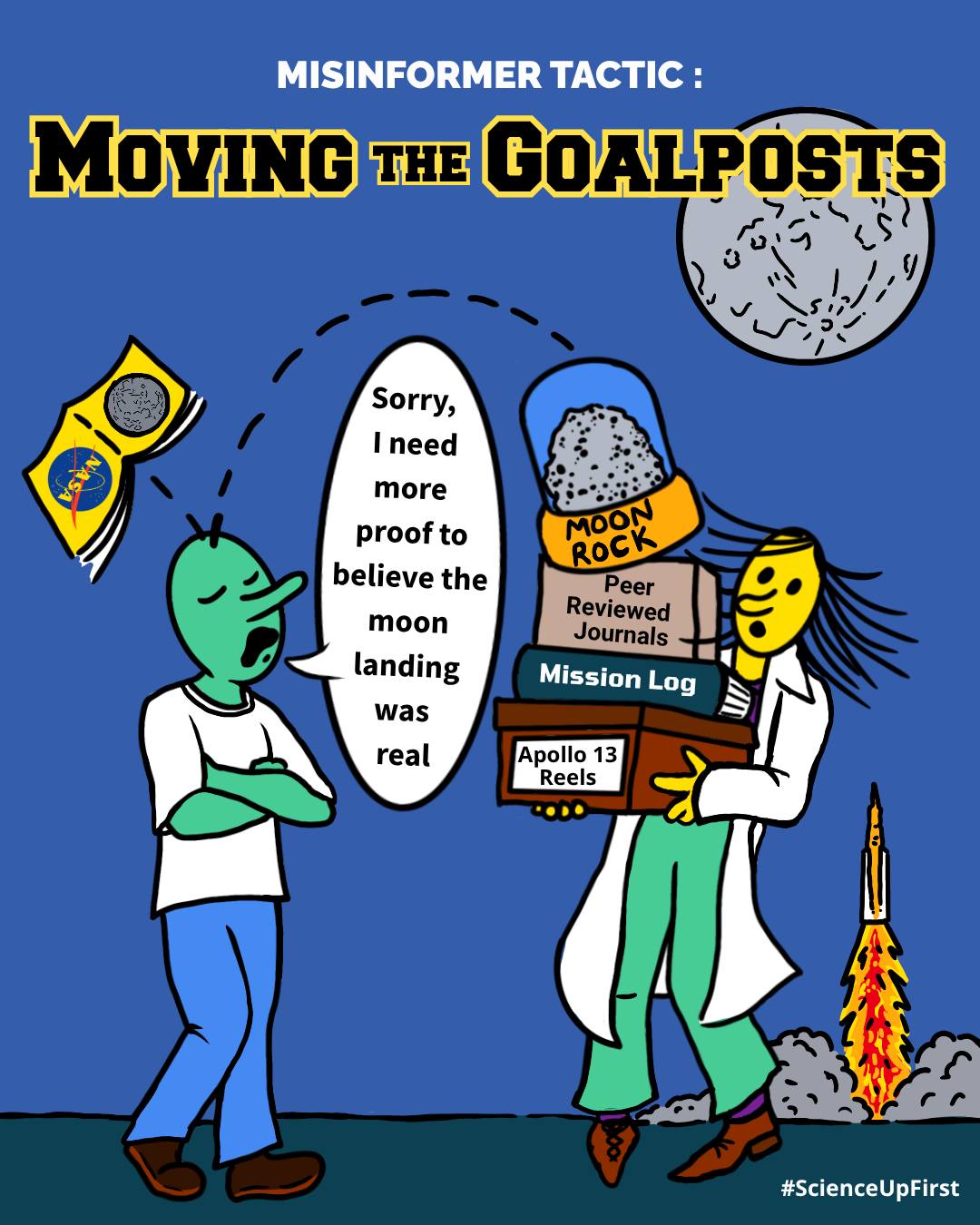
Ever seen a conversation like this?
Person A: “Prove to me the moon landing isn’t fake.”
Person B: “Here are photos from the mission.”
Person A: “Those are photoshopped.”
Person B: “Okay, here’s video footage.”
Person A: “It was filmed in a studio.”
Person B: “We brought back rocks from the moon.”
Person A: “Those could be fake.”
Person B: “You can observe the landing sites from Earth.”
Person A: “I still don’t believe it.”And it keeps going… No matter what proof you bring, it’s never enough.
This is called moving the goalposts (1).
It happens when someone keeps changing what “counts” as proof. No matter how strong the evidence is, they ask for something new instead of engaging with what’s already there (2,3,4).
In real discussions, this can look like (3,5):
- Dismissing evidence without explaining why
- Asking for more and more proof
- Ignoring what was already shared
If you notice this happening, you can gently point it out: “Hey, it seems like the goal keeps changing. What kind of evidence would actually convince you?” (4).
That said, not every conversation will go somewhere. If someone isn’t open to changing their view, it’s okay to step away and save your energy (6,7).
Sources- Move the Goalposts | Cambridge Dictionary
- Moving the Goalposts | Logically Fallacious
- Understanding conspiracy theory tactics: moving the goalposts | The Skeptic | December 2021
- Moving the Goalposts | Bad Arguments – Wiley Online Library | May 2018
- The Fallacy of ‘Moving the Goalposts’, Explained | Snopes.com | February 2023
- Tips on countering conspiracy theories and misinformation | SciBeh | 2020
- How to talk to conspiracy theorists—and still be kind | MIT Technology Review | July 2020
Share our original Bluesky Post!
Ever notice how some debates never move forward? No matter the evidence, the standard keeps changing. That’s called moving the goalposts, and it’s a common misinformation tactic. Read more about it here 👇 scienceupfirst.com/misinformati… #ScienceUpFirst
— ScienceUpFirst (@scienceupfirst.bsky.social) May 12, 2026 at 12:07 PM
[image or embed]View our original Instagram Post!
-
Reranking partisan animosity in algorithmic social media feeds alters affective polarization
Experimental research using novel large language model-based methods demonstrates how, when it comes to the feed-ranking algorithms of social media platforms, reranking the visibility of hostile political content can reduce political polarization.
-
Appeal to Authority Bias
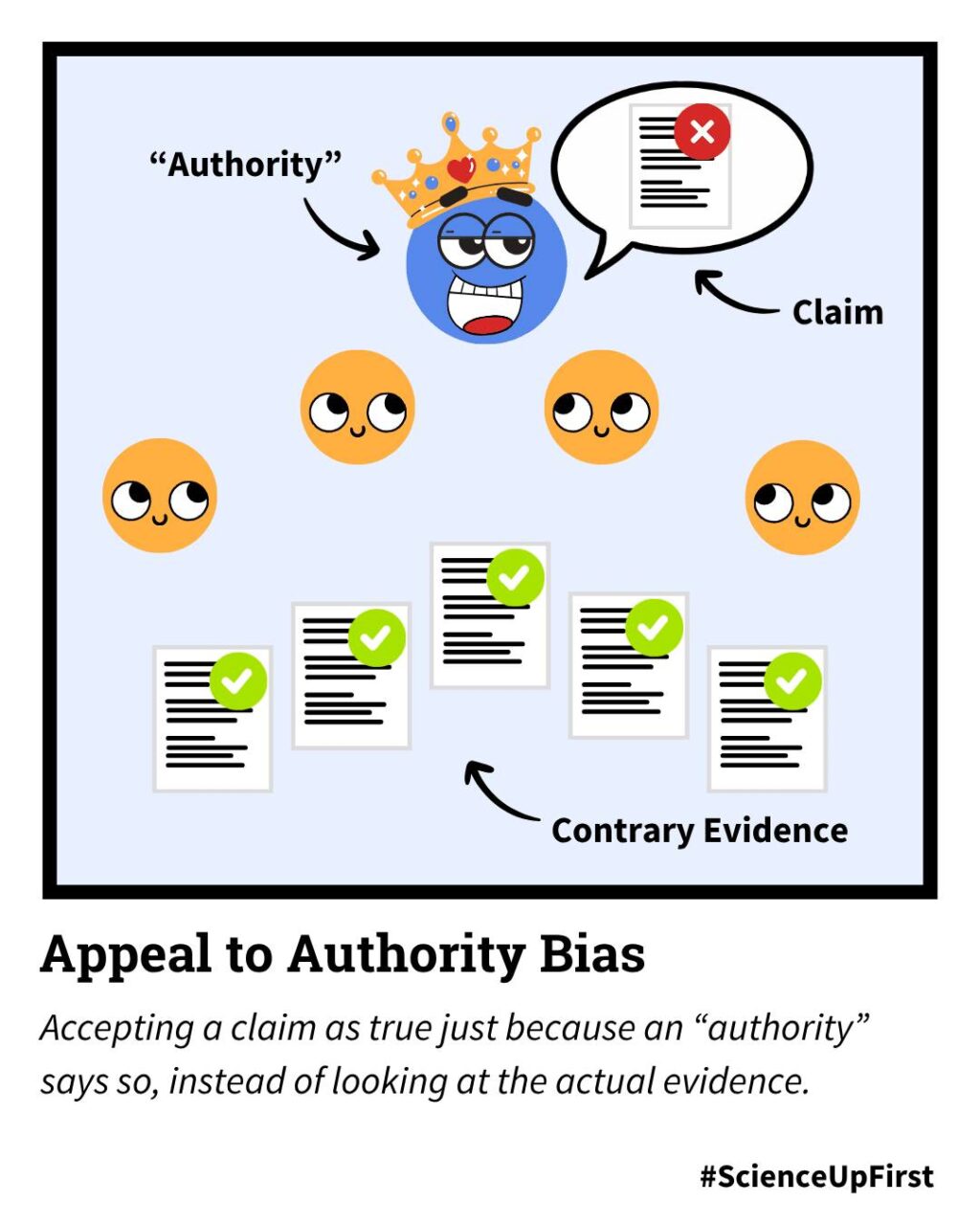
Have you ever seen someone in a lab coat online making bold health claims?🧑⚕️
Whether that person is a doctor or not, the coat makes them appear like an authority on the subject. That’s a classic example of the appeal to authority fallacy (a.k.a. an error in reasoning (1)).
It happens when we accept a claim as true just because an “authority” says so, instead of looking at the actual evidence. That authority could be a celebrity, a “doctor,” or someone who simply looks credible (2,3).
The problem?
Not all authorities are experts. And not all experts speak within their domain of expertise. Someone can be an epidemiologist studying diseases in seal colonies, but that doesn’t make them an expert on COVID-19 in humans. And even real experts can be wrong. What makes a claim reliable isn’t just who says it, but the evidence behind it (4,5,6).This tactic works because we naturally trust people who seem knowledgeable or familiar. On social media, that might mean wearing a lab coat, using technical language, or saying “studies show…” without proof.
And it doesn’t just affect people. One recent study found that AI systems were more likely to accept false health info when it was written like a doctor’s note (7).
That doesn’t mean we should ignore experts. In fact, relying on qualified experts is often helpful (2,4).
But here’s the key (4):
- Is this person actually an expert in this topic?
- Are they showing evidence, or just asking you to trust them?
If you catch this happening, ask: what evidence supports this claim, beyond who said it (8)?
Remember, “they said so” isn’t proof. It’s just a claim (2).
Sources- Fallacies | Internet Encyclopedia of Philosophy
- Appeal to Authority Fallacy | Definition & Examples | Scribbr | June 2023
- Appeals to Authority | Open Library – Studies in Critical Thinking
- Logical Fallacies: Appeal to Authority | ThoughtCo. | March 2021
- Appeal to Authority | Logically Fallacious
- Your logical fallacy is appeal to authority | Your Logical Fallacy Is
- Mapping the susceptibility of large language models to medical misinformation across clinical notes and social media: a cross-sectional benchmarking analysis | The Lancet Digital Health | January 2026
- Appeal to Authority Fallacy: How to Avoid It | Think, But How? | July 2021
Share our original Bluesky Post!
Sometimes we accept a claim as true just because an “authority” (or someone who simply looks credible) says so, instead of looking at the actual evidence. Remember: “they said so” isn’t proof. It’s just a claim. 👇 scienceupfirst.com/misinformati… #ScienceUpFirst
— ScienceUpFirst (@scienceupfirst.bsky.social) April 15, 2026 at 1:47 PM
[image or embed]View our original Instagram Post!
-
Social media use and well-being across adolescent development
Cohort study of one hundred thousand Australian adolescents finds that a moderate amount of social media use correlates with higher level of well-being compared with no and very high use levels. Findings, however, are based on self-reported data, making the study observational and lacking in sufficient rigour to draw strong conclusions.
-
The Quality of Evidence of and Engagement with Video Medical Claims
Analysis on health-related YouTube videos created by health practitioners shows that most medical claims were supported by “very low or no evidence,” and only 20% were supported by “high-quality” evidence. This research shows the ongoing need for online healthcare professionals to substantiate all claims with strong and accurate evidence and for audiences to maintain a critical approach when engaging social media content.
-
About 4 in 10 teens support cellphone bans in classrooms; fewer back all-day restrictions
PEW survey research finds about 40% of American teens support banning cellphone use in classrooms but nearly 75% oppose banning them for the entire day.