
A cluster-randomized trial with nearly 9,000 high school students from 399 different schools in France found that providing general vaccination knowledge, either through pedagogical activities or chatbot engagement, significantly improved vaccination attitudes. This finding suggest, contrary to other evidence, that addressing the knowledge deficit can positively influence personal perspectives.
Category: Misinformation 101
-
Dialogues with large language models reduce conspiracy beliefs even when the AI is perceived as human
An experiment with nearly 1,000 participants finds that conversations with artificial intelligence large language models (LLMs) can reduce participants’ confidence in conspiracies and other inaccurate beliefs. Because the finding holds whether the participant knows the message is being by delivered by a human or an LLM, this indicates that what is most important in persuasive discourse is compelling messages.
-
KFF Health Information and Trust Tracking Poll: Health Information and Advice on Social Media
Survey research on American public finds that over half of American adults, including higher numbers of young adults, and Black and Hispanic adults report occasionally using social media for health information and advice. Health information – notably on the topics of weight loss, nutrition, and diet – also reaches audiences who report never using social media for health information. Approximately 15% (or 1 in 6) report social media influencers are a regular source for health information and advice. People who reported regularly using social media for health information and advice, approximately one third rely on the health content from a particular influencer.
-
Big Pharma is not hiding a secret cancer cure
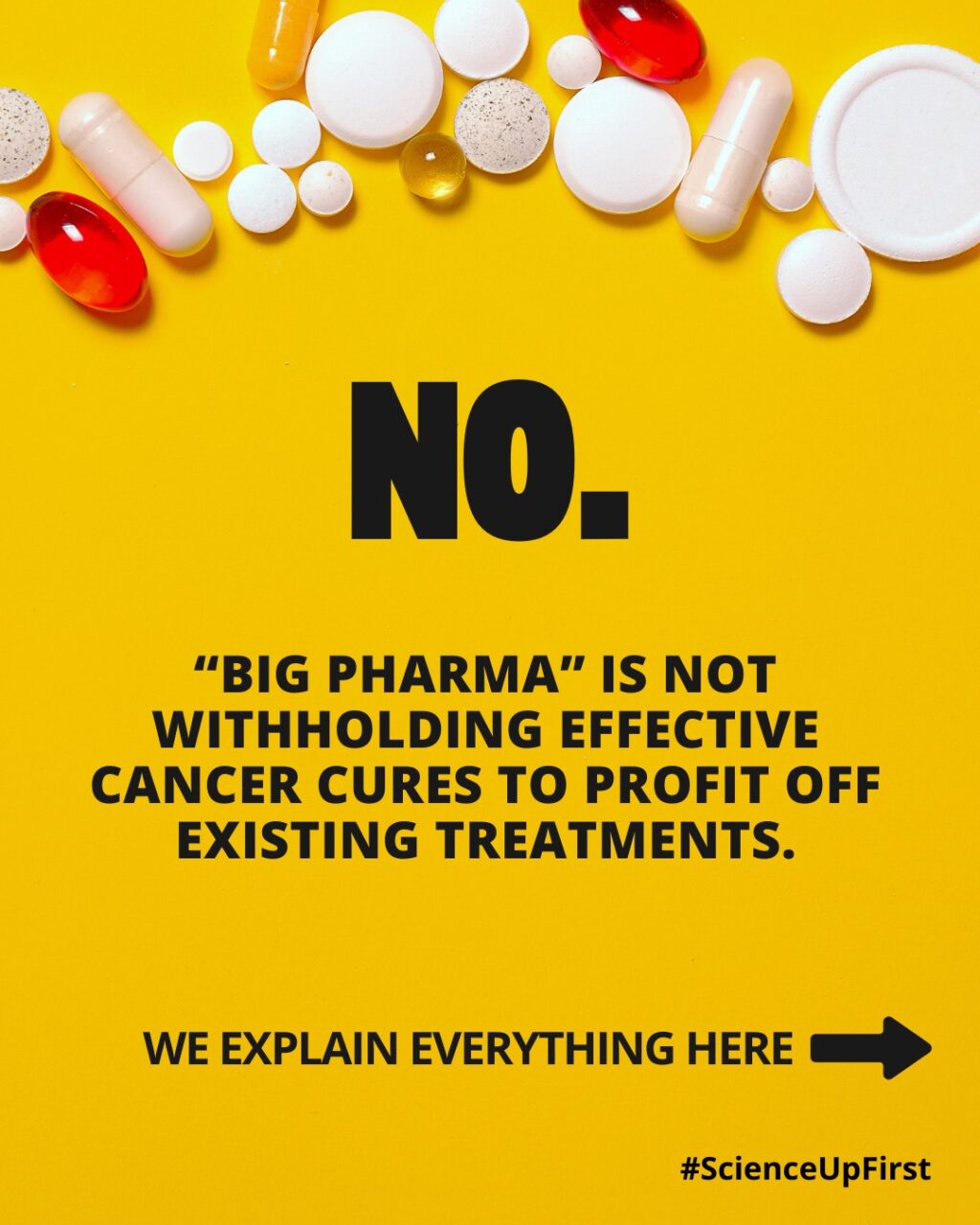
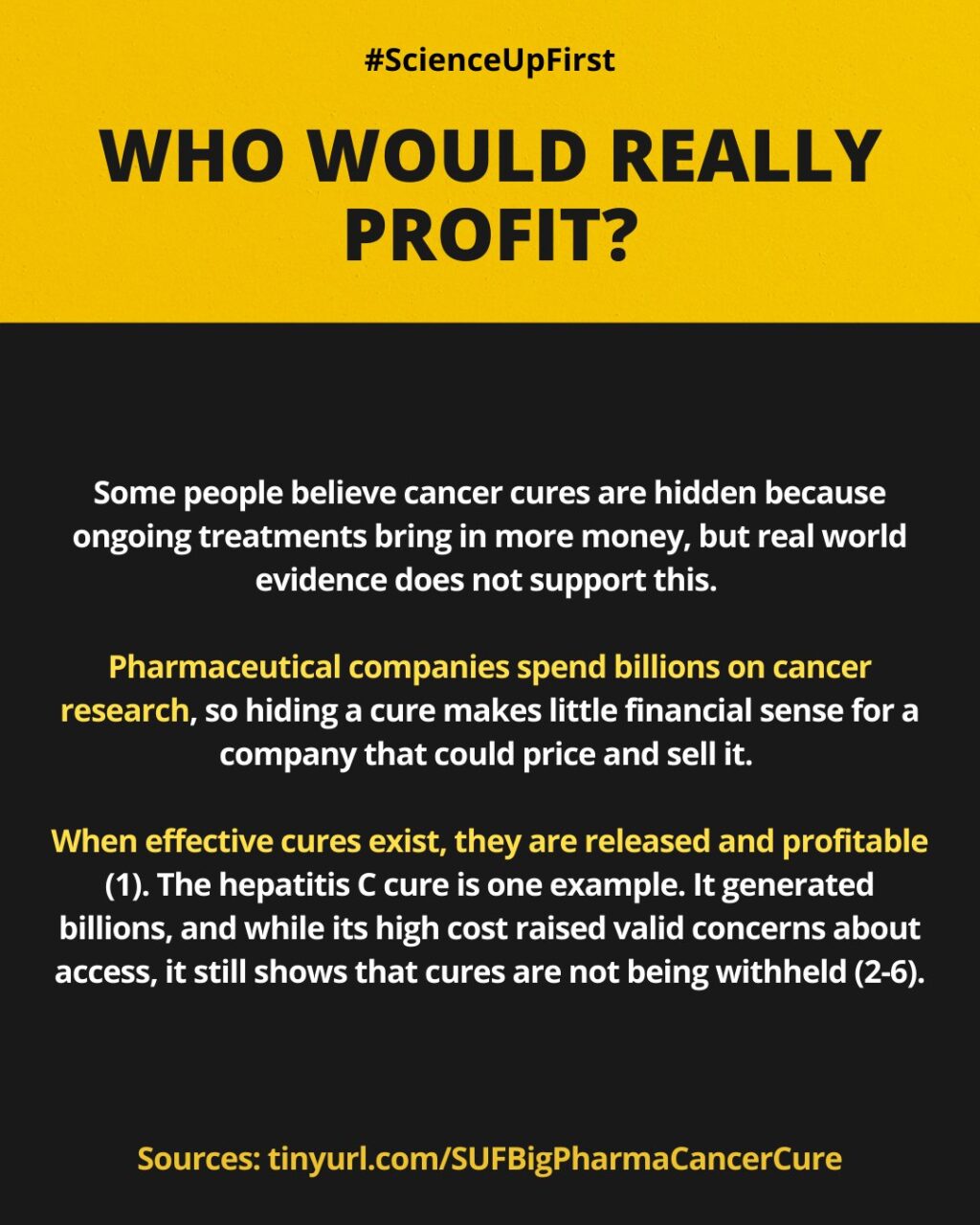
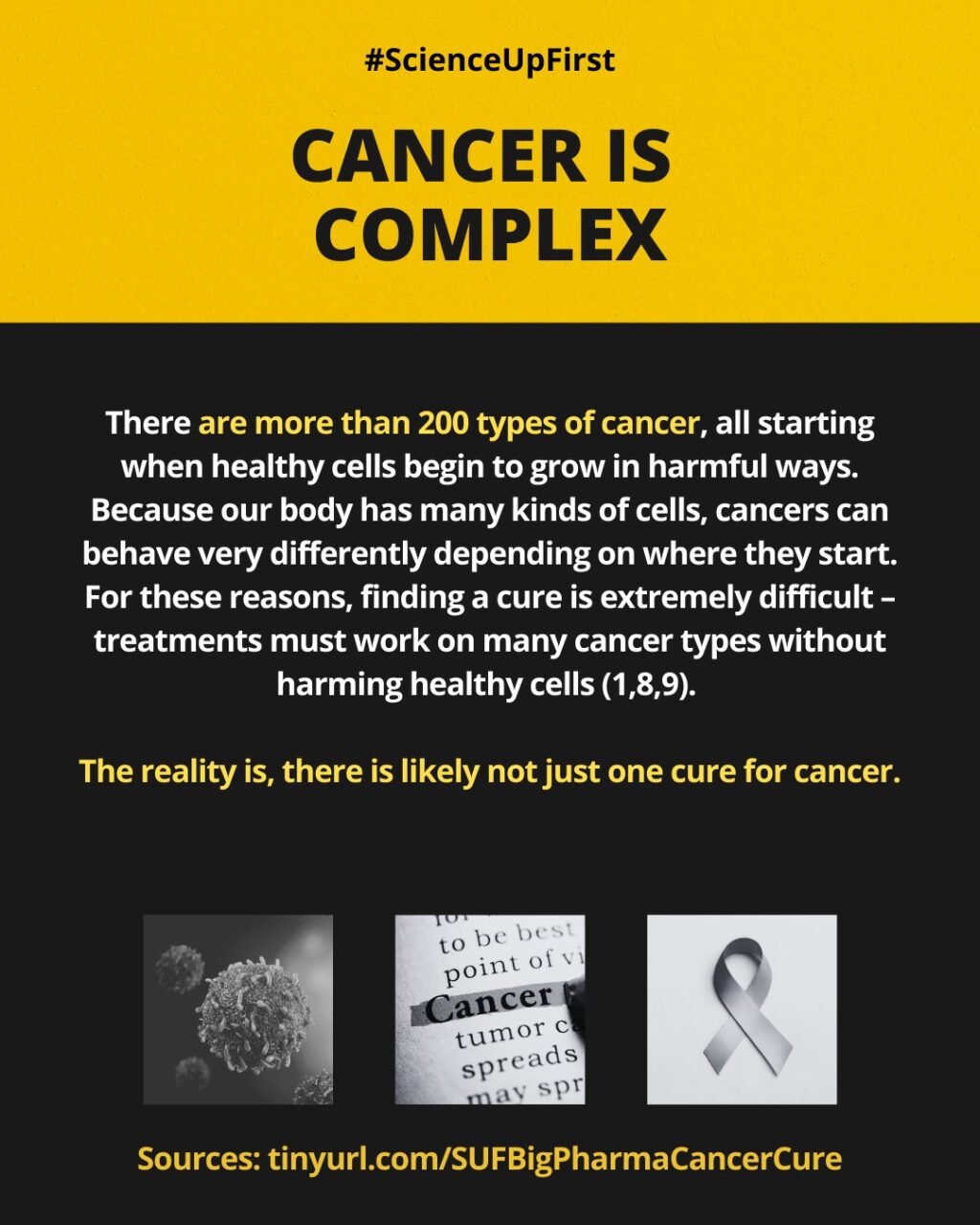
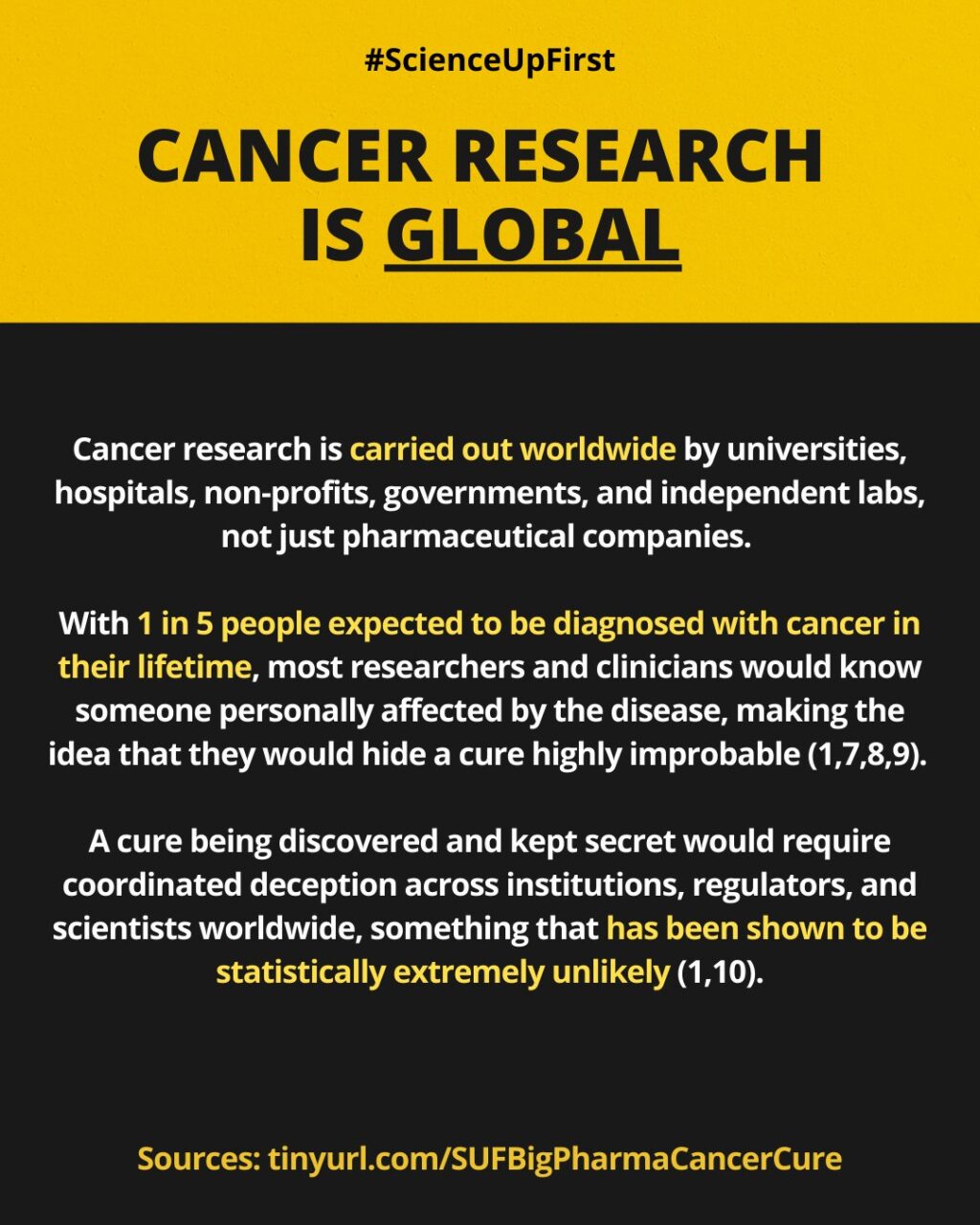

There’s no secret cancer cure being hidden by “Big Pharma.”
Cancer research is global, complex, and driven by people who dedicate their lives to helping patients.
Sources- Busting the conspiracy – is there a hidden cure for cancer? | The Children & Young People’s Cancer Association | November 2023
- Hepatitis C: The Evolution of Treatments | Healthline | April 2019
- Hepatitis C Cure, Sofosbuvir, Turns 5 Years Old: The Vast Majority of People Still Nave Not Been Treated | Hep Coalition | December 2018.
- Maker of $1,000 hepatitis C pill was focused on profits, not patients, report finds | PBS News | December 2015
- A guide to the economics of HCV cure in 2017 | Infectious Disease Clinics of North America on PubMed Central | June 2019
- Non-profit’s $300 hepatitis C cure as effective as $84,000 alternative | The Guardian | April 2018
- Global cancer burden growing, amidst mounting need for services | World Health Organization | February 2024
- Cancer treatment myths: Any truth to these common beliefs? | Mayo Clinic
- Could Somebody Be Hiding The Cure For Cancer? | Worldwide Cancer Research | May 2025
- On the Viability of Conspiratorial Beliefs | PLOS One | January 2016
Share our original Bluesky Post!
There’s no secret cancer cure being hidden by “Big Pharma.” Cancer research is global, complex, and driven by people who dedicate their lives to helping patients. Learn why this myth doesn’t hold up here 👉 scienceupfirst.com/misinformati… #ScienceUpFirst
— ScienceUpFirst (@scienceupfirst.bsky.social) January 15, 2026 at 12:20 PM
[image or embed]View our original Instagram Post!
-
Victims of Conspiracies? An Examination of the Relationship Between Conspiracy Beliefs and Dispositional Individual Victimhood
People who perceive themselves to be victims of unfair treatment are linked with greater beliefs in conspiratorial thinking. This international research covering a large number of respondents from 15 different countries found that higher markers of victim justice sensitivity (VJS) demonstrates an increased relationship to belief in conspiracy theories, notably vaccine-related conspiracies.
-
Is AI-generated information reliable?
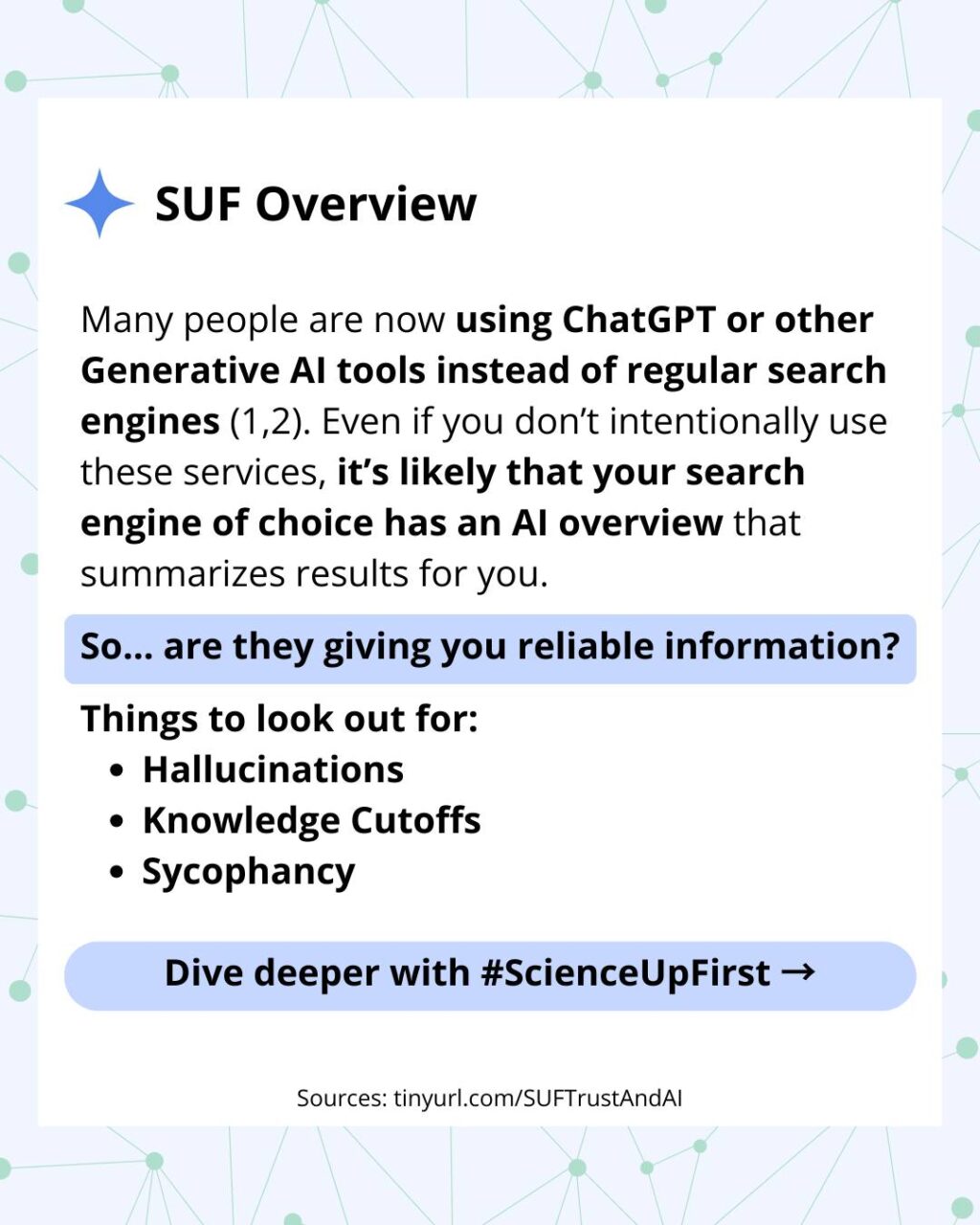
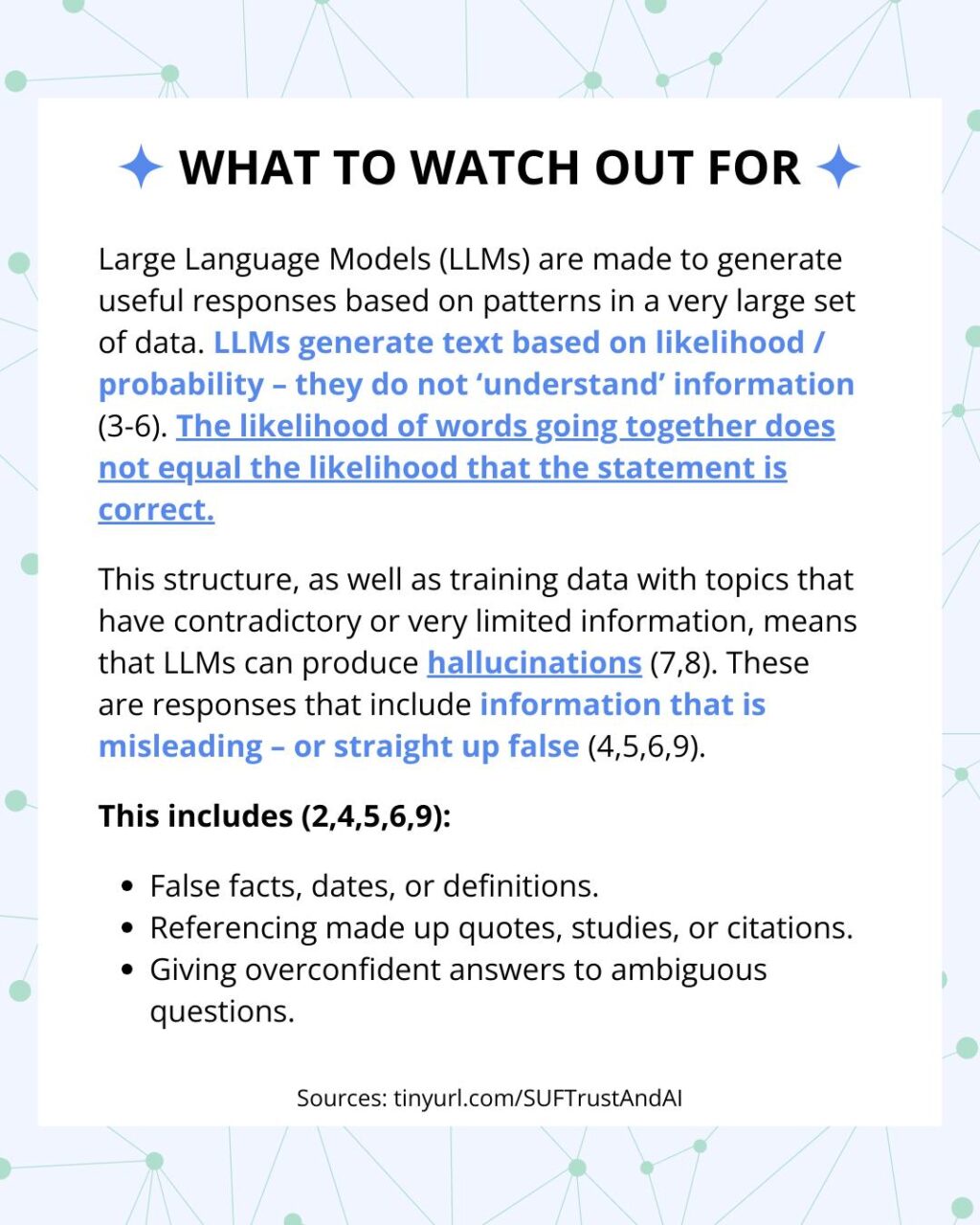
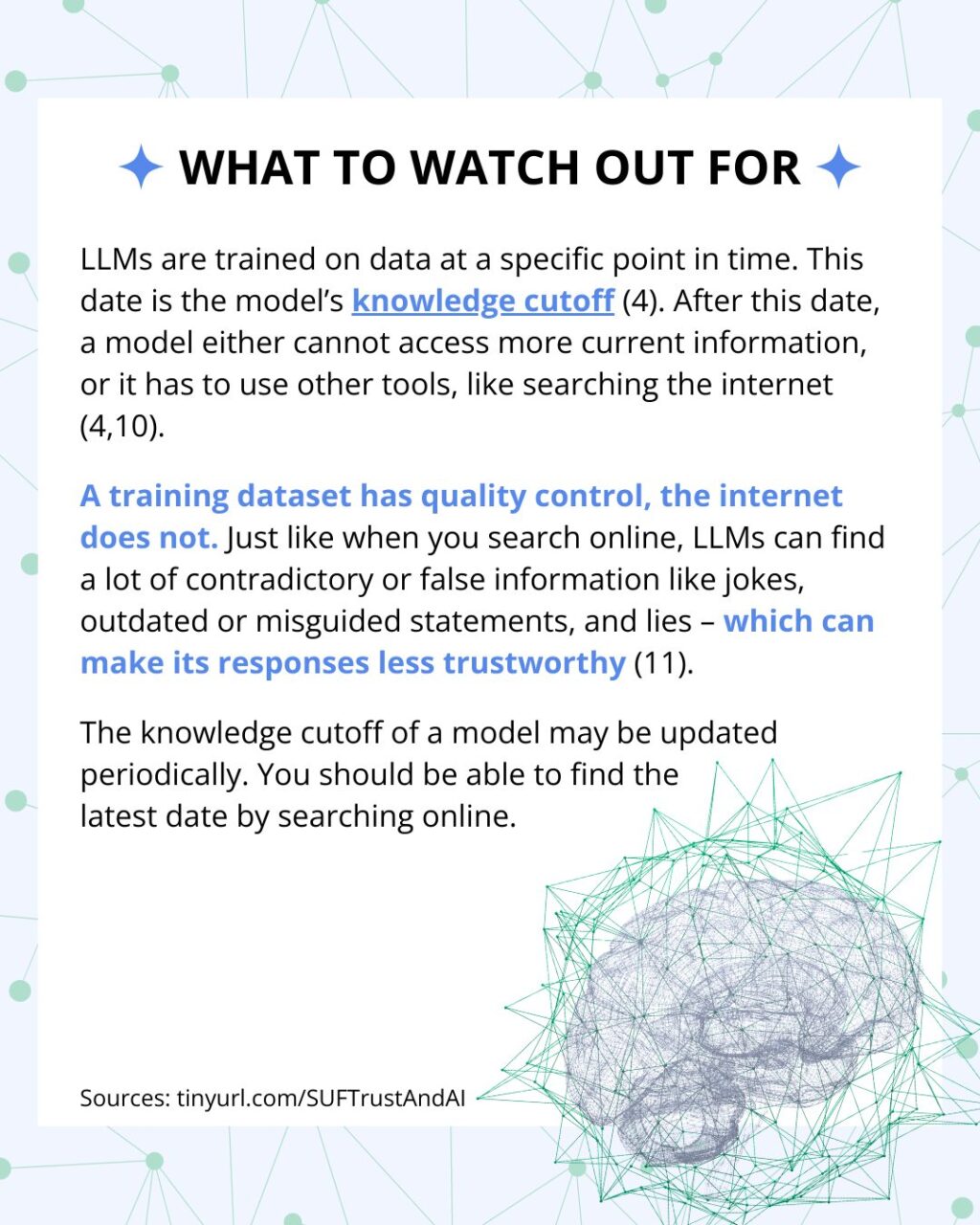
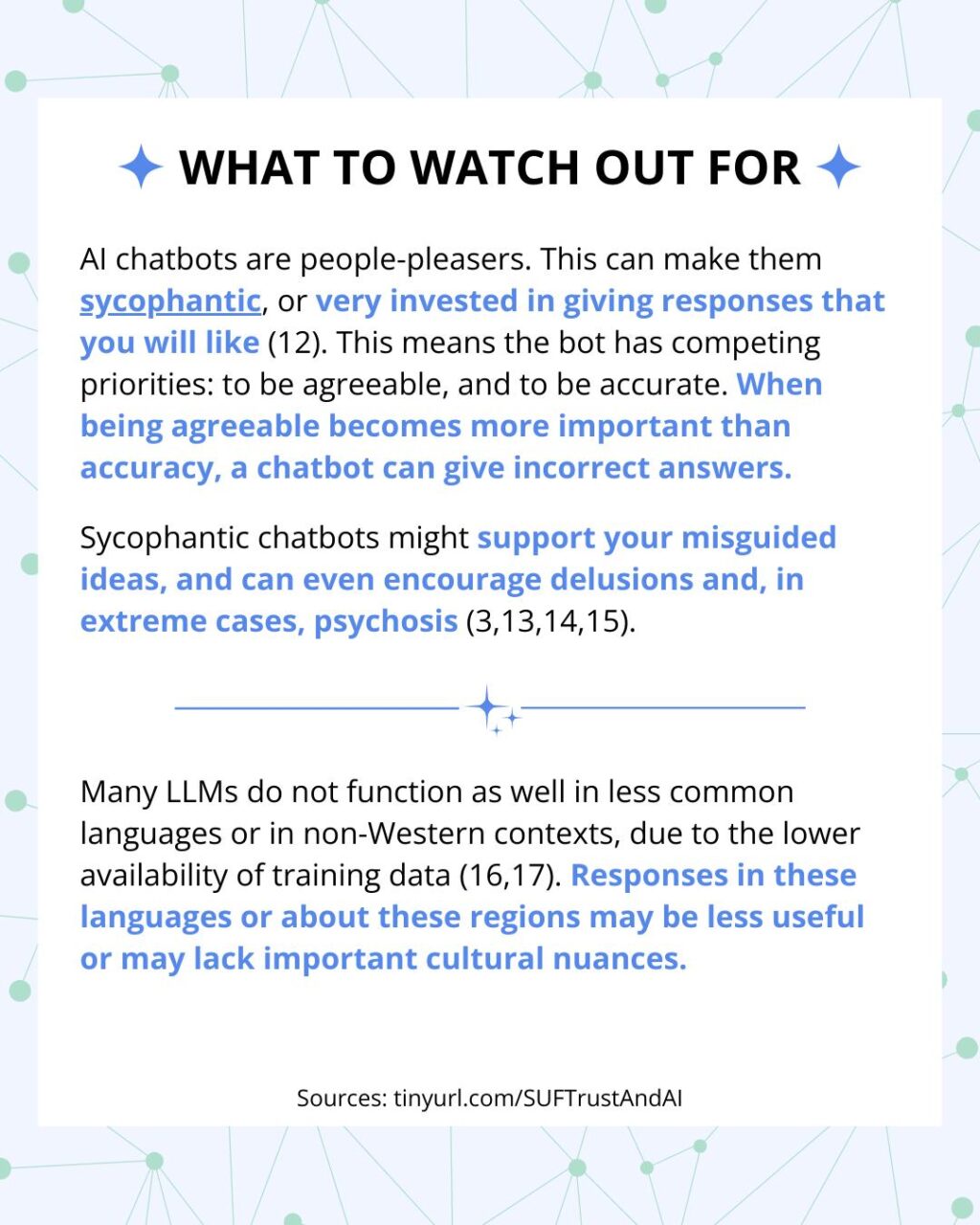
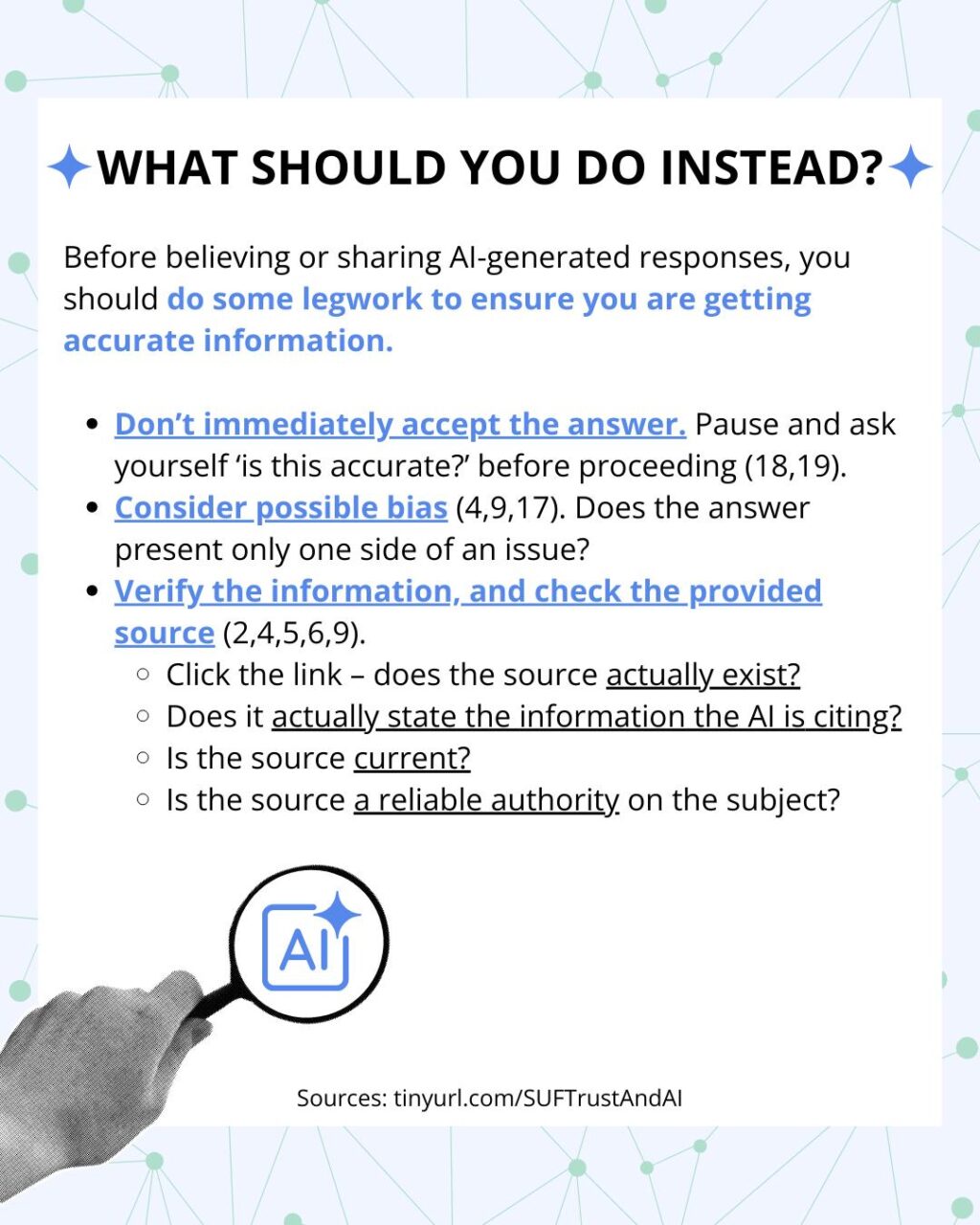
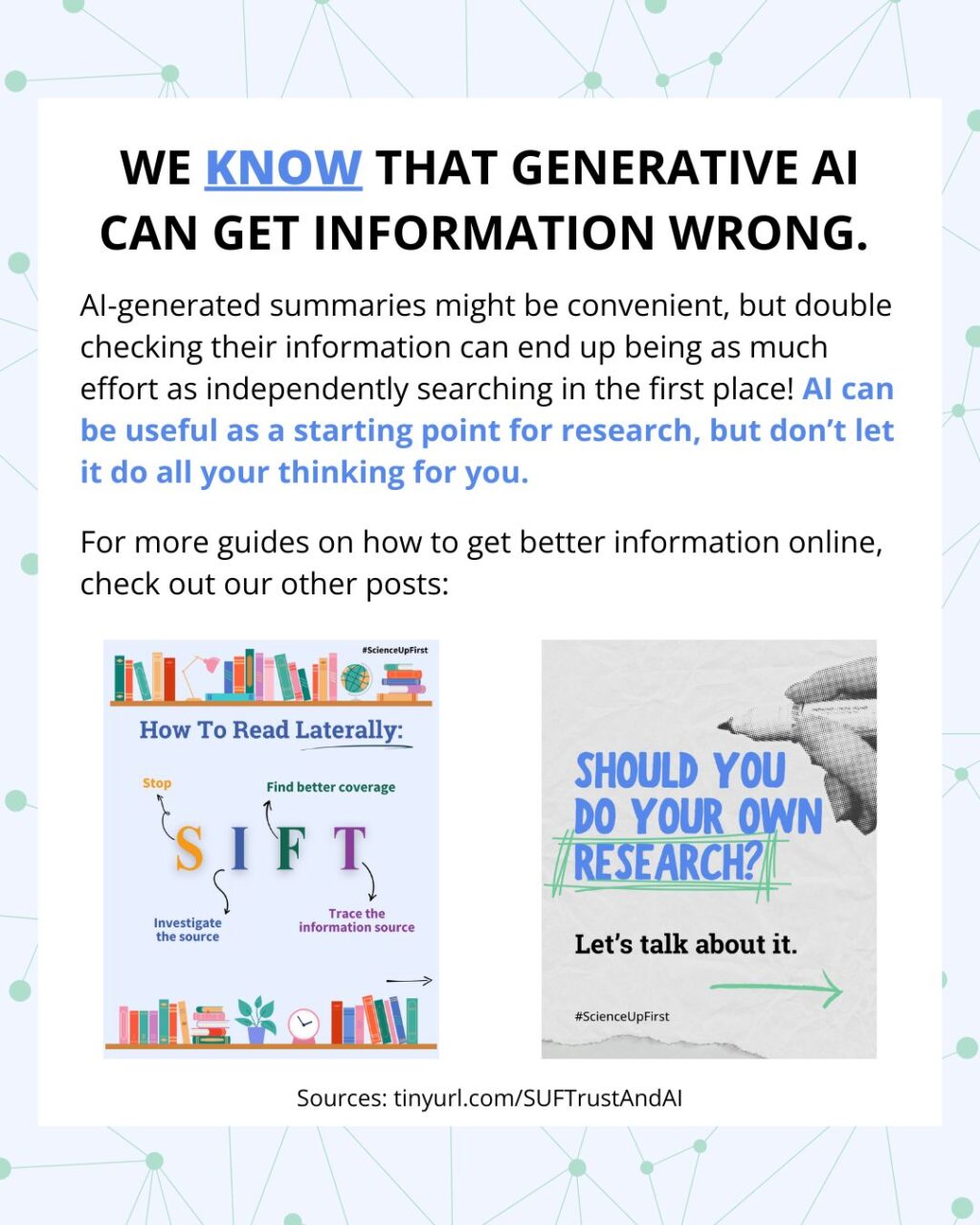
Whether you’re looking for it or not, you are probably coming across AI-generated information when searching online. 🤖
Keep reading for things to look out for and what you should do to make sure the information is accurate. 🔍
Do you have other tips for verifying AI-generated information? Let us know!
Sources- Digital News Report 2025 | Reuters Institute, University of Oxford | 17 June 2025
- Largest study of its kind shows AI assistants misrepresent news content 45% of the time – regardless of language or territory | BBC News | 22 October 2025
- Taxonomy of Risks posed by Language Models | FAccT ’22: Proceedings of the 2022 ACM Conference on Fairness, Accountability, and Transparency | 20 June 2022
- Does ChatGPT tell the truth? | OpenAI | August 2025
- The ChatGPT Fact-Check: exploiting the limitations of generative AI to develop evidence-based reasoning skills in college science courses | Advances in Physiology Education | 18 January 2025
- Using Generative AI | University of Alberta Library | 30 October 2025
- On the Origin of Hallucinations in Conversational Models: Is it the Datasets or the Models? | Proceedings of the 2022 Conference of the North American Chapter of the Association for Computational Linguistics: Human Language Technologies | July 2022
- Calibrated Language Models Must Hallucinate | In Proceedings of the 56th Annual ACM Symposium on Theory of Computing (STOC) 2024 | 20 March 2024
- How to fact-check AI | Microsoft | 19 April 2025
- What is retrieval-augmented generation? | IBM Research | 22 August 2023
- Why Google’s AI Overviews gets things wrong | MIT Technology Review | 31 May 2024
- Sycophancy in GPT-4o: what happened and what we’re doing about it | OpenAI | 29 April 2025
- Truth, Romance and the Divine: How AI Chatbots May Fuel Psychotic Thinking | Scientific American | 24 August 2025
- AI-fuelled delusions are hurting Canadians. Here are some of their stories | CBC News | 17 September 2025
- Will Generative Artificial Intelligence Chatbots Generate Delusions in Individuals Prone to Psychosis? | Schizophrenia Bulletin | 25 August 2023
- Generative AI is already helping fact-checkers. But it’s proving less useful in small languages and outside the West | Reuters Institute for the Study of Journalism | 29 April 2024
- Guide on the use of generative artificial intelligence | Government of Canada | 3 June 2025
- Understanding and combatting misinformation across 16 countries on six continents | Nature Human Behaviour | 29 June 2023
- Shifting attention to accuracy can reduce misinformation online | Nature | 17 March 2021
View our original Instagram Post!
-
Ins and Outs for 2026
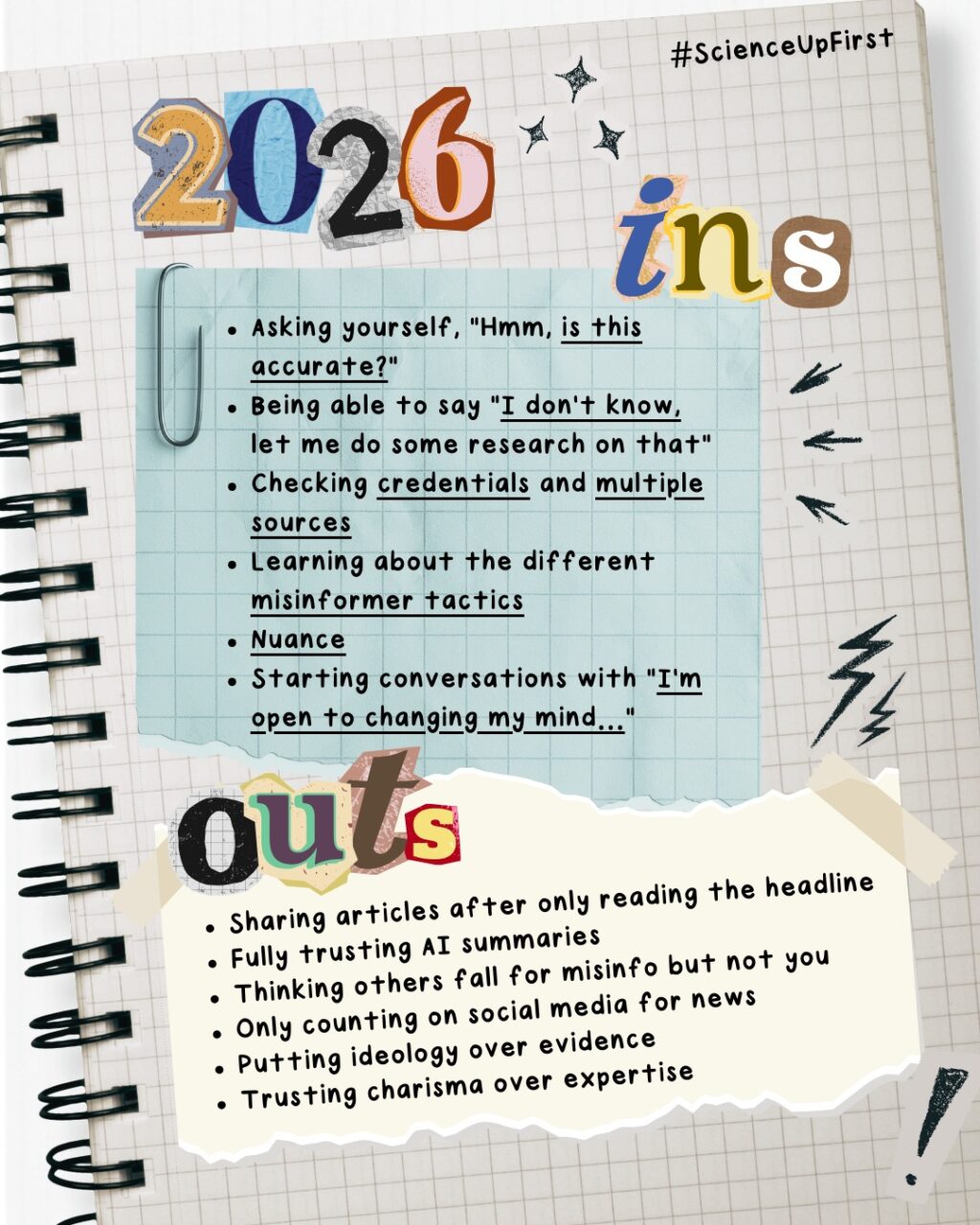
In 2026 it’s cool to care. Myth busting and critical thinking are the in thing. But relying on AI answers, charming personalities and other less than accurate sources are all out baby!
Share our original Bluesky Post!
In 2026 it’s cool to care. Myth busting and critical thinking are the in thing. But relying on AI answers, charming personalities and other less than accurate sources are all out baby! Check out our site for more “in” tips on spotting misinformation. www.ScienceUpFirst.com #ScienceUpFirst
— ScienceUpFirst (@scienceupfirst.bsky.social) January 7, 2026 at 12:24 PM
[image or embed]View our original Instagram Post!
-
Our tips for conversations on polarizing topics
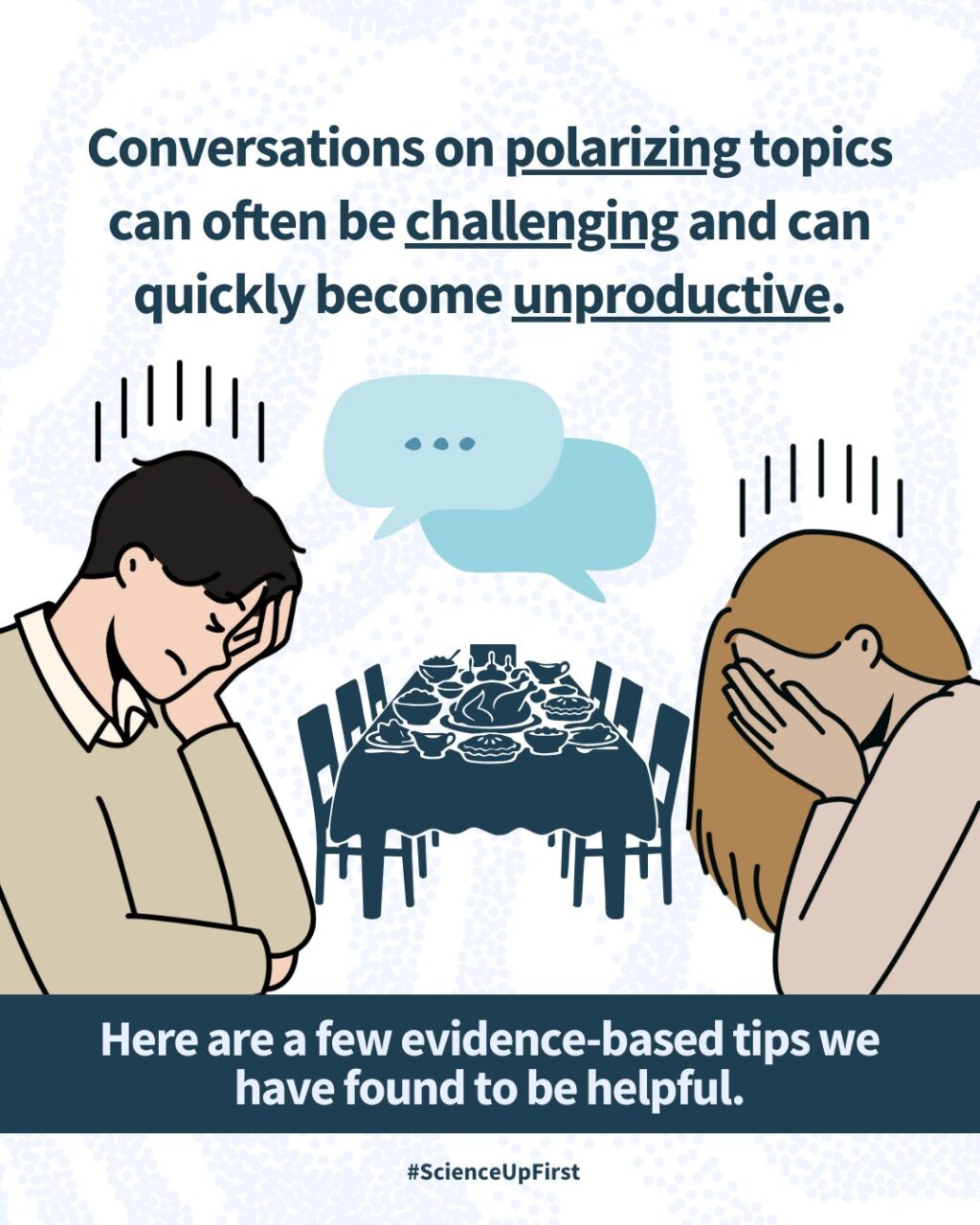

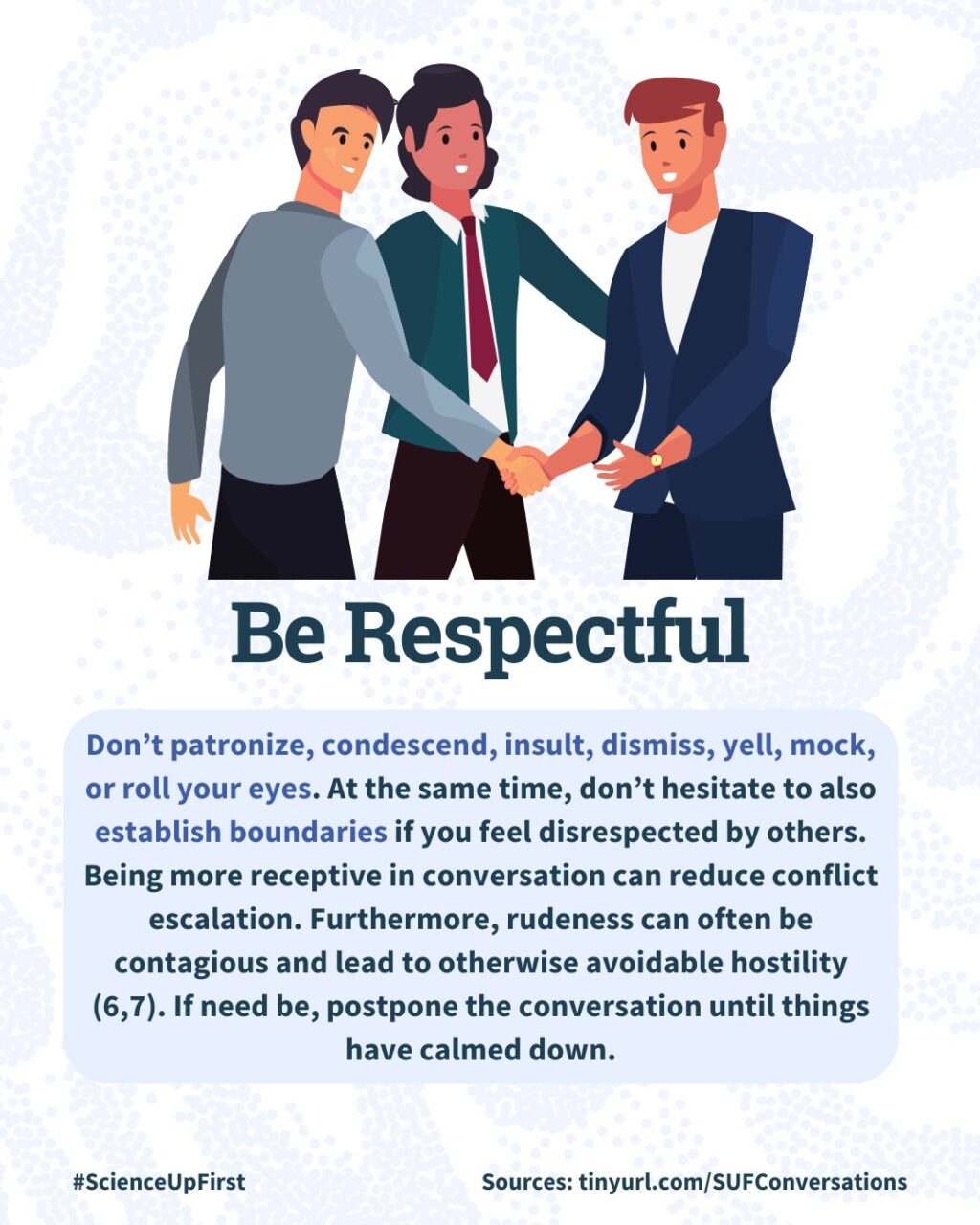

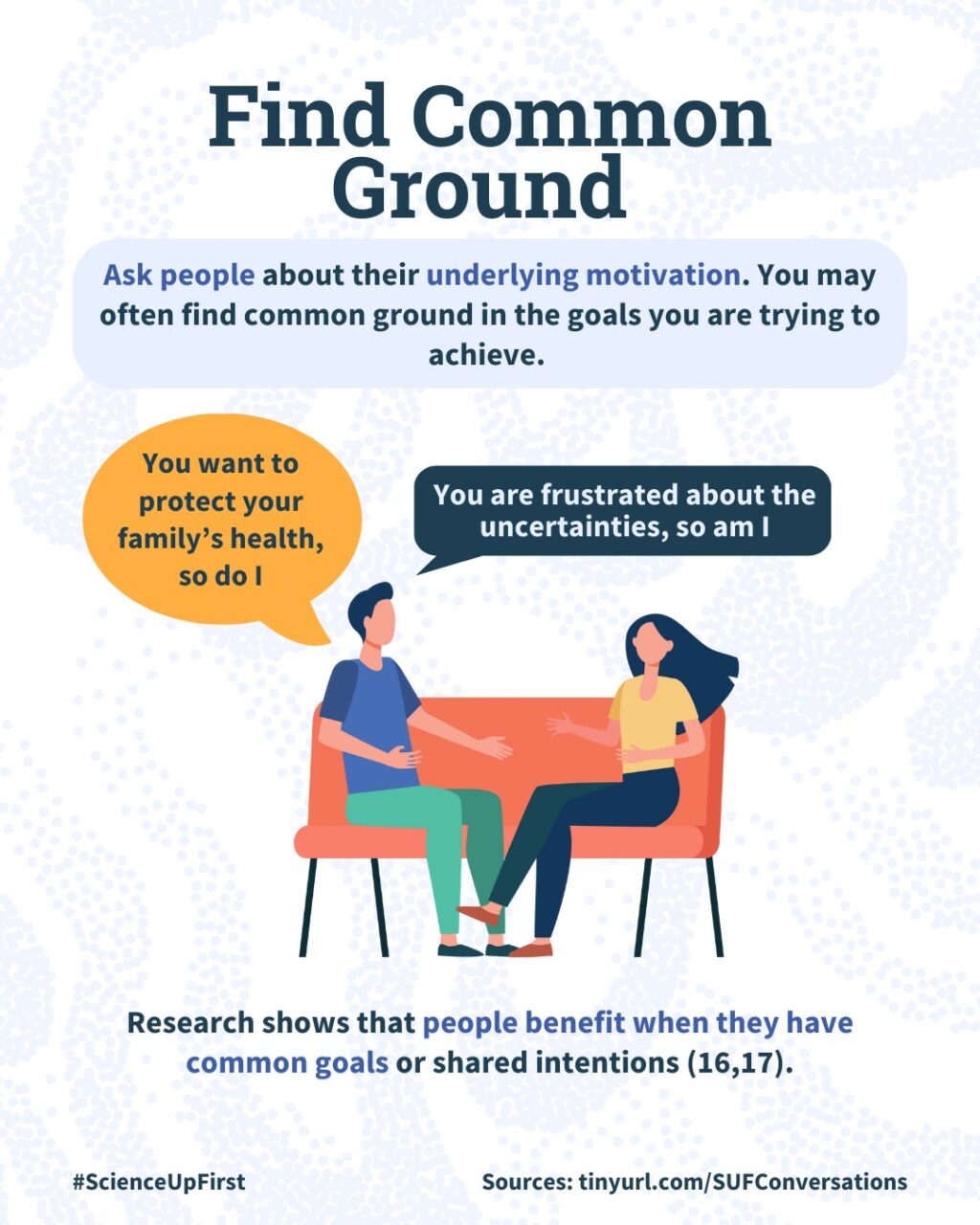
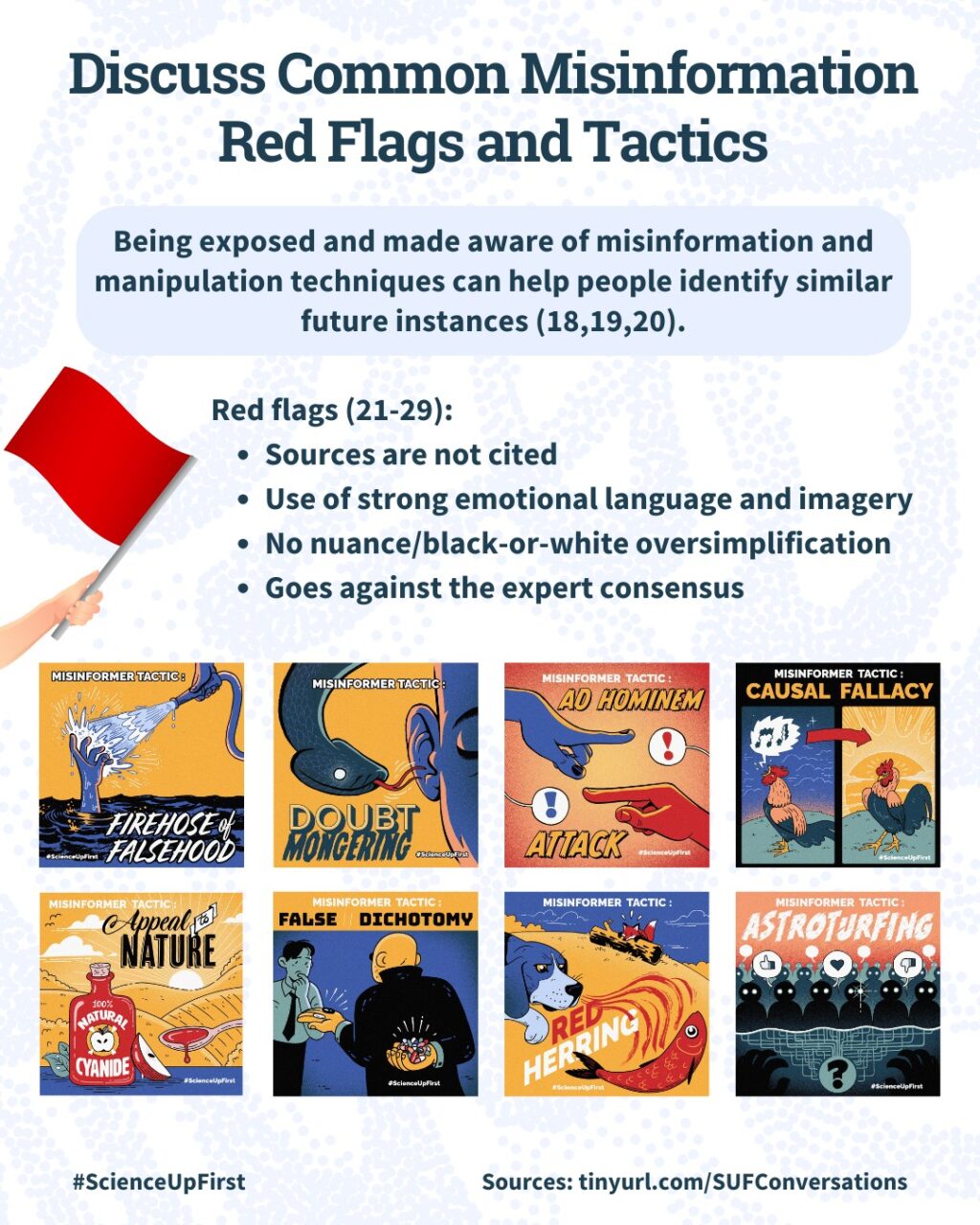
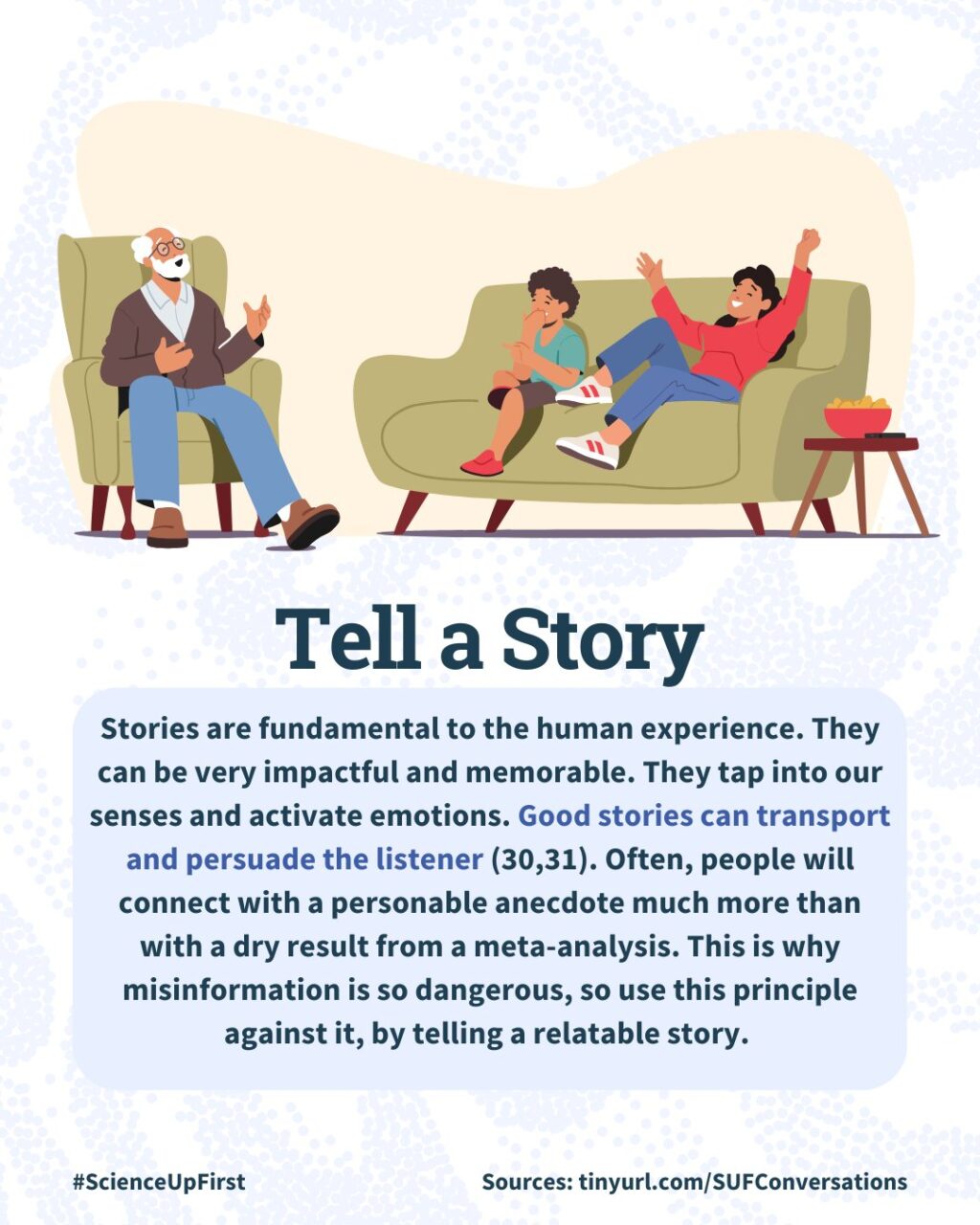
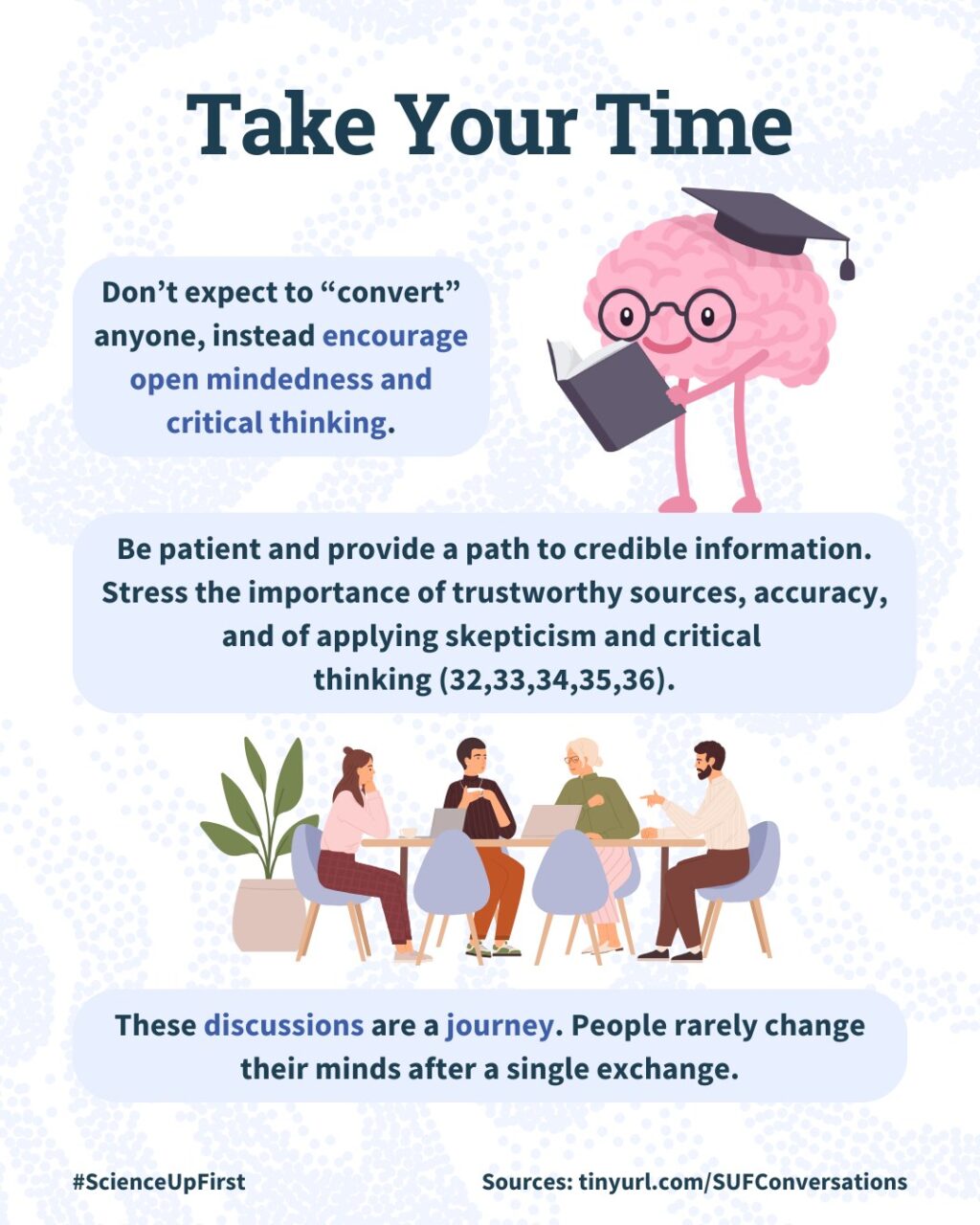
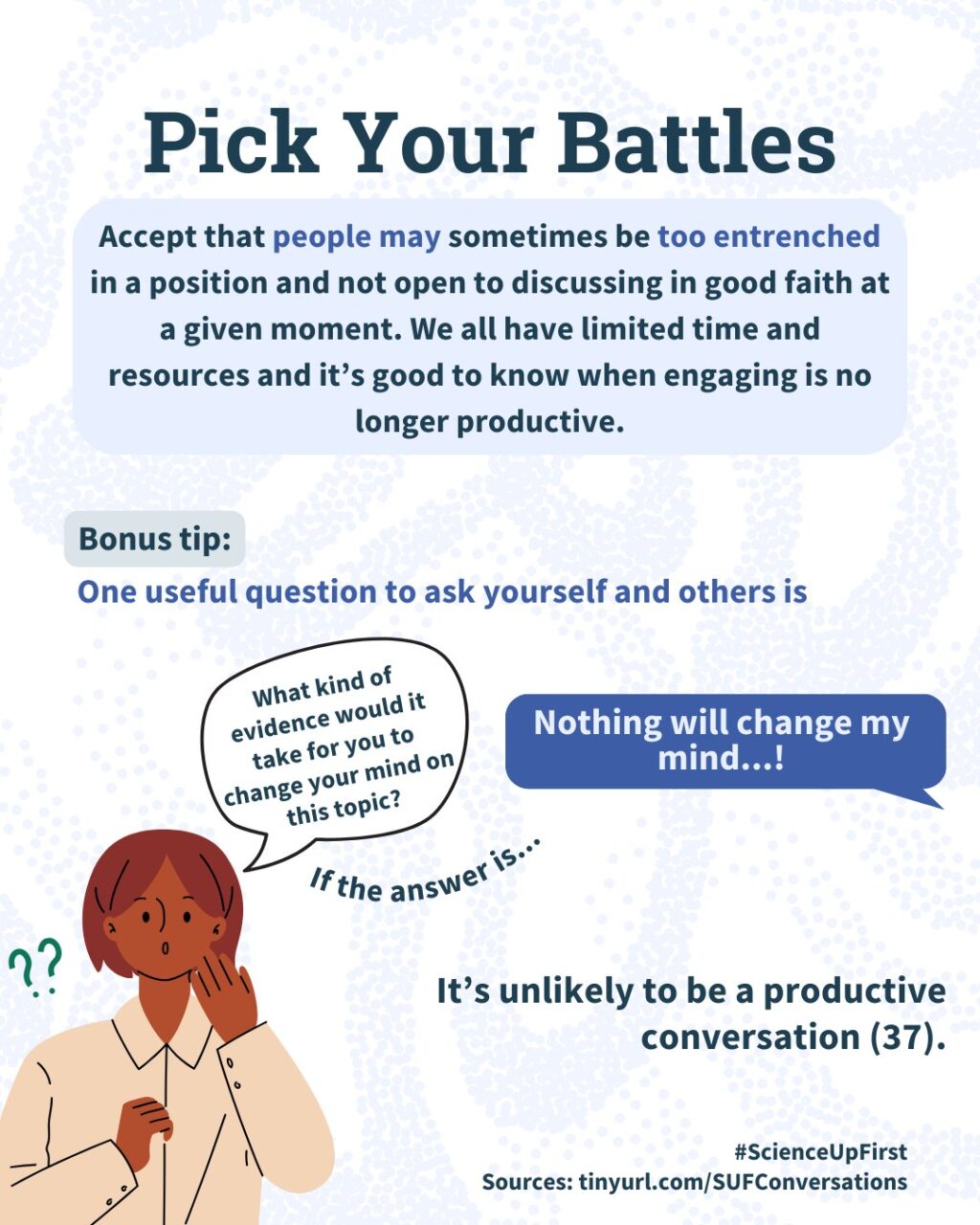
Talking about polarizing topics, whether it’s with friends or family, or strangers on the internet, can be particularly difficult. People can react adversely, get even more closed off, become aggressive, and the conversation can quickly devolve.
Here are a few tips to help you get through these difficult discussions.
What about you? What are some approaches or strategies you have found helpful when discussing controversial topics? Let us know.
There are also resources available across the country to tackle radicalization in friends and family members. Check out our references (38).
Resources
Initiatives and programs to prevent and intervene with individuals and groups at-risk of radicalization to violence: Prevention and Intervention Programs
Sources- A friendly guide to Active Listening | ScienceUpFirst | January 2024
- Active Listening | StatPearls – NCBI Bookshelf | September 2023
- The Role of “Active Listening” in Informal Helping Conversations: Impact on Perceptions of Listener Helpfulness, Sensitivity, and Supportiveness and Discloser Emotional Improvement | Western Journal of Communication | January 2015
- Are We Losing the Art of Actively Listening to Our Patients? Connecting the Art of Active Listening with Emotionally Competent Behaviors | Open Journal of Nursing | June 2015
- Supportive Listening | International Journal of Listening | February 2011
- Conversational receptiveness: Improving engagement with opposing views | ScienceDirect | September 2020
- Catching rudeness is like catching a cold: The contagion effects of low-intensity negative behaviors | Journal of Applied Psychology | January 2016
- Scientific-Consensus Communication About Contested Science: A Preregistered Meta-Analysis | Psychological Science | February 2022
- Communicating the Scientific Consensus on Climate Change: Diverse Audiences and Effects Over Time | Environment and Behaviour | 2022
- Examining the Impact of Expert Voices: Communicating the Scientific Consensus on Genetically-modified Organisms | Environmental Communication | August 2018
- Science as a Vaccine The Relation between Scientific Literacy and Unwarranted Beliefs | Science and Education | January 2019
- (Mis)informed about what? What it means to be a science-literate citizen in a digital world | PNAS | October 2019
- Hierarchy of Evidence | ScienceUpFirst | October 2021
- Hierarchy of Evidence – Evidence-Based Practice in Health | UC Library Guides at University of Canberra | Last updated July 2023
- Hierarchy of Evidence Within the Medical Literature | Hospital Pediatrics | August 2022
- The language of cooperation: shared intentionality drives variation in helping as a function of group membership | Proceedings of the Royal Society Biological Sciences | September 2017
- A Shared Intentionality Account of Uniquely Human Social Bonding | Perspectives on Psychological Science | October 2023
- Fake news game confers psychological resistance against online misinformation | Humanities and Social Sciences Communications | June 2019
- Long-term effectiveness of inoculation against misinformation: Three longitudinal experiments | Journal of Experimental Psychology. Applied | March 2021
- Inoculation theory in the post‐truth era: Extant findings and new frontiers for contested science, misinformation, and conspiracy theories | Social and Personality Psychology Compass | May 2021
- Misinformation Red Flags | ScienceUpFirst | October 2022
- Misinformer Tactic: Firehose of Falsehood | ScienceUpFirst | October 2023
- Misinformer Tactic: Doubt Mongering | ScienceUpFirst | August 2022
- Misinformer Tactic: Ad Hominem Attack | ScienceUpFirst | August 2022
- Misinformer Tactic: Causal Fallacy | ScienceUpFirst | January 2022
- Misinformer Tactic: Appeal to Nature | ScienceUpFirst | January 2022
- Misinformer Tactic: False Dichotomy | ScienceUpFirst | December 2021
- Misinformer Tactic: Red Herring | ScienceUpFirst | December 2021
- Misinformer Tactic: Astroturfing | ScienceUpFirst | December 2021
- How can we use the ‘science of stories’ to produce persuasive scientific stories? | Humanities and Social Sciences Communications | December 2017
- Narrative Persuasion and Storytelling as Climate Communication Strategies | Climate Science | August 2017
- Identifying Credible Sources of Health Information in Social Media: Principles and Attributes | National Academy of Medicine | July 2021
- “I Think This News Is Accurate”: Endorsing Accuracy Decreases the Sharing of Fake News and Increases the Sharing of Real News | Personality and Social Psychology | August 2022
- Accuracy prompts are a replicable and generalizable approach for reducing the spread of misinformation | Nature Communications | April 2022
- How to mitigate misinformation | PNAS | August 2023
- Critical thinking efficacy and transfer skills defend against ‘fake news’ at an international school in Finland | Journal of Research in International Education | April 2019
- How to talk to conspiracy theorists—and still be kind | MIT Technology Review | July 2020
- Prevention and Intervention Programs | Public Safety Canada | Last modified March 2022
Share our original Bluesky Post!
Talking about polarizing topics can be difficult. Regardless of who the conversation is with it’s better for everyone if it goes positively. Here are a few tips to help you get through these difficult discussions.😵💫 www.scienceupfirst.com/project/our-… #ScienceUpFirst
— ScienceUpFirst (@scienceupfirst.bsky.social) December 18, 2025 at 12:48 PM
[image or embed]View our original Instagram Post!
-
6 signs a source is unreliable
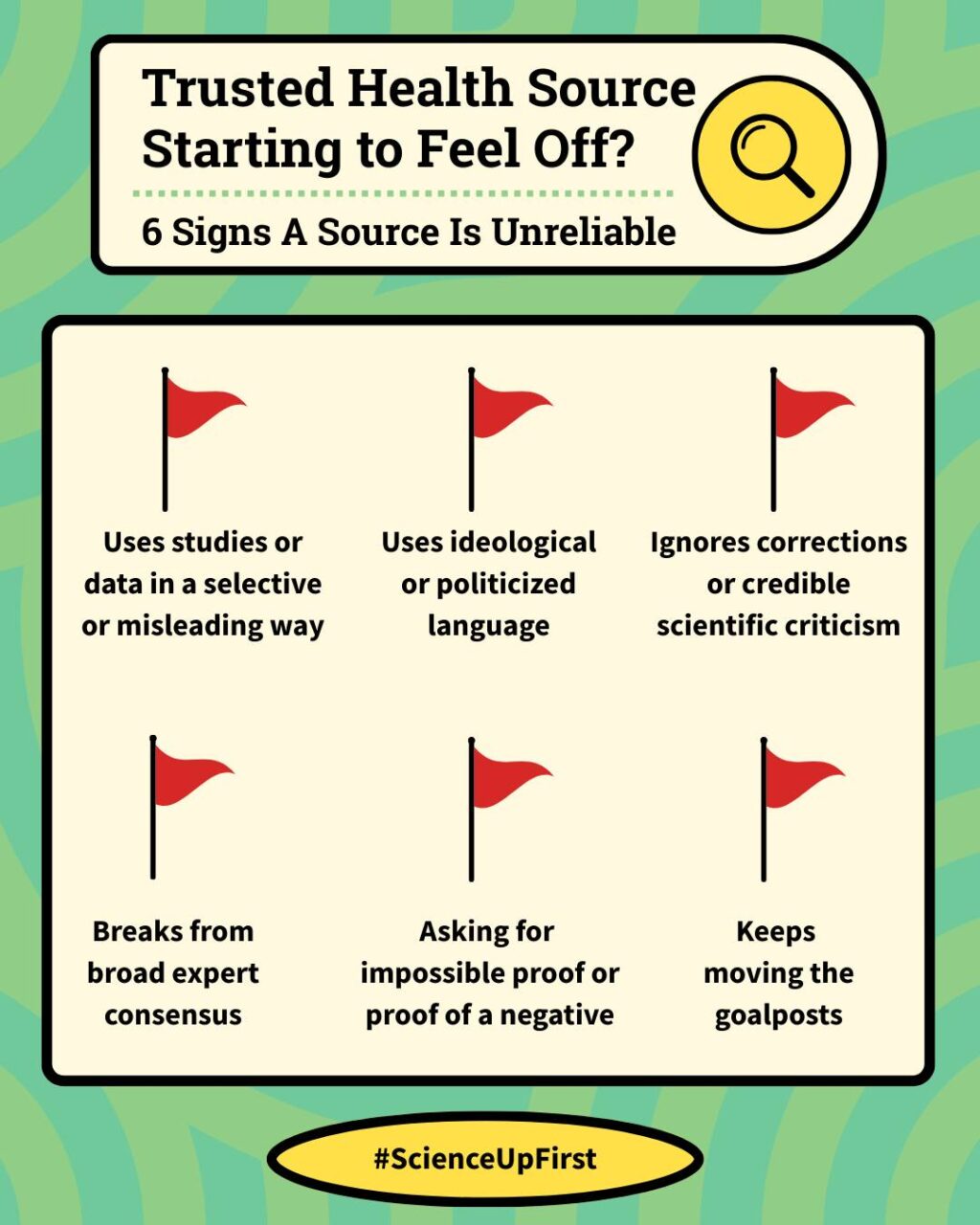
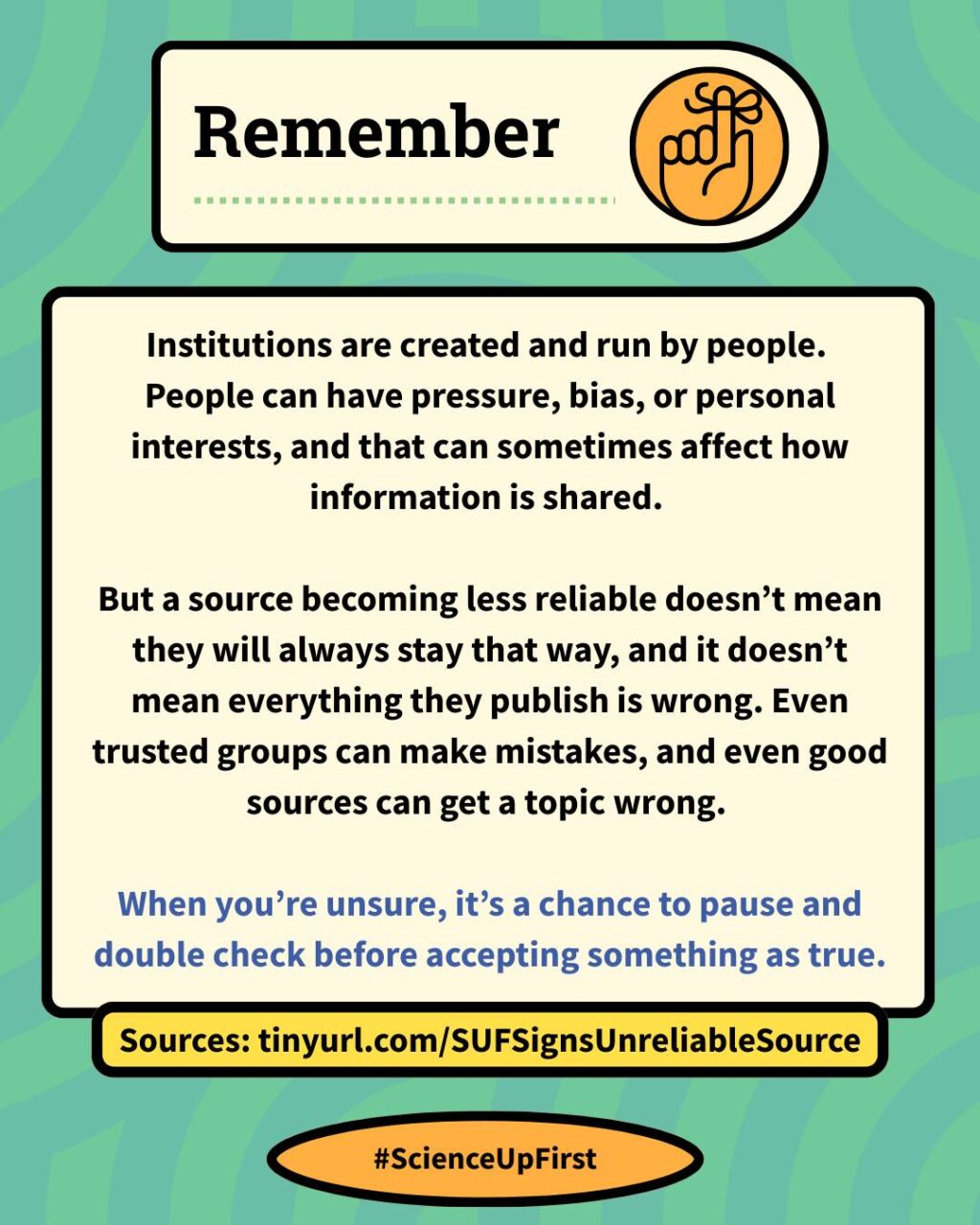
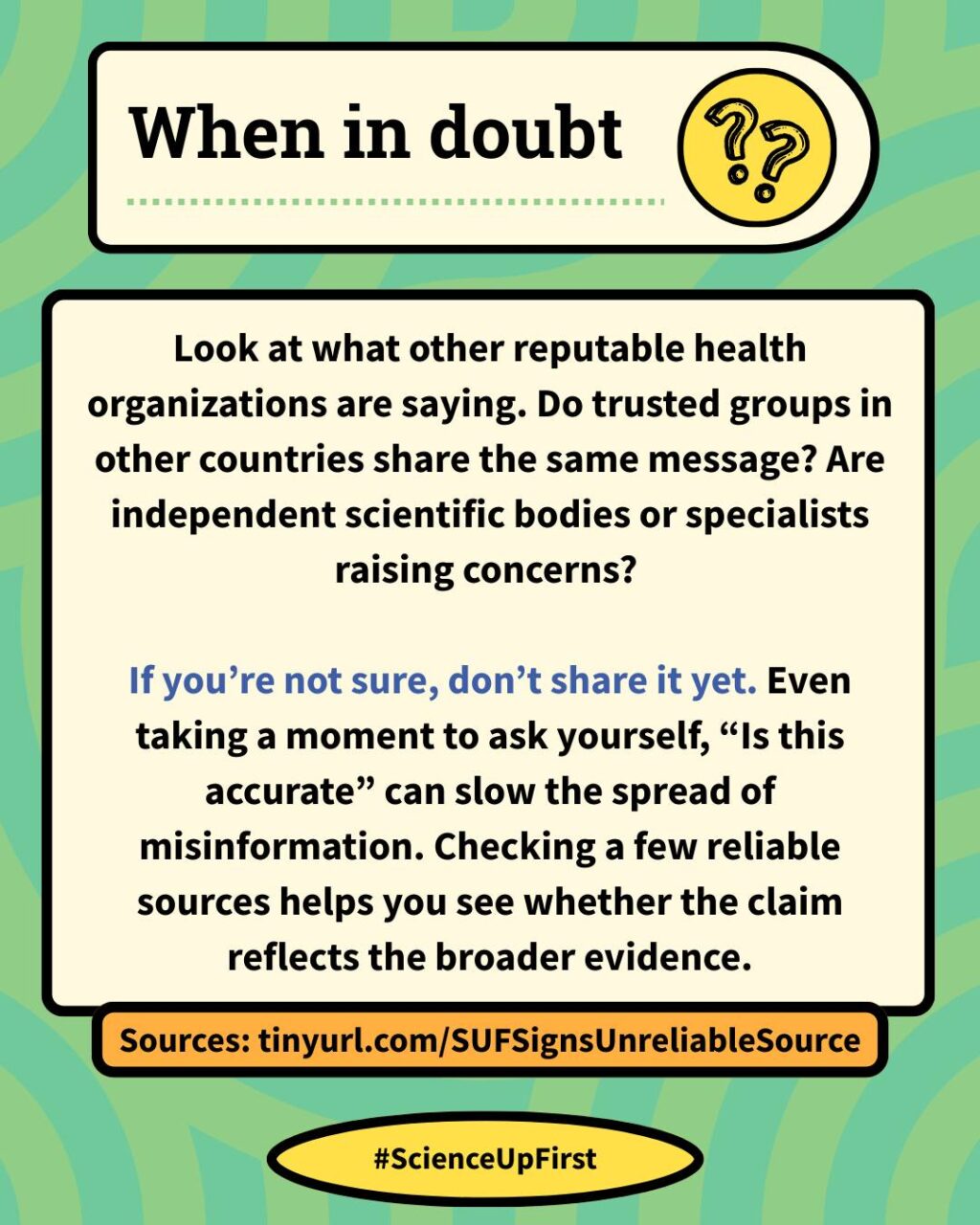
It can be unsettling when a trusted health organization shares something that doesn’t match other evidence. But you’re not powerless. Taking a moment to pause, slow down, look closer, and think critically helps you get a clearer picture, just like you would with any other source.
When something feels off, checking other reputable sources and seeing what experts in the field agree on can help you understand what the evidence actually supports.
Evidence is still your best guide. Science is built on many voices, not one institution. And a single surprising statement, even from a familiar or historically trusted source, doesn’t replace the wider consensus.
Resources
How is a scientific consensus reached? | ScienceUpFirst | November 2023
Misinformer Tactic: Cherry Picking | ScienceUpFirst | May 2024
Moving the Goalposts | Logically Fallacious
The Fallacy of ‘Moving the Goalposts’, Explained | Snopes | February 2023
Proving Non-Existence | Logically Fallacious
Share our original Bluesky Post!
Science is built on many voices, not one institution. A single surprising statement, even from a familiar or historically trusted source, doesn’t replace the wider consensus. But how to gauge reliability?👇 scienceupfirst.com/misinformati… #ScienceUpFirst
— ScienceUpFirst (@scienceupfirst.bsky.social) December 10, 2025 at 1:14 PM
[image or embed]View our original Instagram Post!
-
Misinformer Tactics Mood Board
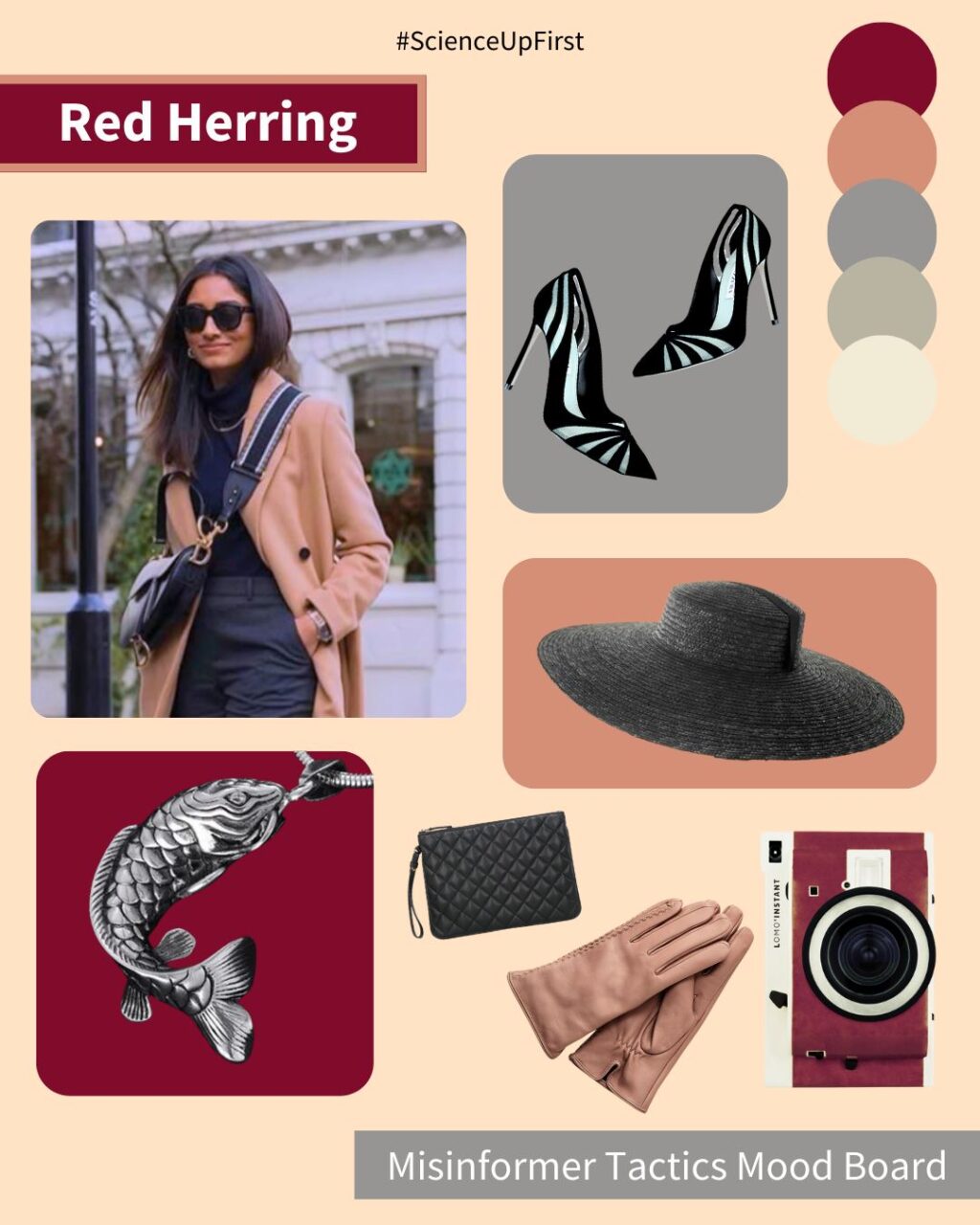
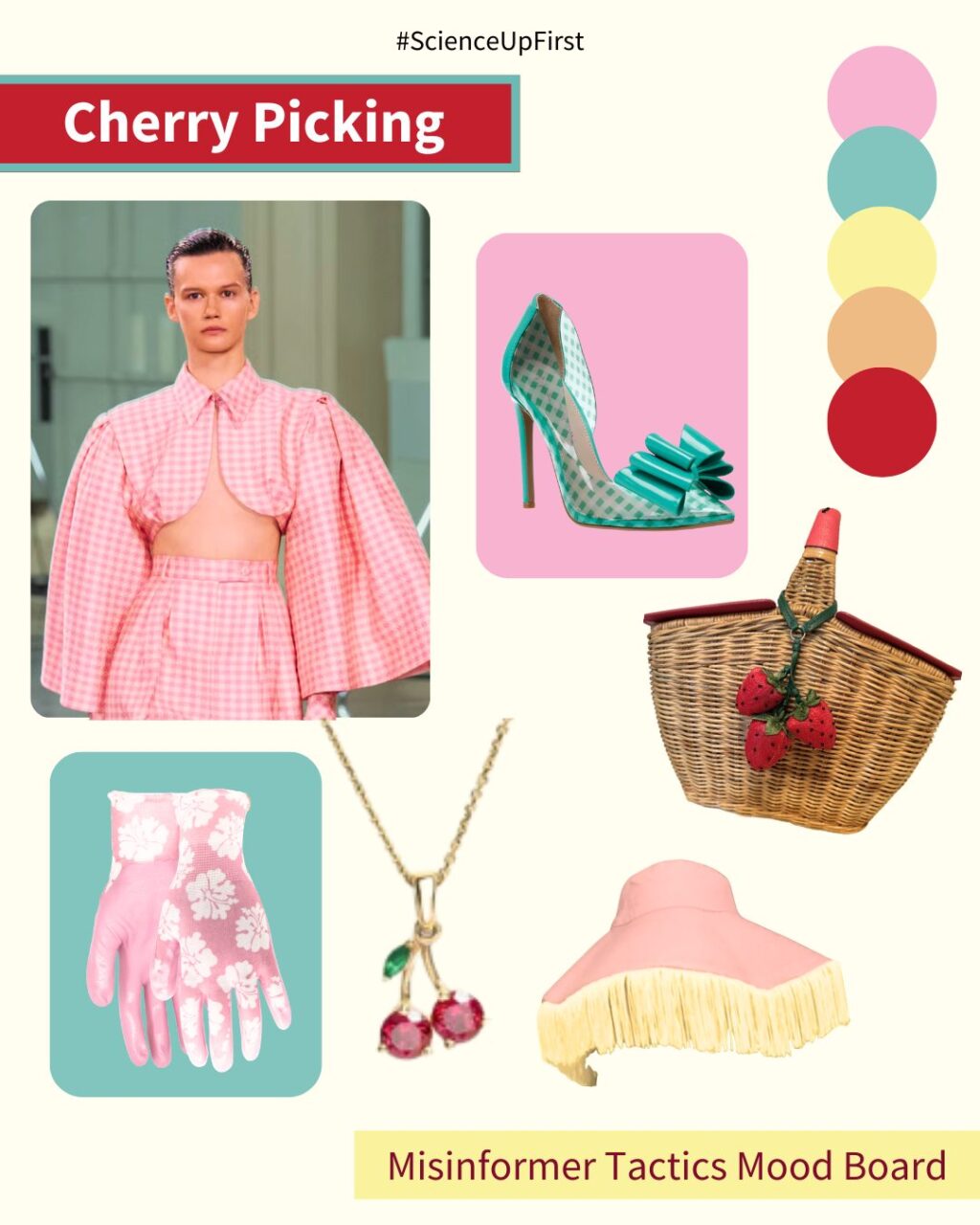

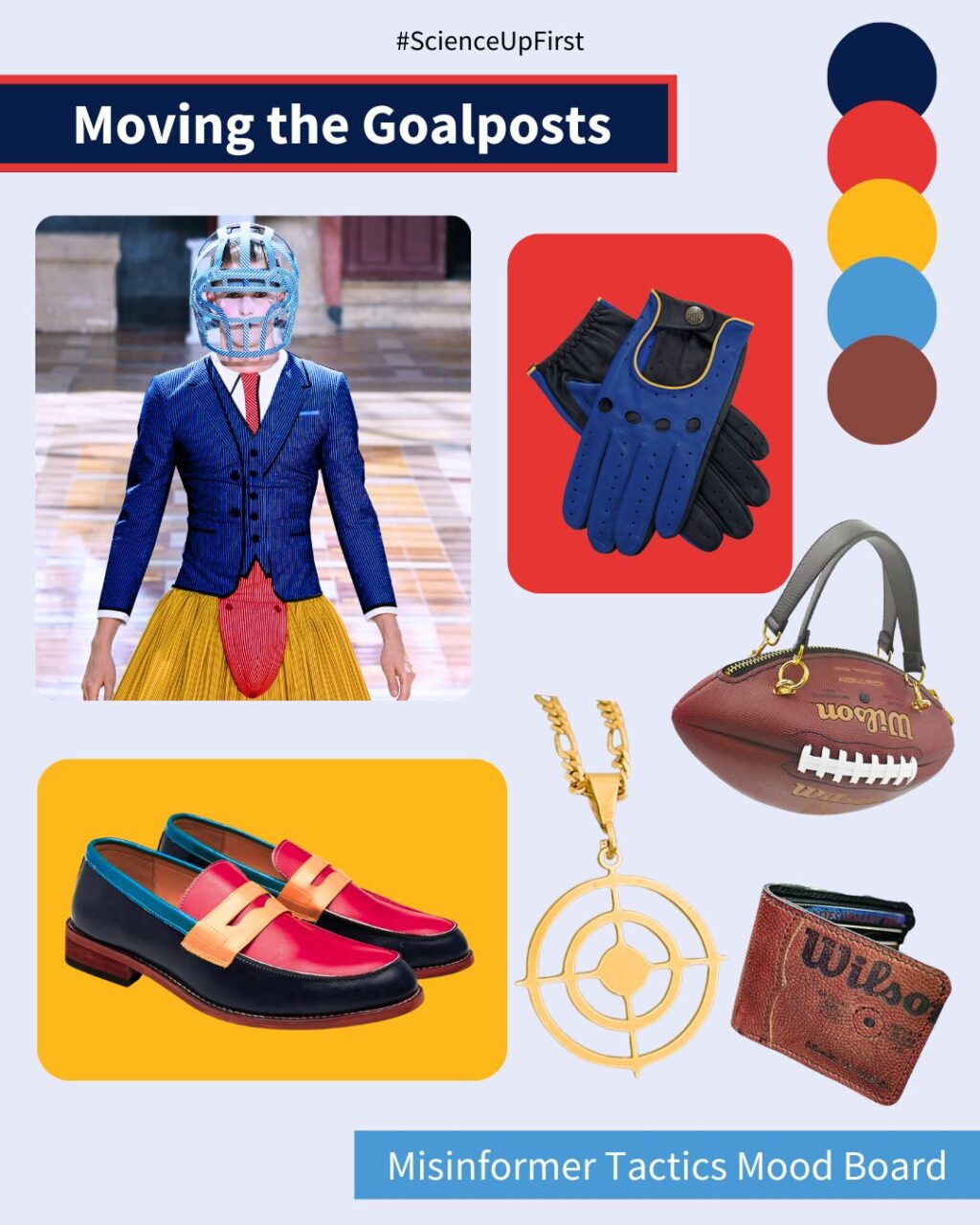
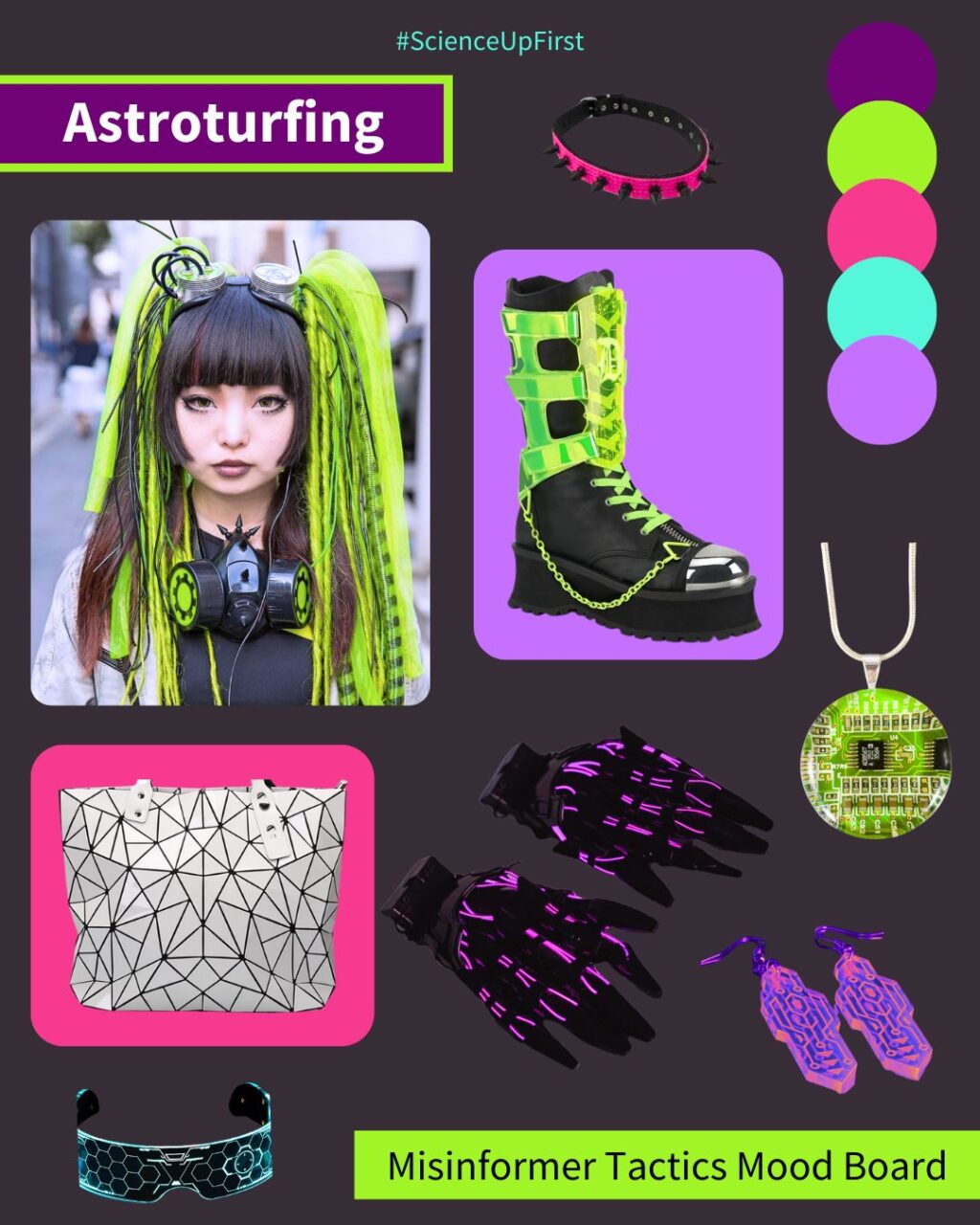

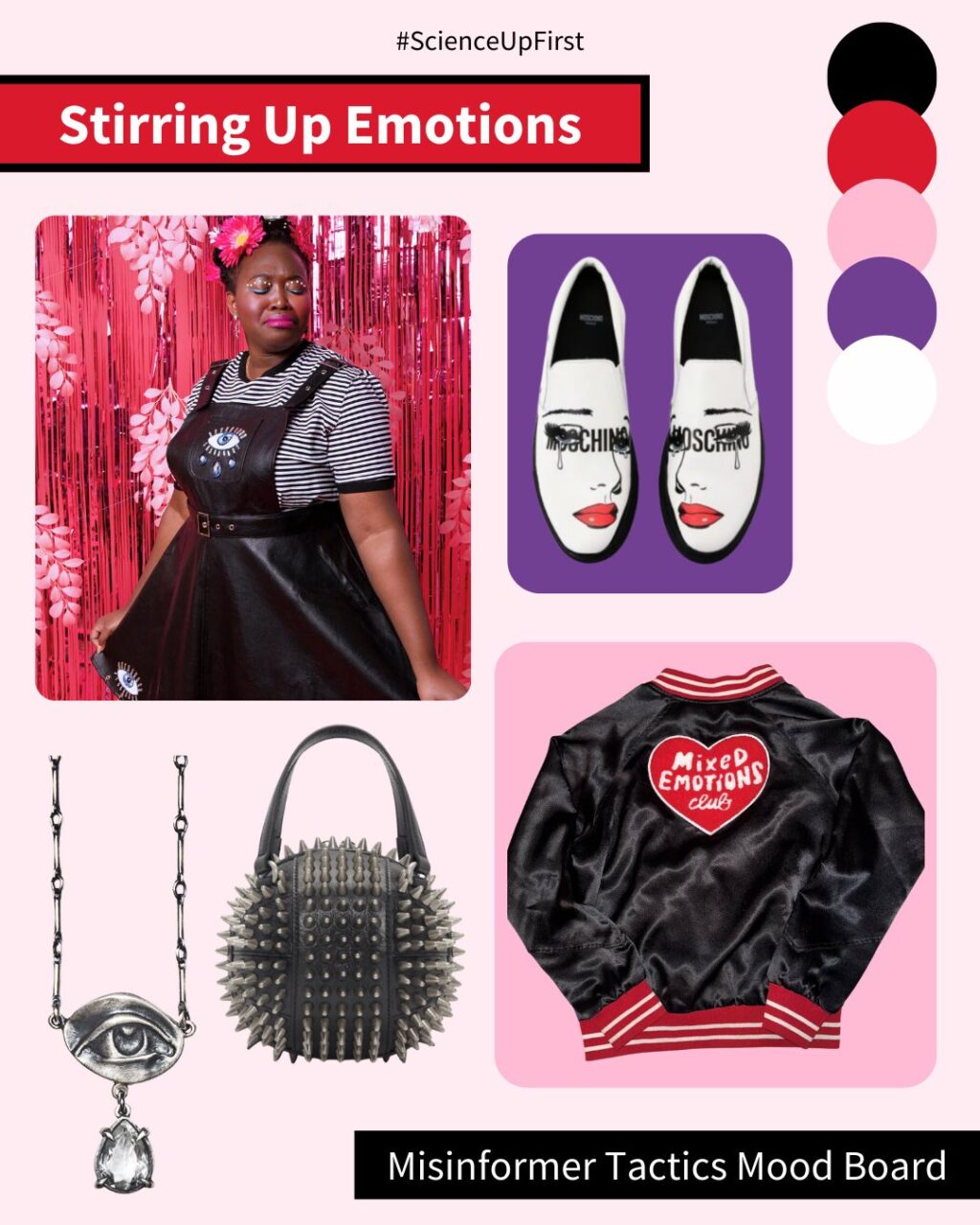
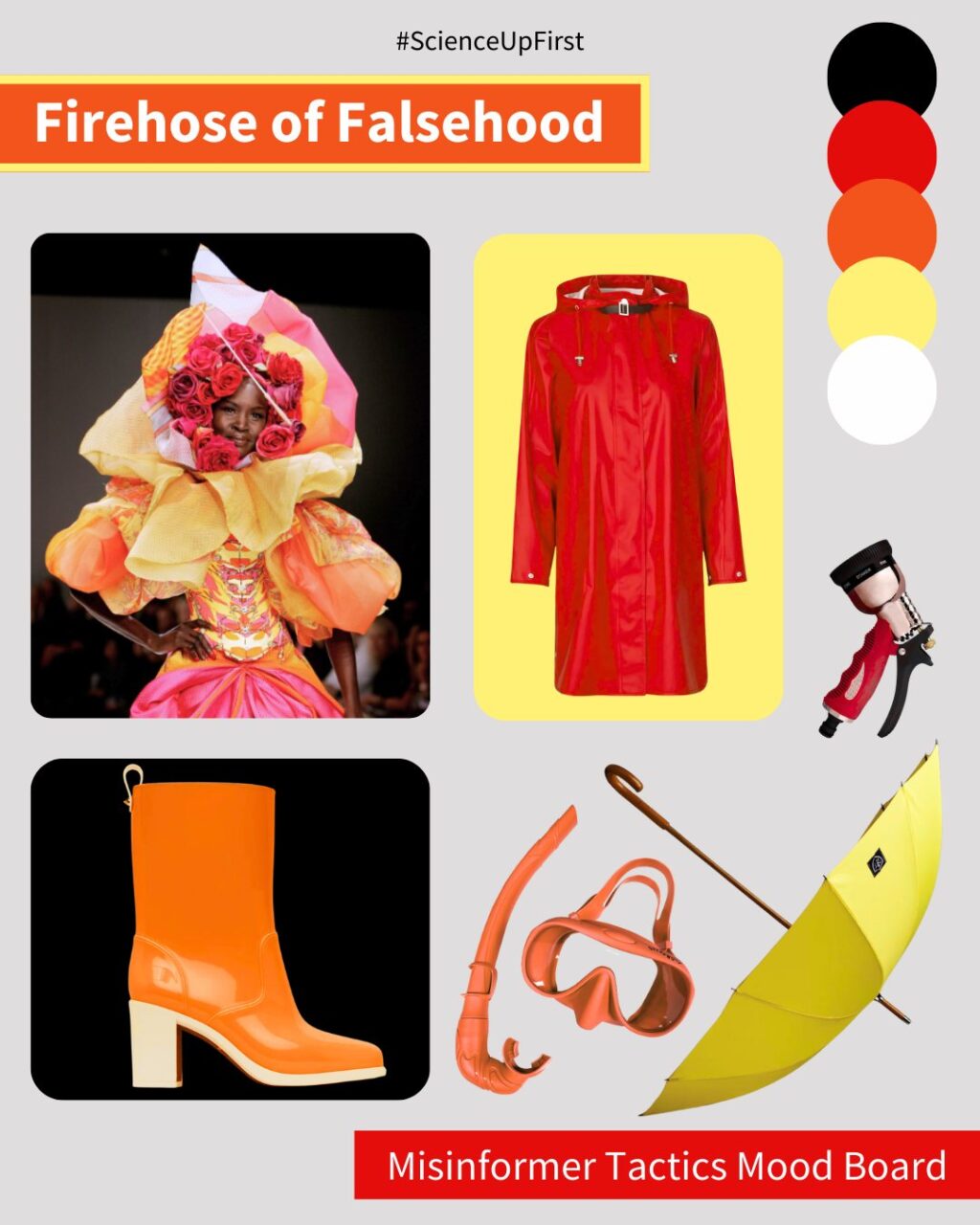

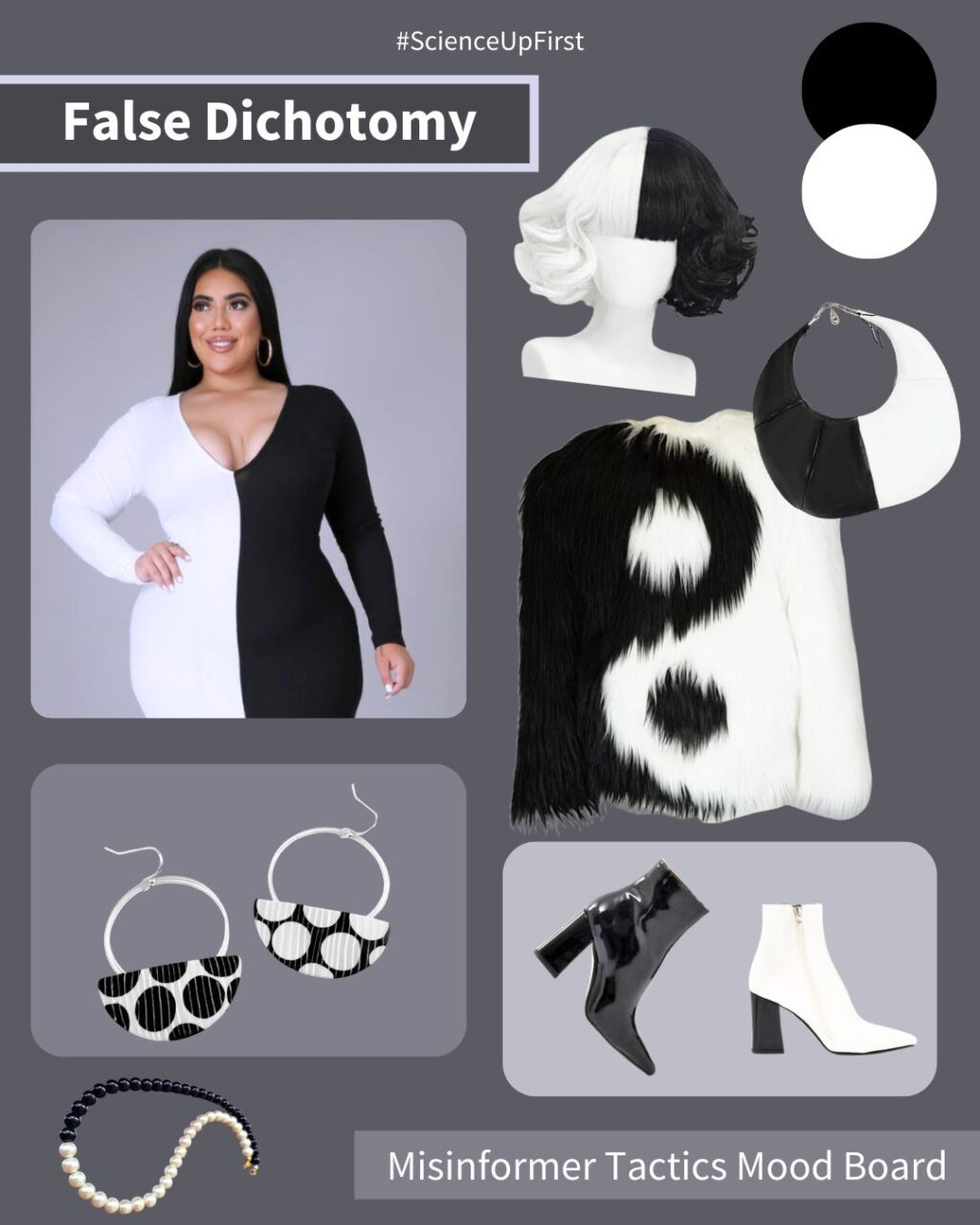
Have you ever wondered to yourself, “if a misinformer tactic were a mood, what mood would they be?” No? Just us? 😅
We hope you enjoy our re-imagining of some of our most common misinformer tactics as fashion icons.
If you need a quick refresher:
- Red Herring: Distracting from the point at hand.
- Cherry Picking: Choosing specific bits of information while ignoring the bigger context.
- Appeal to Nature: A bias toward things that seem “natural.”
- Moving the Goalposts: Repeatedly updating your argument to avoid being proven wrong.
- Astroturfing: Using bots or other tricks to create false grassroots support.
- Slippery Slope: Makes you believe that a minor event could lead to a catastrophe
- Stirring Up Negative Emotions: Using tricks like emotional language, to dull your critical thinking.
- Firehose of Falsehood: Bombarding you with information so that it’s nearly impossible to tell what the facts are.
- Doubt Mongering: Spreading doubt on what has been proven scientifically.
- False Dichotomy: Presenting options as black or white, ignoring the shades of grey.
Share our original Bluesky Post!
What if different misinformation tactics came with different moods and styles? What would cherry picking look like? What about an appeal to nature? Check out this post to see them all! 👉 scienceupfirst.com/misinformati… #ScienceUpFirst
— ScienceUpFirst (@scienceupfirst.bsky.social) December 8, 2025 at 11:07 AM
[image or embed]View our original Instagram Post!
-
The Oxford word of 2025 is “rage bait”
The Oxford word of the year is ‘rage bait’. Defined as “online content deliberately designed to elicit anger or outrage by being frustrating, provocative, or offensive, typically posted in order to increase traffic to or engagement with a particular web page or social media content”.
It’s no wonder that anger is frequently used to make misinformation go viral (1-3) 😡.
Research shows that:
- Tweets that provoke anger rather than joy tend to be retweeted more (3).
- Being angry also makes it easier to believe misinformation (4).
- People who are angry are more inclined to consider false information as “scientifically credible” (5).
Strong negative emotions tend to make us more sensitive to information that confirms our views. This creates an echo chamber (in other words, seeing and believing only what aligns with our perspectives) (6). In fact, emotions such as anger, sadness or frustration scramble the message and diminish our ability to analyze scientific information. Our brains tend to simplify problems and solutions when we’re upset (7). Being aware of this misinformation tactic will help you avoid being fooled (8).
Remember to take your time before sharing any information. Those who read information carefully have better judgment when faced with false information (9,10).
Sources- Emerging and continuing trends in vaccine opposition website content | Vaccines on PubMed | February 2011
- Reliance on emotion promotes belief in fake news | Cognitive Research: Principles and Implications on Springer Open | October 2020
- Anger can make fake news viral online | Frontiers | August 2022
- Anger increases susceptibility to misinformation. | APA PsycNet – American Psychological Association | 2020
- Anger contributes to the spread of COVID-19 misinformation | HKS Misinformation Review | September 2020
- Anger, Fear, and Echo Chambers: The Emotional Basis for Online Behavior | Sage Journals | April 2019
- Emotion and humor as misinformation antidotes | PNAS | February 2020
- Does Debunking Work? Correcting COVID-19 Misinformation on Social Media* | Book Chapter in Vulnerable: The Law, Policy and Ethics of COVID-19 | 2020
- Pausing to consider why a headline is true or false can help reduce the sharing of false news | HKS Misinformation Review | February 2020
- Fighting COVID-19 Misinformation on Social Media: Experimental Evidence for a Scalable Accuracy-Nudge Intervention | Sage Choice on PubMed | July 2020
Share our original Bluesky Post!
Did you know that misinformation on the internet and social media often plays on your emotions to go viral? Rage bait can hinder our critical thinking. Read more on that and how to protect yourself here 👇 www.scienceupfirst.com/project/misi… #ScienceUpFirst
— ScienceUpFirst (@scienceupfirst.bsky.social) December 4, 2025 at 12:55 PM
[image or embed]View our original Instagram Post!
-
Hierarchy of Evidence
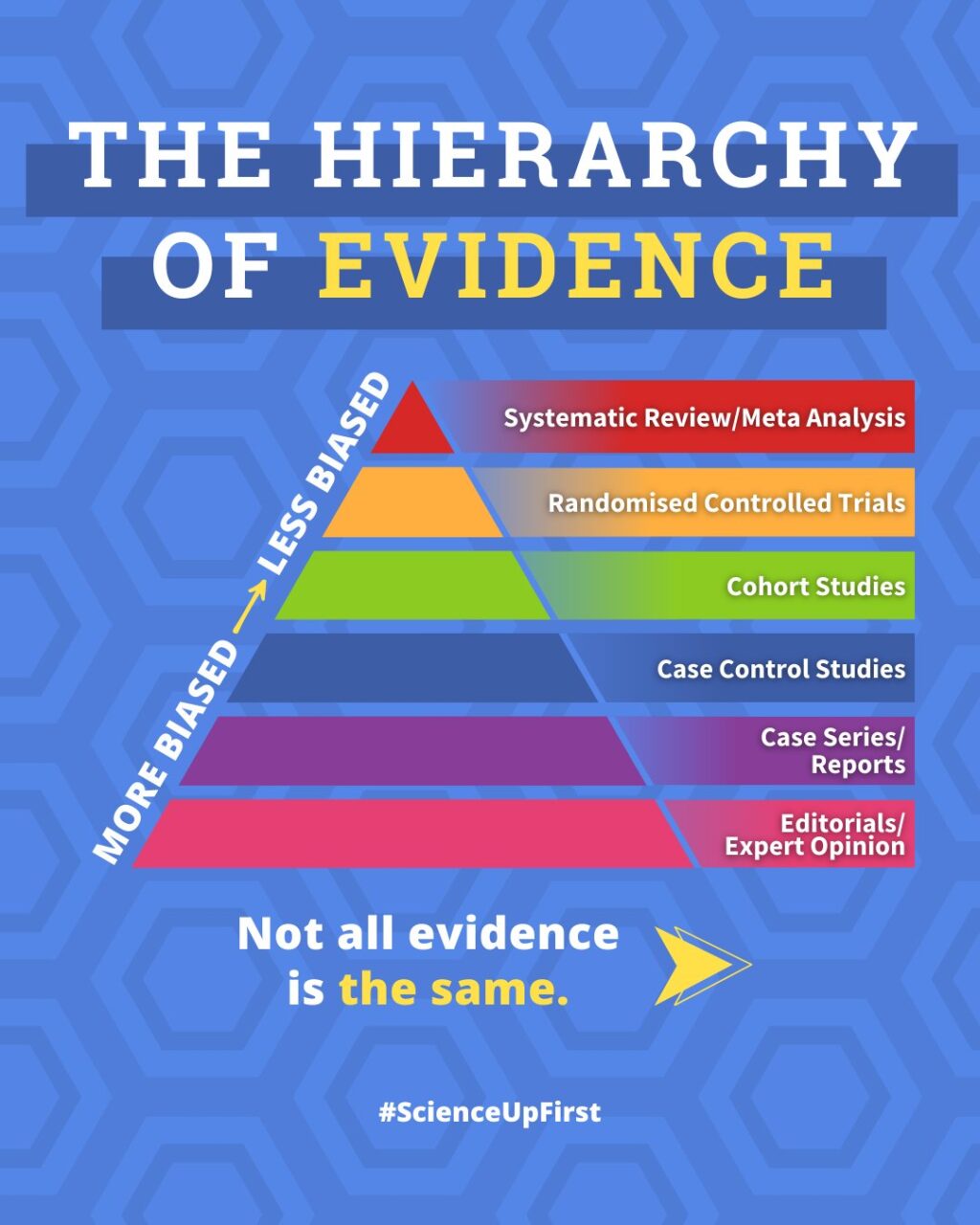
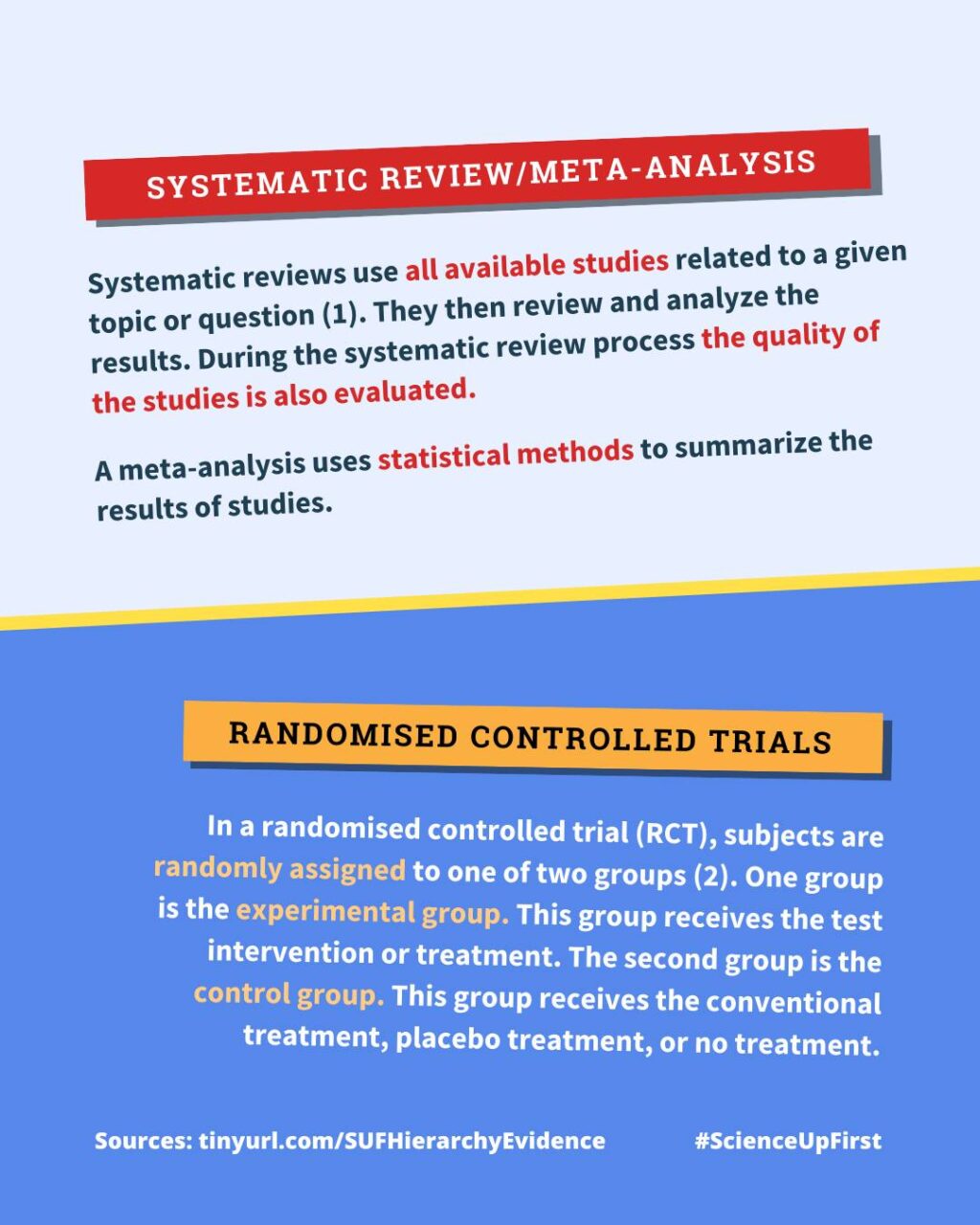
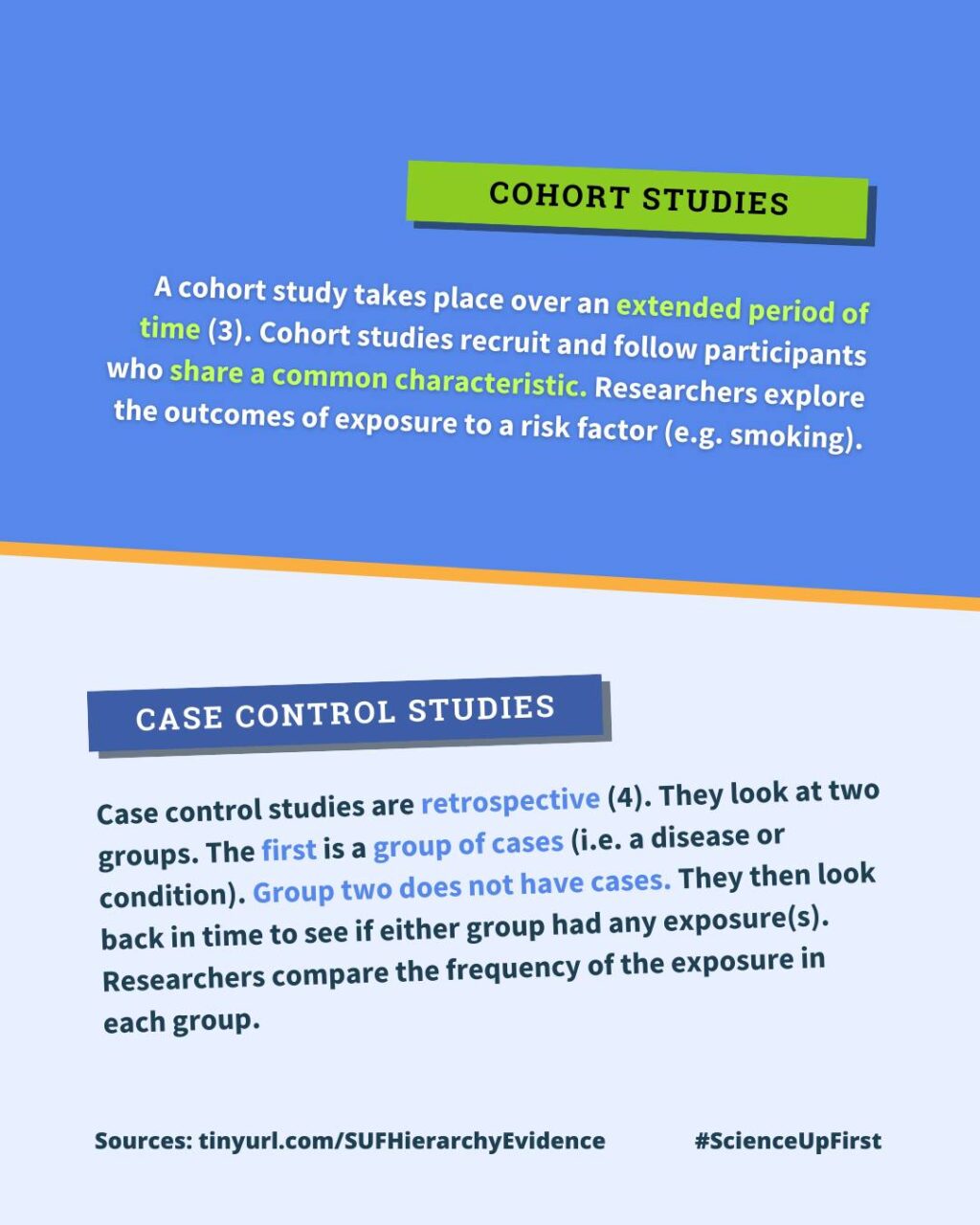
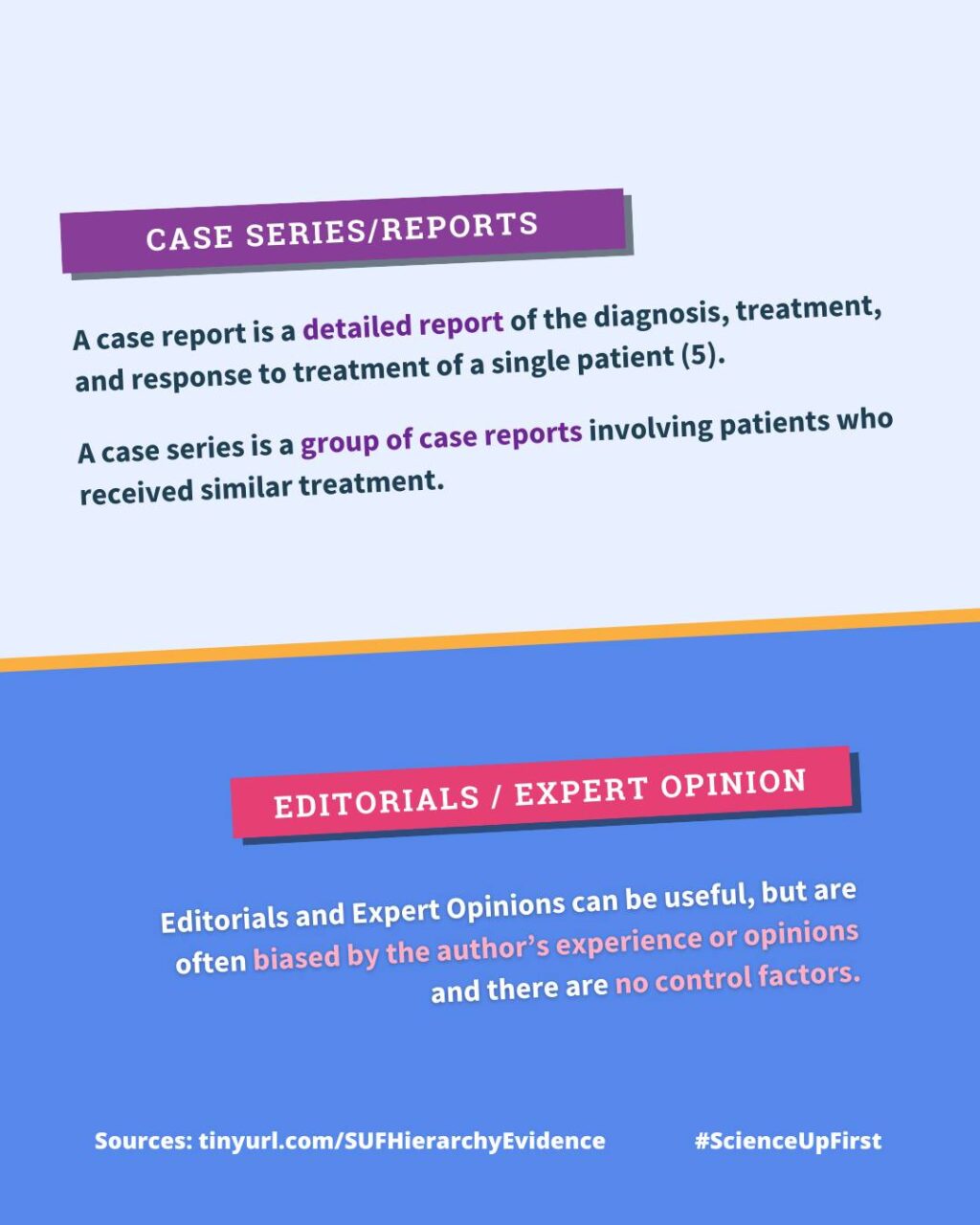
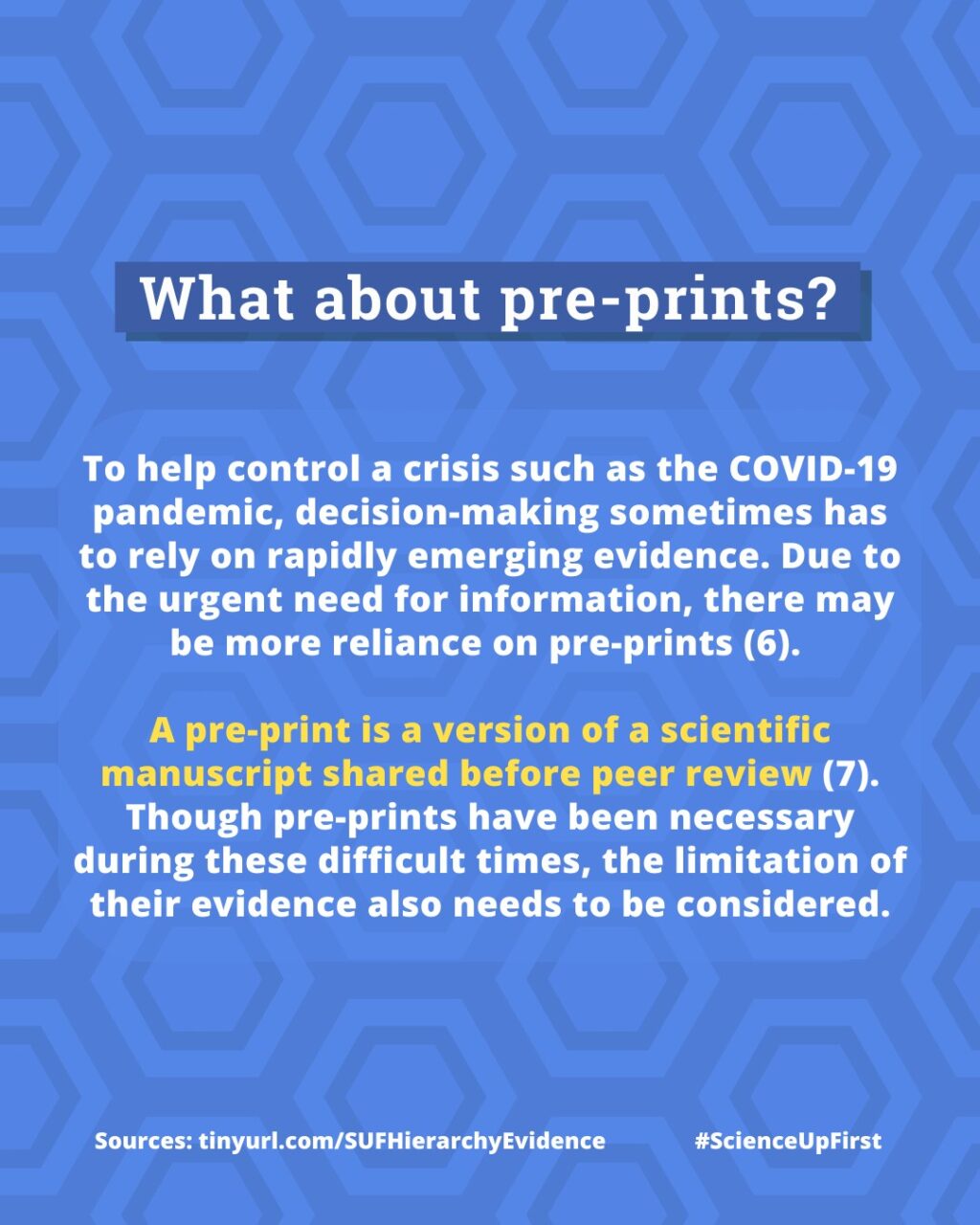
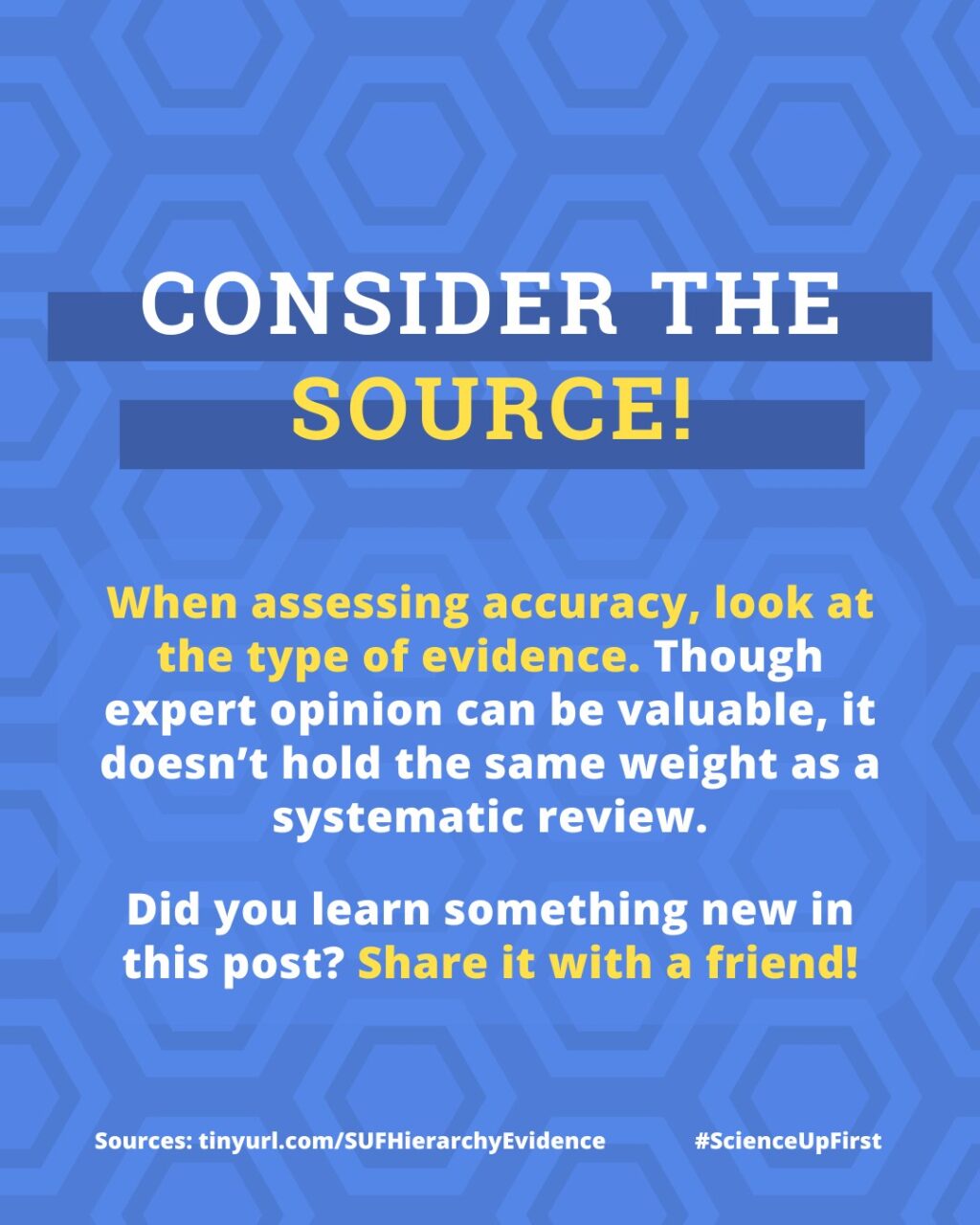
Did you know that not all scientific evidence is equal? 🤔
The more the study is influenced by the expert, the higher the risk of bias.
Check out this post for an explanation of the hierarchy of evidence 🔺
Share this post with a friend to help them recognize strong evidence!
Sources- Introduction to systematic review and meta-analysis | Korean J Anesthesiol. | April 2018
- Designing a research project: randomised controlled trials and their principles | BMJ Journals | March 2003
- What are cohort studies? | BMJ Journals | September 2019
- Epidemiology in Practice: Case-Control Studies | Community Eye Health | 1998
- Case Reports and Case Series | Boston University Medical Campus and Boston Medical Center
- Using preprints in evidence synthesis: Commentary on experience during the COVID-19 pandemic | Journal of clinical epidemiology | October 2021
- Preprints | PLOS
Share our original Bluesky Post!
Did you know that not all scientific evidence has the same weight? The more the study relies on an expert's opinion, rather than many data points and peer-review, the higher the risk of bias. 🔺https://www.scienceupfirst.com/project/hierarchy-of-evidence/ #ScienceUpFirst
— ScienceUpFirst (@scienceupfirst.bsky.social) November 26, 2025 at 12:41 PM
[image or embed]View our original Instagram Post!
-
Please do not feed Sealioners!

Have you ever come across someone who is “just asking questions”… but it never ends?
That’s not curiosity. That’s a tactic called sealioning. It’s when someone jumps into a conversation and fires off endless questions to drain your time and patience, without having any real intention to learn. They keep asking what seems like “polite” follow-ups, but they ignore what’s already been explained. At first glance, it sounds like a civil attempt at conversation, but it’s actually a subtle form of trolling that aims to exhaust you by shifting the burden onto you to teach them again and again (1-4).
The problem with sealioning is that there’s no winning response (1-3,5,6). 👇
If you see the tactic for what it is and choose not to answer, they’ll say you’re avoiding the question because you have no argument, which “proves” they’re right.
If you take the bait and keep answering, you’ll probably end up tired and frustrated. At some point, you might snap, and that’s exactly what they want. They’ll stay calm and polite, pretending to be the “reasonable one,” while you look like the one overreacting and attacking them.
Or, after enough endless questioning, you might slip up, say something slightly off, or contradict yourself. Then they’ll jump on it and claim they’ve proven you wrong.That’s what makes this tactic so manipulative. No matter what you do, they twist it to make you look unreasonable. It’s not a real debate. It’s harassment dressed up as a polite conversation (2,3,5,6).
So what can you do when someone tries this?
Call it out. You can say, “This looks like sealioning. You keep repeating bad-faith questions that have already been answered.” This works both for the person being targeted and for those watching. Sealioning relies on an audience. By naming it, it loses power (3).Sometimes, the best way to stop a bad-faith “debate” is to call it what it is.
Sources- What is Sealioning?: A Type of Trolling | Merriam-Webster
- Sealioning Meaning & Origin | Slang by Dictionary | March 2022
- Just Asking! On “Friendly” Forms of Harassment | Cambridge Core | February 2024
- Sealioning | Urban Dictionary | November 2016
- ‘Sealioning’ Is A Common Trolling Tactic On Social Media–What Is It? | Forbes | March 2019
- Welcome to Advanced Trolling: Sealioning | Medium | July 2020
Share our original Bluesky Post!
They say they’re “just asking questions.” You answer. They ask again, ignoring your answer. And again. And again. That’s not curiosity, that’s sealioning. A polite-looking way to troll and waste your time. Don’t take the bait. Call it out. 🦭 👉 scienceupfirst.com/misinformati… #ScienceUpFirst
— ScienceUpFirst (@scienceupfirst.bsky.social) November 20, 2025 at 1:18 PM
[image or embed]View our original Instagram Post!
-
Quantity of Melatonin and CBD in Melatonin Gummies Sold in the US
Melatonin gummy products in the US are not labelled accurately, with research showing products’ contents having higher amounts of melatonin and CBD than what is stated on the label. This research reaches the same conclusion as an examination of melatonin products in Canada, and contributes to the ongoing body of evidence showing inaccurate labelling of natural health products and dietary supplements.